
When a biscuit company thickens its cream filling, it uses maize starch. When a pharmaceutical plant binds a tablet, it uses maize starch. When a textile mill sizes its yarn for weaving, it likely uses maize starch. When a paper mill coats its surface for printing, same story.
Maize starch is one of those invisible industrial ingredients that quietly holds together large parts of India's manufacturing economy — and yet most people in the maize supply chain know very little about the industry that converts their grain into these products.
That's the gap this post fills. Here's a complete, data-backed look at India's maize starch industry: how big it is, who the key players are, what's driving growth, and where the strategic opportunities lie for agri-businesses in 2026 and beyond.
How Big Is India's Maize Starch Industry?
The numbers tell a story of a market that is large, growing, and increasingly sophisticated.
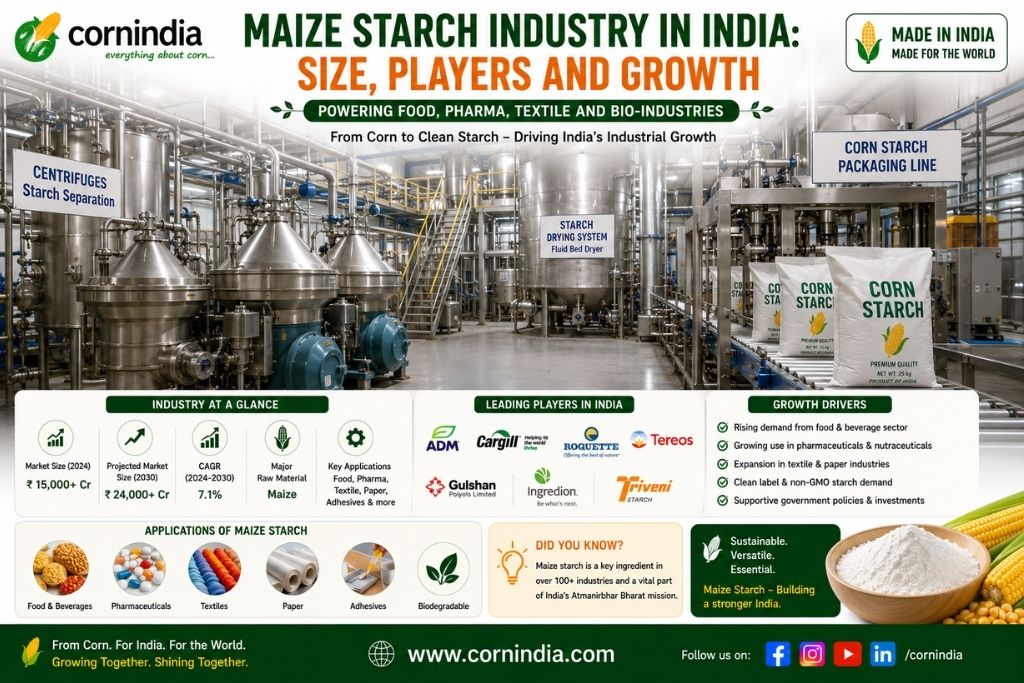
India produced approximately 2.6 million tonnes of maize starch in 2024, while domestic consumption was close to 2.0 million tonnes. The overall market of starch and its derivatives exceeded USD 3.7 billion and is contributing a growth rate of more than 7% CAGR due to food processing, pharmaceutical, and industrial applications.
Looking at the broader starch and derivatives picture: the India industrial starch market generated revenue of USD 6,677.5 million in 2024 and is expected to reach USD 11,782.7 million by 2030, at a CAGR of 10.1%. This is the fastest-growing starch market in Asia and one of the top five globally.
Maize dominates this market. In 2024, maize accounts for 62.34% of India's starch market share, supported by India's position as the 4th largest global maize producer by area and a robust wet-milling infrastructure concentrated in Gujarat, Punjab, and Maharashtra.
The India corn starch market specifically — is estimated to reach USD 4,759.8 million by 2030, growing at a CAGR of 5.2% during the forecast period 2024–2030.
And the broader India Starch Market — covering all starch types — is estimated to reach USD 5,217.1 million by 2030, growing at a CAGR of 6.2% during 2024–2030.
Three different estimates, three slightly different scopes — but the consistent message is that this is a multi-billion dollar, fast-growing market where maize is the dominant feedstock.
What Maize Starch Is and How It's Made
Before mapping the players and applications, a brief explanation of what the industry actually does — because understanding the process helps make sense of where the value is created.
Maize starch is extracted from the endosperm of the corn kernel through a process called wet milling. The steps:
- Steeping: Shelled maize kernels are soaked in warm water (with small amounts of sulphur dioxide) for 24–48 hours to soften the kernel and loosen the starch from the protein matrix
- Grinding and germ separation: The softened kernels are coarsely ground. Germs (which contain the corn oil) float to the surface and are separated
- Fine grinding: The remaining slurry is ground finely to break open starch granules
- Screening and separation: Fibre is separated through screens; the starch-gluten slurry passes through centrifuges to separate starch from protein (corn gluten)
- Washing and drying: Pure starch is washed, dewatered, and dried to produce native corn starch powder
This is the base product — native corn starch. From here, further processing produces:
- Modified starches — chemically or physically altered for specific functional properties (freeze-thaw stability, acid resistance, specific viscosity)
- Glucose syrup (liquid glucose) — starch hydrolysed with acids or enzymes into glucose
- Dextrose monohydrate — crystallised glucose
- Sorbitol — glucose hydrogenated into the sugar alcohol used in pharmaceuticals and personal care
- Corn gluten meal — the protein-rich by-product used in animal feed
- Corn germ — extracted for corn oil production
The integrated wet mill that processes maize starch and produces all of these by-products simultaneously is significantly more profitable than a plant producing only native starch. Stand-alone starch plants are moderately profitable, but profitability is greatly enhanced by the addition of glucose and sorbitol. The highest profit margins in sorbitol production come from its use in pharmaceutical and dental care products. Additional income from by-products like gluten feed further increases project viability.
Where Maize Starch Goes: The Application Segments
Understanding who buys maize starch — and in what form — is essential for any agri-business mapping procurement, processing, or investment decisions.
Food and Beverages — The Largest Segment
In 2024, food and beverage applications command a dominant 53.37% market share in India's starch and derivatives market.
Within food and beverages, maize starch and its derivatives appear in:
- Confectionery: Glucose syrup and dextrose are the backbone of Indian mithai (sweets), hard candies, chocolates, and bakery products. The demand for liquid glucose is experiencing its most rapid growth because of the expanding Indian confectionery and beverage markets.
- Processed and packaged foods: Corn starch as a thickener, binder, and texturiser in soups, sauces, gravies, instant noodles, ready meals, and snack coatings
- Baby food and infant formula: Cargill's new Gwalior plant services a USD 15 billion market for sweets, snacks, dairy, and baby formula — signalling the premium food application opportunity
- Beverages: Modified starches in dairy beverages, cloud agents in fruit drinks, and maltodextrins as carriers for spray-dried flavours
Pharmaceuticals — The Fastest Growing Segment
The pharmaceutical sector emerges as the fastest-growing starch application segment in India, boasting an 8.80% CAGR through 2030, attributed to India's stature as a global pharmaceutical manufacturing powerhouse.
Within pharma, maize starch serves as:
- Tablet binder and disintegrant: One of the most widely used excipients in tablet formulation; ensures tablets bind together during compression and then break apart efficiently when swallowed
- Sorbitol for syrups and chewable tablets: Provides sweetness, bulk, and moisture stabilisation
- Cyclodextrins for drug delivery: Advanced starch derivatives that improve drug bioavailability — a niche but rapidly growing application
- The pharmaceutical sector is analysed to grow with the highest CAGR of 6.1% in the India starch market during 2024–2030.
Textiles
India's textile industry — which exported over USD 44 billion recently — is a major industrial starch consumer. Maize starch is used as:
- Warp sizing agent: Coats and strengthens yarn threads to withstand the mechanical stress of weaving
- Finishing agent: Applied to fabric surfaces to add body, stiffness, and sheen
While synthetic sizing agents have made inroads, the shift toward sustainability and natural ingredients is increasing demand for bio-based starch sizing in the textile export supply chain.
Paper and Packaging
Paper mills use maize starch in:
- Surface sizing: Applied to paper surface to improve printability, smoothness, and ink absorbency
- Wet-end starch: Added to the paper pulp to improve sheet strength and filler retention
- Corrugating adhesives: Starch-based adhesives bond corrugated cardboard layers in packaging
The growth of e-commerce and the ban on single-use plastics are both driving paper and cardboard packaging demand — and with it, maize starch demand. Policy-backed shifts toward starch-based bioplastics following India's single-use plastic ban have created latent demand for starch feedstocks.
Bioplastics and New Applications
This is the emerging frontier. Steady investment in new poly-lactic acid (PLA) projects is anchoring latent starch demand, and e-commerce packaging is seeing starch adhesives replace synthetic glues. As India's sustainability commitments deepen and biodegradable packaging regulations tighten, maize starch's role in bioplastics production will grow significantly.
The Key Players: Who Runs India's Maize Starch Industry
India's starch industry is a dynamic mix of established domestic manufacturers and global multinationals. Here's the landscape:
Domestic Majors
Gulshan Polyols Limited One of India's largest integrated maize processing companies. Gulshan produces corn starch, liquid glucose, dextrose, sorbitol, and ethanol. Gulshan Polyols' Rs 994 crore ethanol supply contract with major oil marketing companies exemplifies the trend toward direct industrial customer relationships. The company's vertical integration across starch, sweeteners, and ethanol gives it significant supply chain resilience.
Sukhjit Starch & Chemicals Ltd. Founded in 1943 in Phagwara, Punjab — one of India's oldest corn wet milling operations, with decades of experience in maize-to-starch processing. Sukhjit produces native corn starch, modified starches, glucose syrup, dextrose, and gluten products. A Punjab-based producer well-positioned relative to northern India's maize growing belt.
Gujarat Ambuja Exports Limited A diversified agri-processing company with significant maize starch and derivatives capacity. Strong presence in Gujarat with proximity to major port infrastructure — well positioned for export-oriented starch production.
Sayaji Industries Limited One of India's largest manufacturers of starches, liquid glucose, dextrose monohydrate, and anhydrous sorbitol, with approximately 1,100 employees and manufacturing based in Kathwada, Gujarat. Sayaji has long served the confectionery and pharmaceutical sectors.
Sanstar Bio-Polymers Ltd. A growing maize processing player with integrated operations. Sanstar has been expanding its starch and derivatives portfolio aggressively, targeting food, pharma, and industrial applications.
Riddhi Siddhi Gluco Biols / Roquette Riddhi Siddhi Private Limited Originally a major domestic starch player, Riddhi Siddhi has been brought into partnership with Roquette (France) — one of the world's largest starch companies. Global leaders like Archer Daniels Midland, Cargill, and Ingredion leverage technological expertise and integrated supply chains to serve high-value applications, while domestic players like Gulshan Polyols, Tirupati Starch, and Sukhjit Starch maintain competitive positions through regional market knowledge and cost advantages.
Tirupati Starch & Chemicals Ltd. Mid-sized integrated processor producing corn starch and derivatives. Active in food and industrial application supply chains.
Universal Starch-Chem Allied Ltd. Focused primarily on native and modified starches for food and industrial applications. Active exporter of maize starch derivatives.
Angel Starch & Food Pvt. Ltd. Established maize starch producer with food-grade specialisation.
Multinationals with Indian Operations
Cargill: Cargill opened its newest Indian corn milling factory in Gwalior, Madhya Pradesh in March 2025, partnering with local producer Saatvik Agro Processors — a plant built to service the confectionery, snacks, dairy, and baby formula markets worth USD 15 billion.
Ingredion: A global specialty starch leader with active India operations. Ingredion introduced the Novation Indulge 2940 starch — a non-GMO functional native corn starch for clean-label texturising in dairy products — in December 2024, targeting India's growing demand for clean-label food ingredients.
Roquette: Through its partnership with Riddhi Siddhi, Roquette brings global specialty starch technology and product portfolios to the Indian market.
The Geography of Maize Starch Production
India's starch processing is geographically concentrated. The robust wet-milling infrastructure is concentrated in Gujarat, Punjab, and Maharashtra.
Key demand hubs are concentrated in states with strong food processing and industrial ecosystems, notably Maharashtra, Gujarat, Karnataka, and the National Capital Region, driven by access to ports, large consumer markets, and proximity to maize/tapioca supply chains. Maharashtra currently leads native starch consumption regionally in India.
Emerging geography to watch: Bihar. Auro Sundram International invested around Rs 250 crore to develop a starch manufacturing factory in Bihar's Araria district in December 2024. The factory will have an annual capacity of 500 tonnes per day and will be operational by March 2027. Bihar's rapidly growing rabi maize crop — of high quality with consistent moisture — is attracting processor investment. This signals a meaningful geographical shift in where new starch capacity is being built.
What's Driving Growth: The Five Tailwinds
Five structural forces are accelerating the maize starch industry's growth in India:
1. Processed food sector expansion. India's food processing industry revenues are projected to reach USD 535 billion by 2025–26. Every percentage point of growth in this sector increases starch demand proportionally. Quick-service restaurants, packaged food, ready-to-eat meals, and organised confectionery are all expanding markets for starch and its derivatives.
2. Pharmaceutical manufacturing boom. India is a global pharmaceutical manufacturing hub — the world's pharmacy for generic drugs. As this industry scales, its demand for pharmaceutical-grade excipients including maize starch, dextrose, and sorbitol grows with it. Sorbitol for pharma is the single highest-margin starch derivative in India. Integrated maize derivative plants are usually delivering 24–28% IRR.
3. Government ethanol blending programme. The government's 17.98% ethanol blend rate achieved by February 2025, combined with the January 2024 revision to prioritise corn over sugarcane for ethanol production, has significantly lifted corn demand across the processing ecosystem. Ethanol plants and starch plants compete for the same corn — which creates a price floor effect that has benefited maize farmers even as it raised processing input costs.
4. Bioplastics and sustainable packaging. The single-use plastic ban and ESG commitments from large FMCG companies are driving investment in starch-based biodegradable packaging. This is an early-stage but rapidly developing application that could become a significant demand driver for maize starch within the next 5 years.
5. Clean-label and non-GMO positioning. Global food brands selling in the EU, Japan, and health-conscious Indian urban markets are actively seeking non-GMO, naturally derived ingredient suppliers. India's entirely non-GMO maize gives domestic starch producers a fundamental advantage over US and Brazilian competitors for these market segments.
The Challenges That Need Honest Acknowledgement
No market analysis is complete without naming the headwinds.
Maize price volatility. A major challenge is fluctuation in raw material prices — corn is subject to price volatility due to seasonal variations, weather conditions, and geopolitical events. These fluctuations create challenges for starch manufacturers in forecasting costs, managing inventory, and setting competitive prices. The ethanol blending programme has intensified this volatility by adding a new competing demand for the same grain.
Competition from imported starch. Speciality modified starches — particularly waxy corn starch, acetylated starches, and high-performance food-grade starches — are still largely imported from Europe and North America. India still depends on imports for specialty maize derivatives. Building domestic capacity for these high-margin products is both the challenge and the opportunity.
Sub-scale wet-milling capacity. Large players like Gulshan Polyols, Sukhjit, and Riddhi Siddhi are operating at 85–90% capacity utilisation, leaving regional and specialty demand unmet — opening up opportunities for MSME entrants in cluster-based manufacturing. The capacity gap in tier-2 processing locations is real.
GMO scrutiny. While Indian maize is entirely non-GMO, India does import small quantities of processed starch from GMO-producing countries. GMO-related quality scrutiny challenges near-term margins, with manufacturers focused on exports encountering intensified scrutiny from global clients demanding non-GM certification — compelling them to establish segregated supply chains and adopt rigorous testing protocols.
Strategic Opportunities for Agri-Businesses
For agri-businesses evaluating the maize starch sector, here are the most actionable opportunity areas:
Farm-to-processor supply chain integration. The quality specifications that starch processors need — consistent moisture (12–14%), low aflatoxin (<10 ppb), yellow kernel type, minimal foreign matter — are the same quality standards needed for export. Building a farmer procurement network that delivers on these specs to starch processors creates a supply chain asset that can serve both domestic and export markets.
MSME-scale processing in maize surplus districts. Regional and specialty demand is not frequently met by large players operating on bulk volumes — opening up opportunities for MSME entrants in cluster-based manufacturing. A 200–300 TPD wet mill in a district like Khagaria (Bihar), Nizamabad (Telangana), or Haveri (Karnataka) — close to maize supply and linked to regional food or pharma buyers — is a viable and increasingly well-supported investment. MoFPI schemes such as PM-FME can reduce capex by as much as 35%.
Specialty derivatives: sorbitol and pharma-grade glucose. The highest-margin products in the maize starch value chain are pharma-grade sorbitol and crystalline dextrose. Current domestic production falls short of demand, and India imports from Europe to fill the gap. Building pharmaceutical-grade processing capability is capital-intensive but delivers premium returns.
Non-GMO export certification. India's non-GMO maize starch advantage is underutilised in export markets. Establishing NABL-certified testing, EU food-grade certifications, and non-GMO documentation infrastructure unlocks export premium pricing for the same starch that currently sells at commodity rates domestically.
Final Thoughts
India's maize starch industry is at an inflection point. Record maize production, a fast-growing food processing economy, a pharmaceutical manufacturing boom, an ethanol blending programme creating structural demand, and new bioplastics applications are converging simultaneously to create one of the strongest demand environments the sector has seen.
The present market conditions show optimal potential for entering this industry because abundant maize exists along with rising domestic demand, government support, and a shortage of high-value derivative products.
The businesses that capture the most value from this environment will be those that move beyond commodity starch trading into processing and derivatives — combining supply chain discipline, quality infrastructure, and buyer relationships to extract the full value that India's maize surplus is capable of generating.
At CornIndia, we work across the maize value chain — from farm-level procurement to industry intelligence and buyer connections. If you're evaluating entry into the starch processing sector or looking to strengthen your position in the existing supply chain, we'd welcome the conversation.
Related reads on CornIndia: How Maize Is Used in the Poultry Feed Industry in India | India's Maize Export Potential: Opportunities and Challenges | Top 10 Maize-Producing States in India





0 Comments