
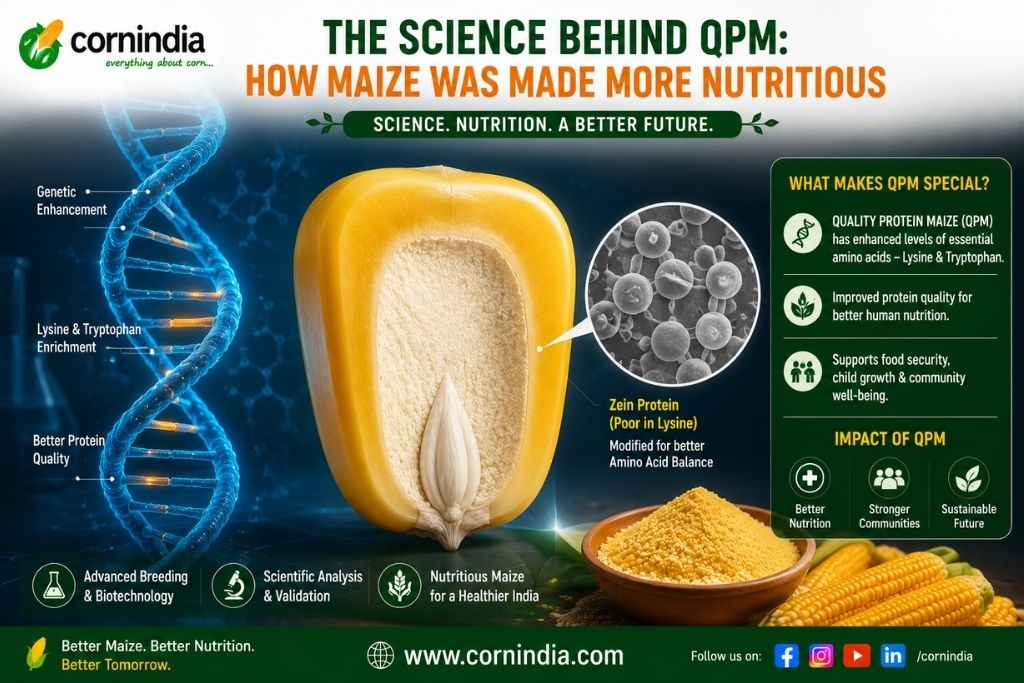
Somewhere inside every maize kernel is a molecular decision being made — a decision about which proteins to build, and in what proportion. In ordinary maize, that decision consistently favours a protein that happens to be nearly worthless for human and animal nutrition. In Quality Protein Maize, a single mutated gene rewires that decision entirely — without changing how the plant looks, grows, or yields.
We've written before about what QPM means for nutrition and who's growing it in India. This piece goes somewhere different: into the actual molecular mechanism. What is the opaque-2 gene doing, at the level of DNA and protein? Why did the original discovery in 1964 nearly fail as a practical crop? And what modern genomic tools are researchers using today to push this 60-year-old discovery even further?
The Problem, at the Molecular Level
To understand the science, you need to understand exactly why normal maize protein falls short nutritionally — and the answer lives inside a specific protein family called zeins.
The primary cause of maize's amino acid deficiency is mostly attributed to zein — the prolamin storage protein fraction — which makes up to 70% of all storage protein in the maize kernel. Zeins are the proteins the maize plant manufactures and stores in the endosperm specifically to nourish the developing embryo and, later, the germinating seedling. They're efficient storage molecules — but they are structurally almost devoid of two essential amino acids: lysine and tryptophan.
In a normal maize kernel, lysine content typically runs just 0.16–0.26%, and tryptophan between 0.02–0.06% — both less than half the level recommended for adequate human nutrition. Since zein dominates the kernel's total protein content by sheer volume, its amino acid poverty drags down the nutritional value of the entire grain, even though other, better-quality proteins exist in smaller quantities elsewhere in the kernel.
This is a structural problem, not a nutrient-availability problem. The plant isn't lacking lysine or tryptophan in its overall biochemistry — it's simply allocating its storage protein budget overwhelmingly toward a protein type that doesn't contain them.
The 1964 Discovery: A Mutation That Changes the Allocation
More than half a century ago, Oliver Nelson and Edwin Mertz at Purdue University found that the maize opaque2 (o2) mutation produces a doubling of endosperm lysine content — creating the foundation for all quality protein maize breeding that followed.
The o2 mutant gene alters the amino acid composition in maize endosperm and doubles the lysine content, as reported by Mertz in a landmark 1964 paper in the journal Science.
Mechanistically, here's what the opaque-2 gene does: the recessive opaque-2 mutant gene reduces the accumulation of alpha-zeins — the largest zein subfraction — in the maize endosperm, which changes the overall amino acid composition of the kernel, induces a chalky, opaque endosperm appearance (hence the name), and increases lysine content.
The gene doesn't add lysine to the kernel directly. It removes the dominant lysine-poor protein, which makes room for other, naturally lysine-richer proteins to take up a larger share of the kernel's total protein. This is the elegant part of the mechanism: rather than engineering new nutritional content into the plant, the mutation simply shifts the plant's existing protein allocation toward fractions that were nutritionally superior all along, but had been diluted by zein's dominance.
How opaque-2 works at the molecular level
The precise mechanism took decades after 1964 to fully unravel. In the 1990s, researchers intensively studied how the O2 gene regulates protein expression, finding that it encodes a protein with structural homology to known transcriptional activators.
The OPAQUE2 protein has a "leucine-zipper" motif — a specific structural feature that allows a protein to bind to particular sequences of DNA. Using this motif, the OPAQUE2 protein binds directly to two specific regions on the promoter region of zein genes, recognising a specific target site on the 22-kD alpha-zein gene.
In plain terms: OPAQUE2 is a transcription factor — a protein whose job is to switch other genes on or off by physically attaching to their DNA control regions. In normal maize, functional OPAQUE2 protein binds to the promoter regions of alpha-zein genes and activates their expression, driving high zein production. In the mutant (o2) form, this transcription factor is disabled or altered, so it can no longer effectively switch on alpha-zein production. With less alpha-zein being manufactured, the kernel's total protein composition shifts toward non-zein fractions — which are richer in lysine and tryptophan.
The O2 gene's effects are pleiotropic and complex — proteomic analysis has shown it plays a role in multiple metabolic pathways, and microarray analysis found 58 genes were up-regulated and 66 genes were down-regulated in o2 mutants compared to normal maize. This is an important nuance for researchers: opaque-2 isn't a single-effect switch. It's a master regulatory gene whose disruption ripples across dozens of other genes in ways that were only mapped decades after the original discovery.
Why the First QPM Nearly Failed as a Real Crop
Here's where the story gets more interesting — and where the real breeding challenge began.
The maize opaque2 mutant has high nutritional value, but it develops a chalky, soft endosperm that severely limits its practical use.The o2 mutant lines carried undesirable pleiotropic effects — soft, chalky kernels and increased susceptibility to pests and diseases — which ultimately reduced yields and made the mutation commercially impractical on its own.
The soft, floury kernel wasn't a cosmetic problem. Soft kernels are:
- More vulnerable to storage pests and fungal infection, since the protein matrix that normally seals and protects the starch granules is diminished
- Harder to process in conventional milling equipment
- Prone to cracking during harvest and handling, which further increases pest and disease vulnerability
- Associated with lower field yield due to the plant's altered resource allocation
For roughly two decades after Mertz and Nelson's discovery, this trade-off effectively stalled opaque-2 maize as a viable commercial crop. The nutrition was there, but the agronomics weren't — and a crop that can't survive storage or achieve competitive yield doesn't help anyone, no matter how nutritious the individual kernel might be.
The CIMMYT Breakthrough: Modifier Genes
The solution came from a second, distinct genetic system layered on top of opaque-2: modifier genes.
To combat opaque-2's undesirable pleiotropic effects, plant breeders introgressed quantitative trait loci known as o2 modifiers (Mo2s) into o2 mutant maize — developing what became known as quality protein maize. This modifier-genetic system, working within the genetic background of the o2 gene, can transform the soft, chalky kernel back into a hard, vitreous (glassy) texture, while retaining the elevated lysine and tryptophan content.
This was the specific breeding achievement of Surinder Vasal and Evangelina Villegas at CIMMYT, work that earned them the World Food Prize in 2000. Modifier genes convert the soft endosperm of opaque2 mutants to a hard, vitreous phenotype — restoring the practical, storable, millable kernel texture that farmers and food systems require, all while keeping the nutritional benefit intact.
The biochemistry of how modifiers work
The primary biochemical change associated with modifier gene expression is a two- to threefold increase in synthesis of a specific storage protein called 27-kD gamma-zein. This is a genuinely elegant piece of biology: gamma-zein is a different zein subtype from the alpha-zeins that opaque-2 suppresses, and cranking up its production is what restores kernel hardness — without bringing back the lysine-poor alpha-zeins that caused the original nutritional problem.
Research tracing the timing of this effect found that although the o2 mutation reduces alpha-zein gene transcription (the process of copying DNA into RNA), the modifier genes increase gamma-zein protein and mRNA levels as early as 16 days after pollination — and this happens through a post-transcriptional mechanism, meaning the modifiers act after the RNA has already been made, likely by affecting how efficiently that RNA gets translated into protein or how stable the resulting protein is.
A more recent structural discovery adds further clarity: gene duplication of the 27-kDa gamma-zein gene confers enhanced expression in quality protein maize — essentially, some QPM lines carry extra copies of the gamma-zein gene, which directly explains the elevated gamma-zein production that restores kernel hardness. This finding, published in PNAS, resolved a mystery that had persisted for decades about exactly how modifier genes achieve their effect at the DNA level.
Why this mattered for breeding practicality: Breeding new QPM hybrids has historically taken longer than breeding regular hybrids, primarily because of the complex and previously unknown components of o2 endosperm modification — a factor that limited QPM's global expansion for years. Modifier genes are not a single gene with a simple dominant/recessive inheritance pattern — they are genetically complex, comprising minor modifying loci that must all be combined with the o2 background through careful, multi-generation breeding. This complexity is precisely why QPM breeding remained a slower, more specialised undertaking than conventional hybrid development for much of its history.
Modern Genomic Tools: Speeding Up What Used to Take Decades
This is where QPM science has moved fastest over the last 15 years — not in discovering new biology, but in dramatically compressing the time it takes to combine the necessary genetic elements.
Marker-Assisted Selection (MAS)
Rather than relying purely on visual kernel inspection and biochemical testing (slow, and not always accurate at early breeding generations), modern QPM breeding uses molecular markers — DNA sequences tightly linked to the genes of interest — to directly verify whether a breeding line carries the opaque-2 allele and favourable modifier loci, often before the plant has even produced a mature kernel to inspect.
The SSR marker phi057, which lies within the opaque2 gene itself, along with additional SSRs flanking opaque2 and its modifier loci, has been used for molecular characterisation in backcross breeding programmes — allowing breeders to track and confirm the presence of favourable alleles generation by generation with precision that visual selection alone cannot match.
Indian research has directly applied this. Researchers at Punjab Agricultural University and IARI New Delhi combined favourable alleles of the crtRB1 and lycopene-epsilon-cyclase (lcyE) genes — both involved in provitamin-A accumulation — into opaque2-based inbred lines using marker-assisted backcross breeding, successfully creating QPM versions of two elite Indian hybrids, Buland and PMH1. Gene-based SSR markers for o2 and InDel markers for crtRB1 and lcyE were used for foreground selection across multiple backcross generations, with recurrent parent genome recovery ranging from 88.9% to 96.0%.
This is "gene pyramiding" — combining multiple valuable traits (protein quality plus provitamin-A) into a single breeding line — made practically feasible by molecular markers that would be essentially impossible to track through visual selection alone.
Practical breeding results from this approach: A marker-assisted selection programme converting standard temperate maize inbreds to QPM equivalents achieved average increases of 30% in tryptophan content and 36% in overall quality index, while producing kernels with less than 25% opaque endosperm — and grain yield actually increased by 11–31% in the improved lines, with combining abilities comparable to the original unconverted lines. This result is a direct demonstration that modern marker-assisted breeding can now deliver QPM's nutritional benefit with essentially no agronomic penalty — solving, at the practical breeding level, the very trade-off that stalled opaque-2 maize in the 1960s and 70s.
CRISPR/Cas9 Gene Editing
The newest frontier moves beyond marker-assisted conventional breeding into direct genome editing.
Targeted CRISPR/Cas9 editing of the 19-kDa alpha-zein gene family has increased lysine content by approximately 30% while maintaining kernel texture and functional opaque-2 activity. Editing efficiencies ranged from 40–60%, and trait stability was confirmed across multiple generations, with minimal trade-offs compared with conventional QPM breeding.
What makes this significant for researchers: CRISPR allows scientists to directly and precisely edit specific zein gene family members, rather than relying on a single naturally occurring mutation (opaque-2) and then spending years finding and combining the right modifier genes to fix its side effects. In principle, this could eventually allow breeders to fine-tune zein composition with a level of precision that traditional mutation-and-modifier breeding could never achieve.
Earlier genome-editing tools, including zinc-finger nucleases (ZFNs) and transcription activator-like effector nucleases (TALENs), offered improved precision over conventional mutagenesis but were technically demanding and largely unsuitable for large-scale crop breeding deployment — a limitation that CRISPR/Cas9's relative simplicity and efficiency has substantially overcome.
It's worth noting for a general audience: CRISPR-edited crops face different regulatory pathways than conventional QPM (which is not genetically modified) in many jurisdictions, including India. Whether and how CRISPR-based nutritional maize reaches commercial fields will depend as much on regulatory frameworks as on the underlying science — a question actively being worked through by regulators globally as this technology matures.
Genomic Selection and Broader Trait Stacking
Beyond lysine and tryptophan specifically, the modifier-gene and marker-assisted toolkit developed for QPM has become a template for stacking multiple nutritional traits simultaneously. Recent Indian research has applied genomics-assisted stacking of waxy1, opaque2, and crtRB1 genes together — combining enhanced amylopectin starch quality with protein quality and provitamin-A accumulation in a single biofortified maize line, aimed at both industrial utilisation and nutritional security.
This reflects where the field is heading: not single-trait improvement, but the simultaneous combination of multiple nutritional and functional traits — protein quality, vitamin content, starch composition — into unified breeding lines, using the genomic tools that QPM research helped pioneer and refine.
What This Means, Scientifically
The QPM story is a genuinely instructive case study in plant breeding science for several reasons:
It demonstrates that a single gene's effect is rarely simple. Opaque-2's pleiotropic effects — the ripple of changes across dozens of other genes — meant that isolating the "good" nutritional effect from the "bad" agronomic effect required understanding an entire regulatory network, not just one gene.
It shows how a second genetic system can rescue a first. Modifier genes didn't reverse opaque-2's core mechanism; they compensated for its side effects through an entirely separate biochemical pathway (gamma-zein upregulation) that happened to restore the needed physical trait without undoing the nutritional gain.
It illustrates the accelerating pace of breeding technology. What took CIMMYT breeders roughly two decades of conventional selection to achieve in the 1970s-80s can now be replicated and extended through marker-assisted backcrossing in a handful of breeding cycles — and CRISPR-based approaches are compressing timelines further still, though regulatory and deployment questions remain open.
It's a template being actively reused. The same modifier-gene and marker-assisted framework that solved QPM's texture problem is now the foundation for stacking additional nutritional traits — provitamin-A, enhanced starch quality — into the same genetic background, as Indian research groups are actively demonstrating.
Final Thoughts
Sixty years after Mertz and Nelson's original 1964 discovery, the opaque-2 story continues to generate new science. What began as an observation about a chalky, underperforming mutant has become one of the most thoroughly characterised examples of how a single regulatory mutation, combined with a compensating genetic system, can be engineered into an agronomically competitive, nutritionally transformed crop — entirely through conventional breeding, decades before genome editing tools existed to make the process faster.
For researchers, QPM remains a rich area of ongoing work: refining modifier gene combinations, applying CRISPR to achieve precision that conventional breeding cannot match, and stacking additional nutritional traits onto the same genetic foundation. For everyone else, it's worth simply appreciating that the roti made from QPM maize carries inside it six decades of molecular biology — most of it invisible, all of it working quietly to make a staple grain nutritionally whole.
At CornIndia, we follow the science behind maize breeding closely, alongside its practical applications for Indian agriculture. If you're a researcher working in this space, we'd be glad to hear from you.
Related reads on CornIndia: Quality Protein Maize (QPM): The Nutrition Story No One Tells | Maize Hybrid Seed Production: How It Works in India | Waxy Corn and High Oil Corn: Emerging Varieties in India










0 Comments