
Most maize farmers track pests closely. FAW, stem borer, aphids — these get attention because the damage is visible. The larva in the whorl, the frass on the leaf, the dead heart — you see it and you react.
Diseases are sneakier. They start quietly, spread in conditions you can't always control, and by the time damage is obvious, the yield loss has already happened. Maize is attacked by as many as 112 diseases worldwide, and in India about 35 diseases have been reported from different locations — predominantly of fungal and bacterial origin.
The financial impact is real. Total disease losses in Indian maize are estimated at 13.2% of potential yield — comprising 5% from foliar diseases, 5% from stalk rots and root rots, 2% from downy mildews, and the remainder from seed blights, smuts, and viruses. On a field producing 25 quintals per acre, that's 3+ quintals lost to disease before you even count pest damage.
The good news: most Indian maize diseases are manageable with the right seed treatment, early detection, and timely fungicide use. This guide covers the seven most damaging diseases in Indian maize — what they look like, what causes them, and exactly how to fight them.
Before We Start: The Three Most Important Principles
1. Resistant varieties first. The cheapest and most effective disease management tool is choosing a hybrid with built-in disease resistance for the diseases prevalent in your region. Before you buy seed each season, ask your dealer or KVK which diseases are a problem in your area and which hybrids carry resistance. Fungicides are rescue tools — resistant varieties are your first line of defence.
2. Seed treatment is non-negotiable. Several major maize diseases — downy mildew, seedling blights, early stalk rots — are either seed-borne or establish in the soil before the plant emerges. Treating seed with the right fungicide before sowing costs very little and prevents losses that no foliar spray can fix after the fact.
3. Scout weekly from emergence. You cannot manage what you haven't detected. Walk your field at least twice a week from germination onwards and check a minimum of 10–15 plants per acre at multiple locations. Disease management is about early response — catching a disease at 5% incidence is manageable; catching it at 50% incidence is usually too late for effective control.
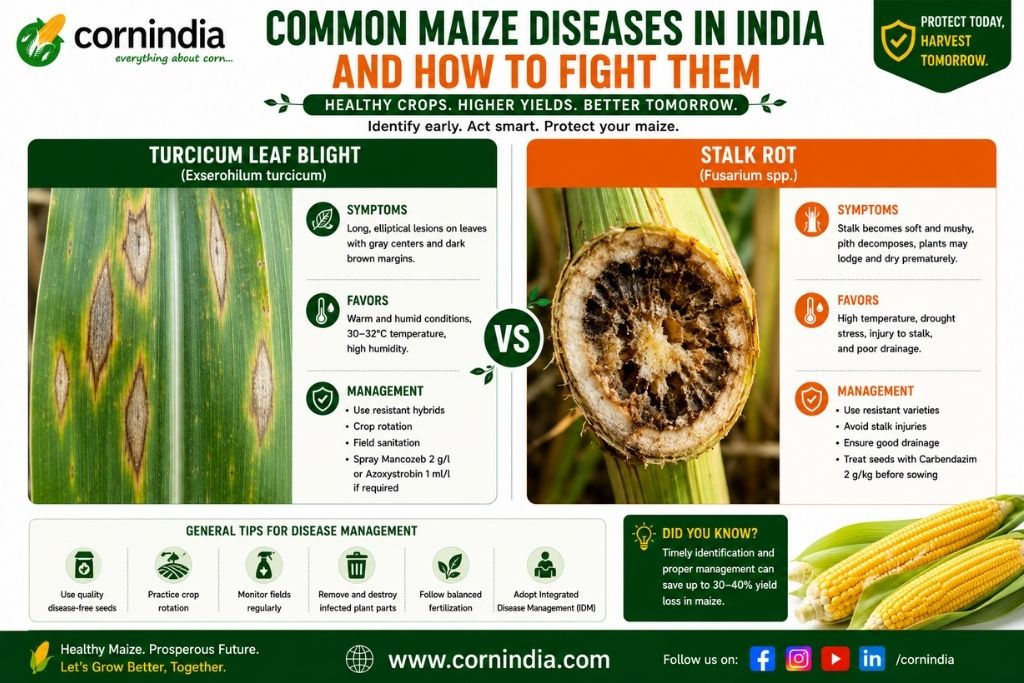
Disease 1: Turcicum Leaf Blight (Northern Corn Leaf Blight)
Caused by: Exserohilum turcicum Season: Kharif (most common); occasional in rabi Yield loss: Up to 66% in susceptible varieties under heavy infection
What to Look For
Turcicum leaf blight is characterised by large, irregularly shaped tan-grey lesions on the upper and lower leaf surfaces, eventually leading to leaf death and defoliation. In severe infestation, lesions coalesce to give a blighted appearance, encircled in a reddish-brown margin.
Start looking for symptoms from the lower leaves upward — the disease typically progresses from the bottom of the plant toward the top. Lesions are long and elliptical, 5–15 cm in length, with a distinctive cigar or spindle shape. In humid conditions, you may see a grey-green mould on the surface of lesions — this is the sporulation of the fungus.
The damage mechanism: as lesions spread and leaves die prematurely, the plant loses photosynthetic area during grain filling, directly reducing grain weight.
Treatment
Seed treatment: Treat seeds with Azospirillum @ 25g + Trichoderma @ 6g per kg seeds, or Thiram 75 WP @ 2g, or Captan 50 WP @ 2g per kg seeds before sowing.
Foliar spray at first symptom:
- Mancozeb 75 WP @ 2.5g per litre of water
- Or Hexaconazole 5 EC @ 1 ml per litre
- Or the combination fungicide Azoxystrobin 18.2% + Difenoconazole 11.4% SC @ 1 ml per litre
Repeat the spray after 15 days. Two sprays at a 15-day interval are generally sufficient to contain turcicum if applied early enough.
Critical timing: Begin spraying at first appearance of disease symptoms, not after widespread spread across the field.
Disease 2: Maydis Leaf Blight (Southern Corn Leaf Blight)
Caused by: Cochliobolus heterostrophus (anamorph: Bipolaris maydis) Season: Kharif (most damaging); warm, humid conditions Yield loss: Up to 30% in susceptible varieties; reportedly up to 80% in severe outbreaks
What to Look For
Maydis leaf blight (MLB) lesions are smaller and more rectangular than turcicum lesions — typically 1–5 cm long, tan-brown, with well-defined parallel edges following the leaf veins. MLB is a major foliar disease in maize worldwide, and is also known as Southern Corn Leaf Blight (SCLB) — caused by the ascomycete fungus Cochliobolus heterostrophus.
In heavy infections, lesions cover large portions of the leaf surface and cause premature drying of leaves from the bottom up. The disease thrives in warm (25–30°C), humid conditions — which describes most of the Indian kharif growing season.
Distinguishing MLB from turcicum: The key visual difference is lesion shape. Turcicum lesions are large (5–15 cm), elongated, and spindle-shaped with irregular margins. MLB lesions are smaller (1–5 cm), rectangular, and have straight edges parallel to the leaf veins.
Treatment
Foliar spray: Apply Azoxystrobin 18.2% + Difenoconazole 11.5% SC @ 1 ml per litre of water immediately after symptom appearance.
Alternatively, Mancozeb 75 WP @ 2.5g per litre is effective as a preventive spray applied at 40–45 DAS in areas where MLB is consistently prevalent.
Both turcicum and maydis blights respond to the same fungicide programme — so a well-timed spray based on either disease's appearance covers both.
Disease 3: Post-Flowering Stalk Rots
Caused by: Multiple pathogens — Pythium aphanidermatum, Fusarium moniliforme, Macrophomina phaseolina (charcoal rot), Rhizoctonia solani Season: Late kharif (post-flowering through grain filling) Yield loss: Up to 100% (total plant death) for bacterial stalk rot; 39.5% for charcoal rot in susceptible conditions
What to Look For
Stalk rot is the most insidious of all Indian maize diseases because by the time external symptoms are visible, the internal damage is often already severe.
External symptoms:
- Lower stalk becomes soft, slimy, and discoloured — yellow, straw-coloured, or water-soaked depending on pathogen
- Plant wilts despite adequate soil moisture
- Lower leaves die prematurely while upper leaves may remain partially green
- Infected plant leaves turn dull green instead of dark green colour; the lower stalk becomes yellow or straw-coloured and the whole plant wilts
- Lodging (plant falling over) in advanced cases — the internal stalk tissue has rotted while the outer rind still holds the plant briefly upright
Internal symptom: Split the stalk lengthwise with a knife. In stalk rot, the internal pith will be discoloured, water-soaked, or completely decomposed. Healthy stalks have white, firm pith. Charcoal rot shows distinctive grey-black sclerotia (tiny fungal bodies) in the rotted pith.
Triggering conditions: Stalk rots are strongly associated with:
- Waterlogging (especially Pythium stalk rot — often 100% lethal)
- Nitrogen imbalance (too much N at late stages, low potassium)
- Plant stress from drought at flowering followed by heavy rain
- Previous crop residue left in the field (harbours pathogens)
Treatment and Prevention
Unlike foliar diseases, stalk rots cannot be rescued with foliar fungicide sprays once they are established. Prevention is the only effective strategy.
Seed treatment: Treat seeds with 25g PSB (Pseudomonas striata H-21) and 6g Trichoderma harzianum or 5 ml Thiram Flo 40 FS per kg seeds before sowing. These biofungicides colonise root zones and suppress soil-borne stalk rot pathogens from germination.
Agronomic prevention:
- Ensure excellent field drainage — stalk rots (particularly Pythium) are directly triggered by waterlogging. Raised beds in kharif season are the most effective preventive measure.
- Apply balanced fertiliser — particularly adequate potassium. Potassium deficiency dramatically increases stalk rot susceptibility.
- Crop rotation with paddy or sesame reduces disease incidence. Avoid mono-cropping of maize.
- Remove crop residues or plough them deeply after harvest to disrupt pathogen carryover between seasons.
If stalk rot appears: If stalk rot is present, harvesting early reduces ear loss. Once plants are wilting and lodging, don't wait for normal harvest maturity — ears on stalk-rotted plants continue to deteriorate rapidly.
Disease 4: Banded Leaf and Sheath Blight (BLSB)
Caused by: Rhizoctonia solani f. sp. sasakii Season: Kharif (especially humid, high-rainfall years) Yield loss: Up to 40.5% in susceptible varieties
What to Look For
Banded leaf and sheath blight is one of the most visually dramatic maize diseases when severe. It starts on the lower leaf sheaths and works its way up the plant:
- Elliptical or irregular greenish-grey lesions with broad, water-soaked margins appear on the lower sheath first
- Lesions expand, develop a banded tan-brown centre with darker margins, and spread upward leaf by leaf
- The lower stalk may also be affected — rings of discolouration that look like "banding" around the stalk
- In severe cases, the whole lower canopy dries out rapidly; plants may lodge
The distinguishing feature: BLSB is caused by Rhizoctonia solani f. sp. — the same fungal group that causes sheath blight in rice — which explains why BLSB is most prevalent in areas where maize follows rice or is grown near rice fields.
Treatment
Cultural: Avoid planting maize immediately after rice in heavily BLSB-infested fields without a break crop. Remove infected lower leaves and sheaths if caught early — this slows upward spread.
Chemical: Two sprays of Mancozeb (2–3g per litre) at 15-day intervals immediately after first symptoms appear. Hexaconazole 5 EC @ 1 ml/litre or Propiconazole 25 EC @ 1 ml/litre are also effective for BLSB.
Resistant varieties: Choosing BLSB-tolerant hybrids is the most practical long-term solution in endemic areas. Ask your KVK for hybrids with BLSB ratings for your region.
Disease 5: Downy Mildew
Caused by: Multiple Peronosclerospora species (P. sorghi, P. maydis, P. philippinensis) Season: Kharif — particularly problematic in peninsular India and some Rajasthan districts Yield loss: 2% average nationally; up to 100% of affected plants
What to Look For
Downy mildew is distinctive — and alarming to look at when severe:
- Young infected plants have pale yellow-white streaking along the leaves
- The underside of infected leaves shows a white, powdery or downy growth — this is the sporulation of the pathogen, visible in the early morning when humidity is high
- Severely infected plants remain stunted, thin, and may fail to produce ears entirely
- "Green ear" — where the tassel transforms into a mass of leaf-like structures — is a distinctive symptom in P. sorghi infection
In Karnataka state, the prevalence of maize downy mildew during kharif seasons ranged between 6.8% (2018) and 19.1% (2022), showing significant year-to-year variation driven by humidity and temperature conditions. Districts and seasons with high early kharif humidity carry the highest risk.
Treatment
Downy mildew is almost exclusively a disease to prevent before sowing — foliar sprays after infection are minimally effective.
The most important intervention: seed treatment. Treat seeds with Metalaxyl + Mancozeb (WS) at the rate of 3.0g per kg seeds.
The most effective management approach combines seed treatment with Metalaxyl (4%) + Mancozeb (64%) WP, followed by a foliar spray of Azoxystrobin (18.2%) + Difenoconazole (11.4%) SC at first symptom. This treatment combination reduced downy mildew incidence by 97.6% and increased maize yield up to 85.6 quintals per hectare in Karnataka field trials, with a benefit-cost ratio of 2.2.
This is a remarkable result — seed treatment alone (Metalaxyl + Mancozeb) combined with a single protective spray reduced downy mildew by nearly 98% in field trials. It's also the treatment protocol with the best-documented evidence base of any disease management recommendation in Indian maize.
Also: In fields previously affected by downy mildew, avoid September sowing — this period carries highest downy mildew risk in peninsular India.
Disease 6: Common Rust
Caused by: Puccinia sorghi Season: Late kharif and rabi Yield loss: Up to 32% in susceptible varieties
What to Look For
Common rust is one of the easiest maize diseases to identify:
- Circular to elongated, reddish-brown pustules (raised, blister-like bumps) scattered across both surfaces of the leaf — the pustules rupture to release rusty-brown spores
- In severe infection, the entire leaf surface is covered with pustules, which turn dark brown-black as the season progresses
- Unlike leaf blights, which form large lesions, rust appears as numerous small individual pustules
Rust typically appears later in the season (from tasselling onwards), particularly in cooler temperatures and high humidity — making it more common in rabi maize and in hill areas during kharif.
Treatment
Agronomic: Early sowing (May–June for kharif) reduces rust pressure, as the crop passes through the vulnerable grain-filling stage before the cooler, rust-promoting conditions of October–November arrive.
Fungicide: Spray Mancozeb (Dithane M-45) at 2.5–4g per litre of water at first appearance of pustules. If disease is severe, three sprays at 15-day intervals are recommended.
Propiconazole 25 EC @ 1 ml/litre is also highly effective against rust and provides longer residual protection between applications.
Disease 7: Smut (Common Smut)
Caused by: Ustilago maydis Season: Kharif Yield loss: Localised; typically 3–5% but can be higher in endemic fields
What to Look For
Common smut is impossible to miss once it appears — it produces large, grotesque galls on any actively growing plant tissue: leaves, tassels, stems, and most commonly, the ear.
- Galls start as white to silver-white swellings on plant tissue
- They expand rapidly, reaching 5–15 cm in diameter on the ear
- When mature, galls rupture to release a mass of olive-black powdery spores (teliospores) that spread through wind and soil
- Affected ears are completely unmarketable — the kernels are replaced by the smut gall
The fungus infects young, actively growing tissue — which is why injury to plant tissue (from hail, insects, or mechanical damage) increases smut infection risk significantly.
Treatment
Prevention:
- There is no effective curative treatment for smut once galls appear — only prevention works
- Remove and destroy smut galls before they rupture and release spores — bag them in plastic and bury or burn away from the field
- Avoid mechanical injury to plants during cultivation
- Do not leave smut-affected crop residue in the field after harvest
Seed treatment: Treating seeds with Thiram 75 WP @ 2g per kg provides partial protection against seed-borne smut.
Resistant varieties: Using hybrids with smut tolerance is the most practical long-term management strategy in fields with smut history.
Disease Quick Reference Guide
| Disease | Key symptom | Peak season | First spray | Dose |
|---|---|---|---|---|
| Turcicum LB | Large grey spindle lesions on leaves | Kharif | Mancozeb 75 WP | 2.5g/litre |
| Maydis LB | Small rectangular tan lesions | Kharif | Azoxystrobin + Difenoconazole SC | 1 ml/litre |
| Stalk Rot | Wilting, soft lower stalk | Late kharif | Seed treatment: Trichoderma + Thiram | Prevention only |
| BLSB | Banded lesions on sheath, lower leaves | Kharif | Mancozeb 75 WP | 2–3g/litre |
| Downy Mildew | White downy growth on leaf underside, stunting | Early kharif | Seed treatment: Metalaxyl + Mancozeb | 3g/kg seed |
| Common Rust | Reddish-brown pustules on leaves | Late kharif/rabi | Mancozeb (Dithane M-45) | 2.5–4g/litre |
| Smut | Large white-black galls on ear or tassel | Kharif | Remove galls; seed treatment: Thiram | Prevention only |
A Word on Fungicide Resistance
Repeated use of the same fungicide class — particularly triazoles (Hexaconazole, Propiconazole) and strobilurins (Azoxystrobin) — can lead to resistance development in fungal populations. To slow resistance:
- Rotate fungicide classes between applications and between seasons — don't use the same active ingredient more than twice per crop
- Use combination products (like Azoxystrobin + Difenoconazole) which combine two different modes of action, reducing resistance pressure from either alone
- Respect label doses — sub-label doses are one of the fastest ways to select for resistant fungal strains
The Seed Treatment You Should Be Doing Every Season
If you take only one thing from this post, let it be this: seed treatment is your highest-return disease management investment.
For less than ₹100 per acre in seed treatment chemicals, you protect against:
- Downy mildew (Metalaxyl + Mancozeb)
- Seedling blights (Thiram or Captan)
- Early stalk rots (Trichoderma + PSB)
- Sucking pests that carry viral diseases (Thiamethoxam)
A combined seed treatment — Metalaxyl + Mancozeb for fungal diseases, plus Trichoderma biofungicide, plus Thiamethoxam for pest protection — covers nearly every early-season risk in a single operation before sowing.
This is the single pre-season action that most directly reduces the probability of facing a serious disease outbreak in your maize crop.
At CornIndia, we work with farmers on integrated crop management solutions for maize. If you're dealing with a disease problem you can't identify or manage, reach out — we can help.
Related reads on CornIndia: How to Identify and Manage Fall Armyworm in Maize | Soil Preparation for Maize: Getting the Basics Right | How to Grow Sweet Corn in India







0 Comments