
India's maize story is usually told in three chapters: field corn for feed, sweet corn for food, and baby corn for vegetables. But there are other chapters being quietly written — in ICAR breeding programmes, in specialty starch labs, in poultry nutrition research units — that most people in the mainstream maize industry haven't read yet.
Two of the most interesting: waxy corn and high oil corn.
Neither is a household name in Indian agriculture. Neither has the farmer adoption numbers of hybrid field corn or the urban consumer pull of sweet corn. But both have compelling science behind them, growing global market demand, and genuine relevance to India's expanding food processing, pharmaceutical, and animal nutrition industries.
This post is for researchers and seed company professionals who want to understand what these varieties are, what they do, how they're different from regular maize, and where India stands in developing and commercialising them.
Part 1: Waxy Corn
What Is Waxy Corn?
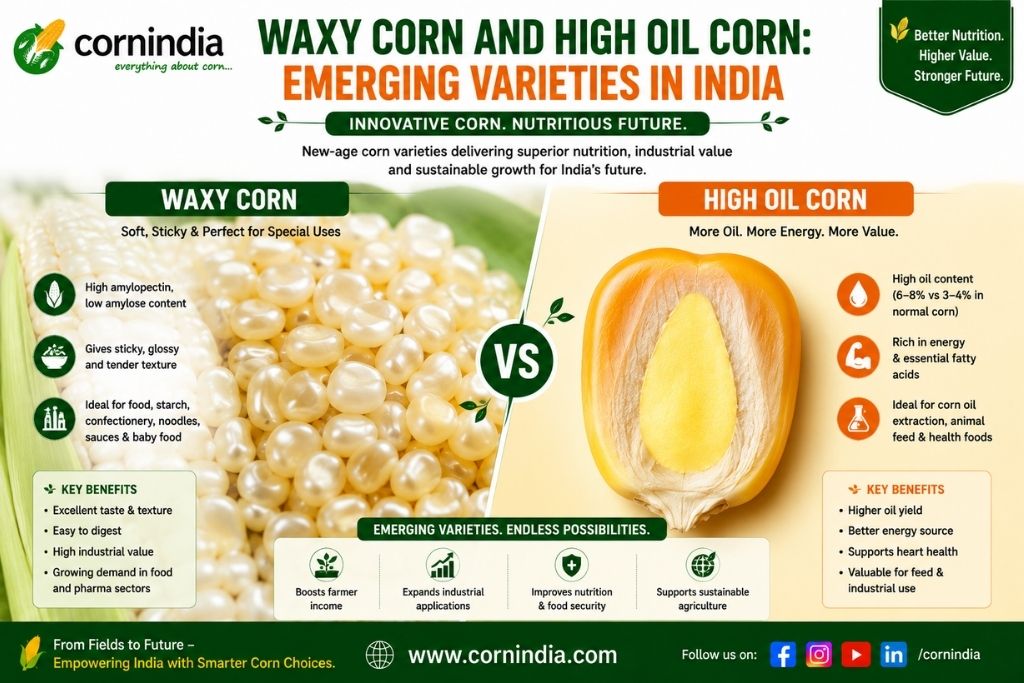
Waxy corn — Zea mays var. ceratina — is a naturally occurring maize type distinguished by one critical genetic difference from regular corn: the composition of its starch.
Normal maize starch is a blend of two polysaccharides: roughly 75% amylopectin (a highly branched, complex chain) and 25% amylose (a longer, linear chain). Each behaves differently when dissolved, heated, or cooled — and their ratio determines how a starch product performs in food, industrial, or pharmaceutical applications.
Waxy corn carries a recessive mutation at the waxy (wx) locus that effectively eliminates amylose production. The result: waxy corn starch is composed of approximately 99% amylopectin and less than 1% amylose.
This seemingly small biochemical difference creates a starch with fundamentally different functional properties — properties that are extremely valuable in specific industrial applications:
- Superior freeze-thaw stability: Waxy starch retains its texture and consistency through freeze-thaw cycles, unlike regular corn starch which undergoes retrogradation (becoming grainy and separating from liquid). This is why waxy corn starch is preferred in frozen foods like ready meals, frozen soups, and ice cream.
- Enhanced clarity: Waxy starch pastes are more transparent than regular starch, which matters in products where appearance is important — clear gravies, sauces, glass noodles.
- Better water-holding capacity: Important in processed meats, dairy products, and bakery items where moisture retention extends shelf life and improves texture.
- Modified starch base: Waxy maize starch, with its enhanced oxidative stability and modified applications, is a key contributor to market growth in specialty starches. Waxy corn starch is the preferred raw material for most modified starch production — because its near-100% amylopectin content gives chemical and physical modification processes a more uniform starting point, producing more consistent, predictable functional starches.
The name "waxy" comes from the appearance of the endosperm under polarised light — it looks waxy rather than the glassy appearance of regular corn.
Why Waxy Corn Starch Matters for India
India's starch industry is growing. The India corn starch market reached 7.90 million tonnes in 2024 and is projected to reach 9.30 million tonnes by 2033. This market spans food and beverages, pharmaceuticals, textiles, paper, and increasingly bioplastics — all sectors that are expanding in India simultaneously.
But India's starch industry currently processes almost entirely regular (non-waxy) maize. Modified starches — including those based on waxy corn — are imported at significant cost from global suppliers like Ingredion, Cargill, Roquette, and Tate & Lyle.
The global waxy corn starch market is estimated at USD 2.5 billion in 2024, projected to reach USD 6.5–6.8 billion by 2032–2033 at a CAGR of approximately 4.5–5.5%. Asia Pacific is the fastest-growing regional market within this, driven by food processing expansion in China, India, and Southeast Asia.
The gap between global market growth and India's domestic waxy corn production capacity is the opportunity. Specifically:
Food processing: Corn starch is used extensively as a thickener, stabiliser, and emulsifier in sauces, soups, bakery items, and confectionery products. India's food processing industry revenues are projected to reach USD 535 billion by 2025–26. As Indian food processors upgrade their formulations — particularly for export-oriented products targeting EU and US retail markets — the demand for modified starches with consistent, predictable performance will pull waxy corn starch into the supply chain.
Pharmaceuticals: The pharmaceutical sector is the fastest-growing starch application in India, with an 8.80% CAGR through 2030. India's pharmaceutical manufacturing sector is projected to reach USD 100 billion by 2025. Pharmaceutical-grade modified starches — including waxy corn derivatives — are used as tablet binders, disintegrants, and drug delivery matrix materials. India currently imports much of this from Europe and North America.
Bioplastics: Policy-backed shifts toward starch-based bioplastics following India's single-use plastic ban have created latent demand for starch feedstocks, alongside steady investment in new poly-lactic acid (PLA) projects that anchor starch demand. Waxy corn starch, with its superior film-forming properties and biodegradability, is well-positioned as a bioplastic feedstock.
Paper and textiles: Modified waxy corn starches are used in surface sizing and coating of premium papers and in textile warp sizing. India's textile industry — which exported over USD 44 billion in recent fiscal years — is a significant industrial starch consumer that could benefit from domestically sourced waxy corn starch.
Waxy Corn in India: Breeding and Variety Development
Waxy corn development in India is still early-stage relative to the crop's commercial potential. ICAR-IIMR has initiated waxy maize breeding programmes and has made progress in developing germplasm lines adapted to Indian growing conditions. The institution has also registered waxy maize germplasm lines that serve as foundational material for hybrid development.
The challenge in waxy corn production is isolation. Because the waxy trait is recessive, cross-pollination from adjacent normal maize crops will produce non-waxy kernels — destroying the commercial value of the waxy crop. Waxy corn must be grown in isolation of at least 400–500 metres from other maize, or under temporal isolation through staggered sowing. This limits its adoption in landscapes where maize cultivation is dense and diverse.
For seed companies, the waxy corn opportunity lies in:
- Developing high-yielding waxy hybrids adapted to India's key maize agro-climatic zones (Karnataka, MP, AP, Bihar) that can compete with regular corn yields
- Establishing contract farming supply chains with industrial buyers (starch processors, food companies) who need guaranteed, isolated waxy corn production
- Building starch quality testing into the supply chain, including amylose/amylopectin ratio verification through iodine staining or NIR analysis
Clean-label opportunity: Rising adoption of clean-label modified starches across food and beverage categories is a key growth driver. December 2024 saw Ingredion introduce a non-GMO functional native corn starch for enhanced texture capabilities in dairy products, dairy alternatives, and desserts. India's waxy corn — entirely non-GMO — is naturally positioned to serve this clean-label demand both domestically and in export markets.
Part 2: High Oil Corn
What Is High Oil Corn?
Normal maize grain contains about 3.5–4.5% oil by weight. High oil corn (HOC) is a category of maize varieties and hybrids that have been selected — through conventional breeding, not genetic modification — to contain significantly elevated oil levels: typically 6–8% oil, and in some lines exceeding 10%.
The oil in maize is concentrated in the germ (embryo) of the kernel. High oil corn has proportionally larger germs, which allows more oil accumulation. This has been achieved through several decades of directional selection in maize breeding programmes, most notably at the University of Illinois (the Illinois High Oil programme, the longest-running continuous plant selection experiment in history) and in parallel programmes at CIMMYT.
The elevated oil content changes the kernel's nutritional and economic profile in several important ways.
Why High Oil Corn Matters for Poultry and Livestock Feed
Corn oil is a premium oil and regularly more valuable than starch, the other major component of corn kernels. High oil corn possesses a higher available energy content than ordinary corn, making it more valuable as feed for poultry and livestock. In animal feeding trials, less high oil corn is required per unit of gain than is required with ordinary corn. In addition, high oil corn requires substantially less soybean meal to balance a typical animal diet.
The mechanism is straightforward: fat contains approximately 2.25 times as much metabolisable energy per gram as carbohydrate. So a maize grain with 7–8% oil delivers meaningfully more energy per kilogram than one with 3.5–4% oil — without requiring any increase in feed volume.
For a poultry industry where animal fat or animal-vegetable fat blends are added at approximately 5–8% of the diet to increase energy density of feed rations, high oil corn with significantly higher energy content can reduce or totally eliminate the use of or need for added fat when used in a typical poultry ration.
In concrete terms: if a feed mill is currently adding 5% palm oil or animal tallow to its broiler finisher ration to hit the required energy density, switching to high oil corn as the base grain could reduce that fat addition significantly — potentially eliminating it. At current Indian palm oil prices, the savings per tonne of feed are meaningful.
Feeding high-oil maize grain to swine and poultry has resulted in accelerated weight gain compared to standard maize grain in animal feeding trials. Better FCR (feed conversion ratio) with the same or lower feed volume is the feed industry equivalent of getting more for less.
High Oil Corn for Oil Extraction
Beyond feed use, high oil corn has a secondary value in the corn oil extraction industry. Normal maize processing for starch recovers a small amount of corn oil as a by-product from the germ stream. High oil corn, with nearly double the germ size and oil content, produces proportionally more corn oil per tonne processed.
The animal feed composition from high oil corn can be tailored for particular uses such as for poultry feed, swine feed, cattle feed, equine feed, aquaculture feed, and pet food, and can be tailored to animal growth phases. After extraction, the remaining corn meal has a higher relative percentage of protein and lower relative percentage of oil than similar products made with conventional corn.
This creates a value-added processing scenario: the extracted high oil corn oil can be sold as premium edible oil or industrial lubricant, while the defatted corn meal retains good protein content for feed applications — essentially generating two revenue streams from one grain.
October 2024 saw IFF launch OPTIMASH® enzymes for enhancing corn starch processing by boosting corn oil recovery by 15%, reflecting the growing commercial focus on corn oil as a value-added by-product of starch processing. As Indian starch processors upgrade their wet-milling technology, high oil corn becomes a more attractive feedstock because every additional percentage of oil content translates directly into more oil revenue per tonne processed.
ICAR's Work on High Oil Corn in India
ICAR-IIMR has been developing high oil corn germplasm as part of its specialty maize programme. High oil maize lines have been incorporated into the IIMR's breeding pipeline, and quality trait characterisation has been undertaken as part of the broader speciality maize research effort.
Between March 2024 and July 2025, ICAR notified 679 new field crop varieties including hybrids and trait-specific lines, with 64 trait-specific germplasm lines registered incorporating traits such as high protein content, drought tolerance, and early maturity. High oil maize is among the trait categories represented in this pipeline.
The commercial release of high oil corn hybrids in India remains limited compared to what's available in the US and European markets, where companies have developed high oil corn lines specifically for feed and processing applications. This is an area where seed companies with both breeding capability and feed industry relationships are well positioned to move ahead of public sector development timelines.
The Fatty Acid Profile Dimension
Not all corn oil is equal — and for certain high-value applications, the fatty acid composition of the oil matters as much as the oil quantity.
Normal corn oil contains approximately 25% oleic acid (a monounsaturated fatty acid with health benefits and oxidative stability). High oleic versions of high oil corn — developed through continued selection — can push oleic acid content to 60% or higher. Increasing the oleic acid content of the oil in high oil corn from 25% to 60% increases the oleic acid in a typical broiler feed ration by 120% — a substantial change that influences carcass fat quality and meat oxidative stability.
For food-grade corn oil producers, high oleic high oil corn represents a premium product — naturally higher in heart-healthy monounsaturated fat, with longer shelf life due to oxidative stability. As Indian consumers become more nutritionally aware and edible oil companies differentiate on fatty acid profiles, this is a meaningful product development angle.
Comparing the Two: Where Each Fits
| Feature | Waxy Corn | High Oil Corn |
|---|---|---|
| Key trait | Near-100% amylopectin starch | Elevated oil content (6–10%+) |
| Genetic basis | Recessive waxy (wx) gene | Quantitative trait; multiple QTLs |
| Primary markets | Food processing, pharma, bioplastics, textiles | Poultry/livestock feed, oil extraction |
| India market status | Nascent — mostly imported starch | Very early; research stage |
| Global market size | USD 2.5B waxy starch (2024); growing 5% CAGR | Niche but commercially established in US/Europe |
| Key challenge | Isolation from regular maize; processor linkage | Yield trade-offs; processing infrastructure |
| ICAR status | Germplasm registered; hybrid development underway | Lines in breeding pipeline; limited releases |
| Seed company opportunity | Develop HOC hybrids for contract farming + starch processors | Develop high oil hybrids for feed industry |
| Non-GMO status | Yes — both varieties are conventional breeding outcomes | Yes — both varieties are conventional breeding outcomes |
What It Would Take to Scale Both in India
For researchers and seed companies thinking about where to invest, here's an honest assessment of what scaling waxy corn and high oil corn in India requires:
On the breeding side: Both crops need India-adapted hybrids — not germplasm imports from US or European programmes designed for different growing conditions. ICAR has the foundational lines; the private sector has the scale-up capability. Collaboration between the two is the fastest path to commercial-quality varieties adapted to Karnataka, MP, Bihar, and Telangana's specific agro-climatic conditions.
On the market linkage side: Neither crop can scale without committed industrial buyers. Waxy corn needs starch processors willing to invest in segregated procurement and quality testing infrastructure. High oil corn needs feed mills willing to reformulate rations and verify oil content specifications at intake. These relationships need to be built before the seed goes in the ground — the crop is not something farmers can sell at a general mandi.
On the quality assurance side: Waxy corn's value is entirely contingent on maintaining varietal purity (no cross-pollination from regular maize). High oil corn's value requires verified oil content at delivery. Both demand testing infrastructure — NIR spectrometry for oil content, iodine staining or amylopectin analysis for waxy purity — that most Indian mandis and rural procurement points don't currently have. Building this testing capability into the supply chain is an early investment requirement.
On the policy side: In January 2024, the government revised its ethanol procurement policy to prioritise corn over traditional sugarcane sources, significantly impacting domestic corn demand. A similarly directed policy signal toward specialty starch production — perhaps through targeted PLI (Production Linked Incentive) scheme coverage for domestic waxy starch production to reduce imports — could accelerate the waxy corn ecosystem significantly.
Final Thoughts
Waxy corn and high oil corn are not the maize of today's Indian market. They're the maize of the market India is becoming — a larger food processing economy, a more sophisticated pharmaceutical sector, a poultry industry optimising for energy efficiency, and a starch industry that will inevitably move toward domestic sourcing of speciality starches as scale allows.
The research is solid. The global markets are real and growing. The domestic demand drivers are present. What's needed now is the bridge between ICAR's germplasm work and commercial deployment — and that bridge is built by seed companies willing to invest in variety development, contract supply chain infrastructure, and the patience to develop markets that don't yet fully exist.
India has done this before, most recently with QPM. The trajectory for waxy corn and high oil corn could follow a similar arc — from research curiosity to commercial reality — if the right partnerships form between the public breeding sector, private seed companies, and end-use industries.
At CornIndia, we track specialty maize developments closely and can connect researchers, seed companies, and industrial buyers across this emerging segment. Reach out if you're working in this space — we'd welcome the conversation.
Related reads on CornIndia: Quality Protein Maize (QPM): The Nutrition Story No One Tells | Maize Hybrid vs Open-Pollinated Varieties: Pros and Cons | How Maize Is Used in the Poultry Feed Industry in India




0 Comments