
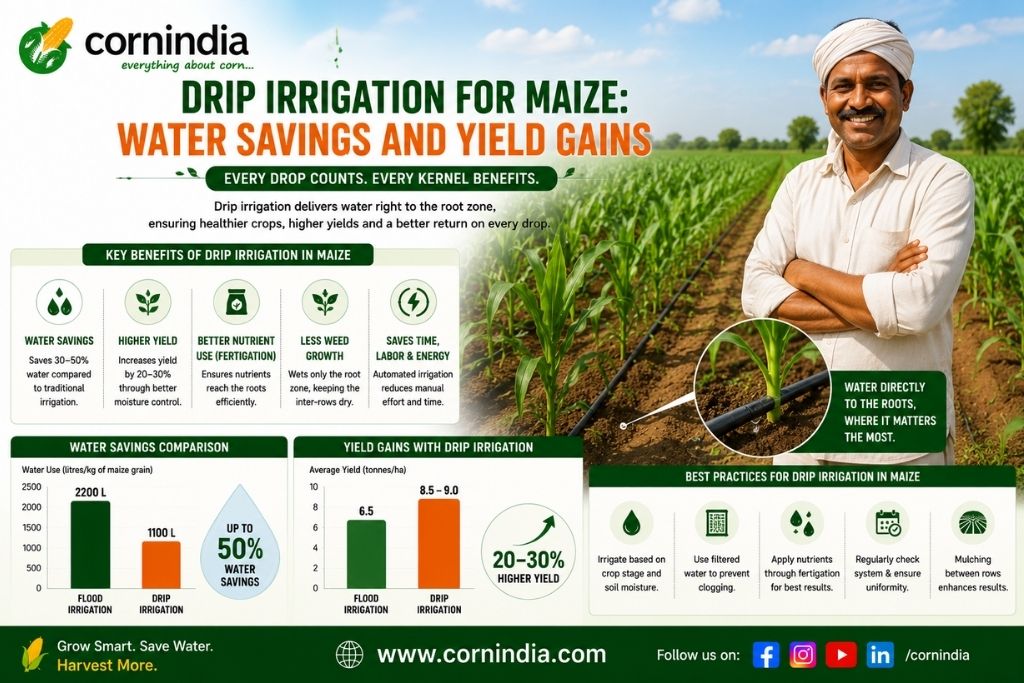
India grows more maize than almost any other country on earth. And increasingly, that maize is being grown with less water per kilogram than ever before — because more and more Indian farmers are switching from flood and furrow irrigation to drip.
The numbers behind this shift are genuinely compelling. A seven-year field study comparing drip irrigation to conventional border irrigation for maize found that drip irrigation increased yield by 14.39%, while water use efficiency increased by 53.77% and irrigation water use efficiency by 57.89%. That means more grain per drop of water — which in a country facing serious groundwater stress, is not just a yield story but a sustainability story.
But drip irrigation for maize also comes with real costs, practical challenges, and important decisions. This guide walks through all of it — so you can decide whether it makes financial sense for your farm.
Why Maize and Water Have a Complicated Relationship
Maize needs a consistent, adequate water supply throughout its growing cycle — but it does not tolerate waterlogging. It's sensitive to both drought stress and excess moisture, which makes it one of the crops that responds best to precise, controlled irrigation.
In kharif season, monsoon rains supply most of the water — but erratically. Too much rain at the wrong time damages roots and invites stalk rot. Too little at tasselling and grain filling — the two most water-sensitive stages — directly cuts kernel number and weight.
In rabi season, there's no rain to rely on. Every litre of water the crop gets comes from a borewell, canal, or tank — which means every litre costs you something. Efficiency here isn't just about sustainability; it's about input cost management.
Drip irrigation addresses both problems: it prevents waterlogging (because it delivers water slowly and only where needed), and it maximises the productivity of every litre you pump (because almost none of it is lost to evaporation, runoff, or deep percolation).
What Drip Irrigation Actually Does — Simply Explained
Drip irrigation replaces flood or furrow irrigation with a network of pipes and emitters (drippers) that deliver water slowly and directly to the root zone of each plant — at a rate the soil can absorb without runoff or evaporation.
The system has four main components:
- The head unit: A pump, filter (to prevent emitters from clogging), pressure regulator, and (if you're fertigating) a fertiliser injector unit
- Mainline: The large pipe that carries water from the pump to the field
- Sub-mains: Secondary pipes that branch off the mainline into different field sections
- Laterals with drippers: The thin tubes that run alongside each row of maize, with emitters spaced at plant intervals — typically 20–30 cm apart for maize
For maize, inline drip systems — where drippers are integrated into the lateral tubing at regular intervals — are the standard choice. Inline drip irrigation is suitable for row crops and closely spaced crops such as maize, wheat, and potato.
The system can be run for a set number of hours per irrigation cycle — typically 2–4 hours — then shut off. Over a growing season, this level of precision adds up to significant water savings.
The Real Numbers: Water Savings and Yield Gains
Let's be specific about what drip irrigation delivers for maize, based on published Indian and international research:
Water savings
Drip irrigation offers water savings of 30–70% compared to traditional irrigation methods. For maize specifically:
- Combining subsurface drip irrigation with integrated crop management in a maize-wheat rotation in northwest India reduced irrigation water use by 51.2% and improved irrigation water productivity by 113.8%.
- Drip irrigation reduces water usage by up to 50% per acre for corn farmers in India.
- Pneumatic broad-bed planting with furrow irrigation resulted in 9–20% saving of irrigation water with 11–26% higher apparent water productivity compared to ridge planting — and combining this with straw mulch and subsurface drip increased grain yield by 9–13% and net returns by 10–16% in 2024 trials.
In practical terms: if you're currently pumping 800 mm of water per acre across a rabi maize season using flood or furrow irrigation, drip can reduce that to 400–500 mm — while maintaining or improving yield.
Yield gains
Drip irrigation increased maize yield by 14.39% compared to conventional border irrigation in a seven-year study, with dry matter translocation efficiency improving by 13.97%.
Studies show that drip irrigation can increase crop yields by up to 30% while reducing water usage by 50%.
Many farmers have reported a 20–40% increase in crop yields after adopting drip irrigation.
For a rabi maize farmer currently yielding 25 quintals per acre under flood irrigation, a 20% improvement from drip translates to 30 quintals per acre — an additional 5 quintals that, at ₹2,000/quintal, means ₹10,000 more gross income per acre per season.
The Real Advantage: Fertigation
This is the part of drip irrigation that most farmers underestimate — and arguably the most economically significant benefit for maize.
Fertigation means injecting fertilisers directly into the irrigation water, which then carries dissolved nutrients straight to the root zone of each plant. Instead of broadcasting or side-placing solid fertilisers — where 30–40% may be lost to leaching, volatilisation, or runoff — fertigation delivers nutrients precisely where and when the plant needs them.
For maize, which has a high and time-sensitive nitrogen requirement, this is transformative:
- Nitrogen losses are dramatically reduced. In kharif maize, heavy rains leach applied urea out of the root zone before the plant can absorb it. With fertigation, nitrogen is applied in small, frequent doses through the drip system — matching plant uptake rates and minimising loss.
- Fertiliser use efficiency improves by 30–40%. Fertigation enables precise application of fertilisers through the irrigation water, increasing nutrient use efficiency and potentially boosting crop yields by 20–30%. This means you may be able to achieve the same yield with 30% less fertiliser — which directly reduces your input cost.
- Micronutrients can be fertigated too. Zinc sulphate, magnesium sulphate, and boron — all commonly deficient in Indian maize soils — can be dissolved and delivered through the drip system at the exact growth stage where the plant needs them.
- Labour cost for fertiliser application drops to near zero. No more manual urea broadcasting or side-placement operations. Open the fertigation injector, add the dissolved fertiliser, and it flows through the system with the irrigation water.
A rough calculation: if drip + fertigation reduces your fertiliser requirement by 30% and you're spending ₹8,000/acre on fertilisers, that's ₹2,400 saved per acre per season — before accounting for yield gains.
Drip Irrigation System Design for Maize: What You Need to Plan
Before you invest in a drip system, here are the key design decisions to get right:
Emitter spacing and flow rate
For maize with standard 60 cm row spacing, use inline drippers at 20–30 cm intervals with a flow rate of 1–2 litres per hour per dripper. This ensures adequate lateral water distribution to reach the plant root zone across the bed.
Lateral spacing
One lateral per maize row is the most common configuration. For narrow row spacing (45–60 cm), one lateral per two rows with a wider-spread dripper type can reduce material cost.
Drip tape vs drip pipe
- Drip tape (thin-walled): Lower upfront cost (₹8–₹12 per metre), suitable for 1–3 seasons. Good option for farmers trialling drip for the first time.
- Drip pipe (thick-walled, UV-stabilised): Higher upfront cost (₹15–₹25 per metre), lasts 7–10 years. UV-stabilised quality laterals with minimum 0.9mm wall thickness from quality brands like Netafim, Jain, or EPC last 7–10 years — the price difference of ₹3–5 per metre buys you 5–7 more years of system life. For a permanent maize field, invest in the thicker pipe.
Filter quality
The filter is the most critical maintenance component in any drip system. A clogged filter means uneven water distribution and yield patches. For maize fields with sediment-bearing borewell water, use a sand + screen filter combination. Clean filters weekly during the season and after every fertigation cycle.
Pressure management
Most maize drip systems operate at 0.8–1.2 kg/cm² pressure. Excessively high pressure causes dripper damage; too low means poor distribution uniformity. Install a pressure gauge and regulator at the head unit.
Cost, Subsidy, and Payback: The Economics
Here's what drip irrigation for maize actually costs, and how the government subsidy changes the math:
System cost (per acre, before subsidy)
| Component | Estimated cost |
|---|---|
| Pump and motor | ₹15,000–₹25,000 (if not existing) |
| Filter bank | ₹3,000–₹8,000 |
| Fertigation unit | ₹5,000–₹12,000 |
| Mainline and submain pipes | ₹4,000–₹8,000 |
| Laterals with drippers (per acre) | ₹12,000–₹20,000 |
| Labour for installation | ₹3,000–₹5,000 |
| Total (drip system per acre) | ₹35,000–₹60,000 |
The drip irrigation cost per acre in India is around ₹45,000–₹60,000, depending on system design and land conditions.
Government subsidy under PMKSY (Per Drop More Crop)
This is where the investment becomes significantly more accessible:
The Central Government provides subsidy at 55% of the indicative unit cost to small and marginal farmers and 45% to other farmers under the Per Drop More Crop (PDMC) scheme.
Under PDMC, assistance is limited to 5 hectares per beneficiary, available again only after 7 years for the same land, and requires an Aadhaar-seeded bank account with DBT enabled.
State governments add their own subsidy on top:
| State | Subsidy range |
|---|---|
| Andhra Pradesh | Up to 70% (SC/ST farmers: higher) |
| Telangana | 50–70% |
| Maharashtra | 45–55% |
| Karnataka | 45–55% |
| Rajasthan | 45–55% |
| Tamil Nadu | 50–60% |
Subsidies potentially reduce out-of-pocket costs by 30–70% depending on state and farmer category.
After subsidy, your actual investment: On a ₹50,000 per acre system with a 55% subsidy, your out-of-pocket cost is approximately ₹22,500 per acre. With a 50% subsidy, it's ₹25,000 per acre.
The return on investment usually comes within 1–2 seasons due to reduced labour and increased yield. For rabi maize specifically — where every litre of water pumped has a direct electricity or diesel cost — the payback can be even faster.
How to apply for PMKSY subsidy
- Contact your state agriculture or horticulture department for the current scheme details and vendor empanelment list
- Collect required documents: Aadhaar card, land ownership records (7/12 or patta), bank account details, passport photo
- Purchase from a PMKSY-empanelled vendor only — purchases from non-empanelled suppliers are not eligible for subsidy
- Get the system installed and inspected by a government officer
- Subsidy amount is released via Direct Benefit Transfer (DBT) to your bank account after inspection
KVKs offer training programmes on drip irrigation setup, operation, and maintenance — farmers who attend these programmes are better equipped to maintain systems and stay compliant with subsidy rules.
Drip Irrigation in Kharif vs Rabi Maize
Kharif (monsoon season): Drip irrigation during kharif is less about water supply and more about precision. The system allows you to supplement between rain events when the crop hits its critical water-sensitive stages (tasselling, grain filling). The major benefit in kharif is fertigation — delivering nitrogen and micronutrients in small, frequent doses that monsoon rains would leach away if applied conventionally. Drip also prevents waterlogging in low-lying areas by replacing flood irrigation entirely.
Rabi (winter season): This is where drip irrigation makes the most unambiguous economic sense for maize. Every irrigation is applied from groundwater or canal, at real cost. Water savings of 40–50% directly translate to energy savings (pumping costs) and reduced drawdown of borewells. Combined with the yield advantage and fertigation efficiency, rabi maize under drip is one of the strongest economic cases for drip adoption in Indian field crops.
Common Mistakes to Avoid
1. Buying cheap drip tape for a permanent field. Thin-walled drip tape that cracks after 2 seasons gives you the capital cost without the long-term benefit. Invest in UV-stabilised thick-walled laterals for fields you'll drip-irrigate across multiple seasons.
2. Skipping filter maintenance. The most common reason drip systems underperform in Indian conditions is clogged emitters from poor filter maintenance. Clean your filter every week during the season.
3. Not using the fertigation unit. Many farmers install drip but continue broadcasting fertilisers manually — capturing only half the benefit. The fertigation unit is where the fertiliser efficiency gains come from. Use it from your very first irrigation.
4. Applying too much water. Drip delivers water efficiently, but applying it for too many hours still causes over-irrigation and root zone saturation. Run your system for 2–4 hours per irrigation event, depending on soil type and crop stage. Sandy soils need shorter, more frequent runs; clay soils need longer, less frequent ones.
5. Buying from a non-empanelled vendor. If you're claiming the PMKSY subsidy, always buy from a government-empanelled vendor. Purchases from unregistered suppliers disqualify you from subsidy eligibility entirely.
Is Drip Irrigation Right for You?
Here's a simple framework for deciding:
Drip makes strong sense if you:
- Grow rabi maize with borewell or canal irrigation (water cost savings are immediate and significant)
- Have 2+ acres of maize in the same location each season (fixed cost spread over more area)
- Have faced yield losses from over-irrigation or uneven fertiliser distribution
- Are in a state with 55–70% PMKSY subsidy available
Drip may be premature if you:
- Grow kharif maize on purely rain-fed land with no supplemental irrigation
- Farm fragmented plots less than 1 acre (installation economics don't work well below 1 acre)
- Plan to change your crop rotation significantly — drip systems are crop-specific in their layout
Middle ground: If you're unsure, start with 1–2 acres in rabi season. The data from that first season — water usage, yield, and fertigation response — will tell you more than any guide can.
Final Thoughts
Drip irrigation for maize is not a luxury technology for large farms anymore. With PMKSY subsidies reducing installation costs by 45–70%, system payback in 1–2 seasons, water savings of 40–50%, and yield improvements of 14–30%, the financial case for drip in Indian maize farming — particularly for rabi season — is stronger than it's ever been.
The farmers who benefit most are those who combine drip with fertigation, invest in quality materials, and maintain the system consistently. Do those three things, and drip irrigation will pay back your investment several times over across its 7–10 year lifespan.
At CornIndia, we work with farmers navigating this decision and can connect you with agronomic guidance, system recommendations, and information on PMKSY applications in your state. Get in touch — we're here to help.
Related reads on CornIndia: Soil Preparation for Maize: Getting the Basics Right | Kharif vs Rabi Maize: Which Season Suits Your Farm? | How to Grow Sweet Corn in India









0 Comments