
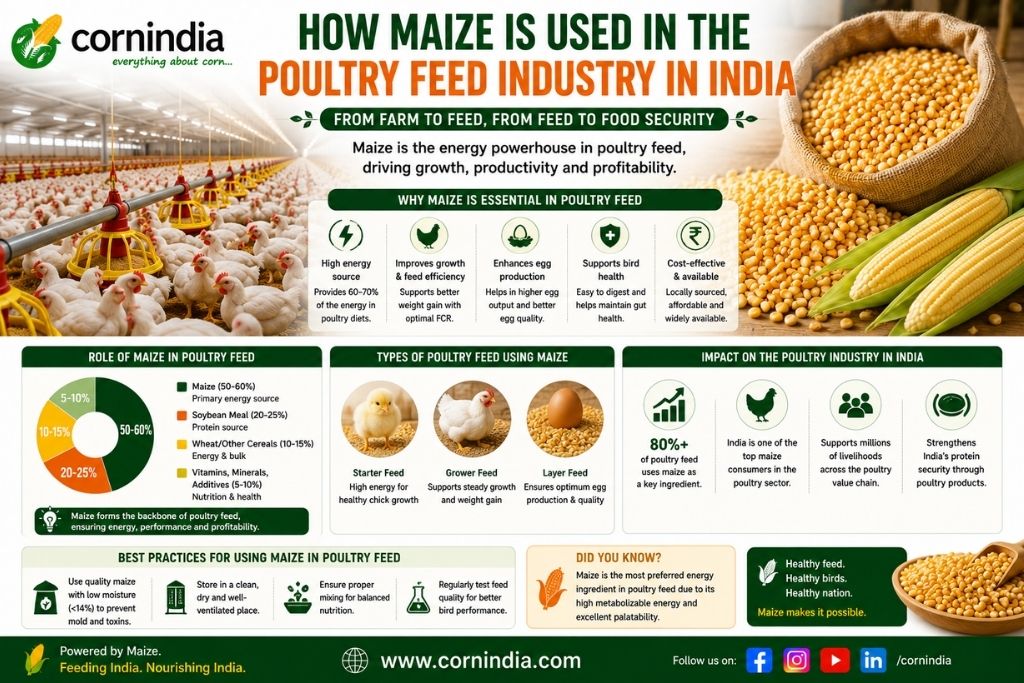
Every time India's broiler industry grows — and it is growing fast — someone, somewhere, needs more maize.
That's not a simplification. It's the structural reality of how Indian poultry nutrition works. Maize is the energy foundation of virtually every commercial broiler and layer ration produced in India today. Without a steady, affordable, quality supply of maize, the poultry industry as we know it cannot function.
Understanding this relationship — between maize farmers, feed mills, poultry integrators, and the Indian consumer eating increasingly more chicken and eggs — is essential for anyone working in the maize supply chain, agri-business, or agricultural policy in India today.
This post unpacks that relationship with the latest data, explains exactly why maize is so central to poultry nutrition, and maps the supply-demand dynamics that will define the maize-poultry connection over the next decade.
The Scale of India's Poultry Feed Industry
Before getting to maize specifically, it helps to understand the sheer scale of the industry it feeds.
The India poultry feed market reached INR 955.3 billion in 2024 and is projected to reach INR 1,290.7 billion by 2033, growing at a CAGR of 3.23% during 2025–2033.
Another research estimate puts it even higher: the India poultry feed market reached approximately USD 20.56 billion in 2024 and is projected to grow at a CAGR of 7.29% between 2025 and 2034, reaching USD 41.56 billion by 2034.
Regardless of which estimate you use, the direction is unambiguous: India's poultry feed industry is large, growing, and growing fast.
Total poultry feed production stands at 22 million tonnes in India, with per capita chicken consumption reaching 3.23 kg in 2023. India's poultry population exceeded 851 million birds and continues expanding as income growth drives protein demand across urban and semi-urban India.
Poultry held 44.70% of the India compound feed market share in 2025, with cereals — maize being the dominant cereal — accounting for 57.40% of the India compound feed market size.
Why Maize? The Nutritional Logic
To understand why maize is so central to poultry feed, you need to understand what poultry nutrition actually requires.
A broiler chicken has two primary nutritional needs: energy (to grow fast) and protein (to build muscle). Modern broilers have been genetically selected to convert feed to meat with remarkable efficiency — feed conversion ratios (FCR) of 1.6 to 1.9 are typical, meaning 1.6–1.9 kg of feed produces 1 kg of live weight.
Maize is the dominant energy source in this equation for three clear reasons:
1. Energy density: Maize is exceptionally energy-rich among cereal grains. Its high starch content — typically 65–72% of dry matter — provides the metabolisable energy that broilers need for rapid growth. In a 100g maize-based broiler ration, maize contributes the majority of the 2,800–3,200 kcal/kg energy requirement.
2. Digestibility: Maize starch is highly digestible for poultry — more so than wheat or sorghum. This means more of what the bird eats is converted to growth, which is why FCR improves when maize is the primary grain.
3. Palatability and physical form: Maize-based feed is palatable to poultry and pellets well — both important factors in commercial broiler operations where feed uniformity, wastage minimisation, and palatability directly impact production efficiency. Pelleting technology improvements are lifting feed conversion efficiency, and pelleted feed now captures 52% of nationwide feed volume.
The result: maize accounted for a 46% share of the Indian poultry feed market in 2024, remaining the primary energy source in feed formulations. Maize constitutes around 46% of broiler feed formulations.
Maize in the Feed Formula: How It Works
A standard Indian commercial broiler feed ration — the kind produced by large integrators like IB Group, Japfa Comfeed, Venky's, or CP India — looks roughly like this:
| Ingredient | Typical inclusion rate |
|---|---|
| Maize (yellow) | 55–65% |
| Soybean meal | 25–30% |
| Vegetable oil (soya/palm) | 2–4% |
| Di-calcium phosphate | 1–2% |
| Limestone | 1–1.5% |
| Salt | 0.3–0.5% |
| Vitamin-mineral premix | 0.25–0.5% |
| Synthetic amino acids (lysine, methionine) | 0.1–0.3% |
| Enzymes, acidifiers, coccidiostats | Minor additions |
In this formula, maize does the heavy lifting on energy, while soybean meal covers most of the protein and amino acid requirements. Together, maize (~65–70%) and soyameal (~25–30%) contribute to the bulk of feed cost, with the balance being other additives including fat, minerals, vitamins, and medicines.
Cereal grains make up between 70–80% of feed mixes depending on the growth stage in broiler chickens, serving as the primary source of energy, while oilseeds and other additives make up the rest providing protein and other important nutrients.
Feed formulations vary by bird type and production stage:
- Broiler starter (0–10 days): Higher protein (22–23%), slightly lower maize inclusion to accommodate more soybean meal
- Broiler grower (10–24 days): Standard formulation; maize inclusion at 55–62%
- Broiler finisher (24 days to slaughter): Slightly higher maize inclusion; protein requirements drop as the bird reaches finishing weight
- Layer feed: Different from broiler feed — higher calcium (for eggshell formation), lower energy requirement; maize inclusion typically 50–58%
How Much Maize Does India's Poultry Sector Actually Use?
This is the number that should get every maize farmer and agri-business's attention.
India's total maize production in 2024–25 reached a record 43.41 million tonnes. Of this, the poultry and livestock feed sector consumes the largest single share. Conservative industry estimates suggest the poultry sector alone absorbs 18–22 million tonnes of maize annually — roughly 40–50% of India's total maize production.
Feed constitutes more than 70% of the cost of raising broiler chickens, and maize and soybean meal together form the largest portion of that feed cost.
To put this in perspective: every 1% growth in India's broiler industry translates directly into additional maize demand of roughly 180,000–220,000 tonnes per year. The broiler sector is projected to grow at over 7% annually through 2030. That's an additional 1.2–1.5 million tonnes of maize demand per year from broilers alone — before accounting for layers, ducks, turkeys, and other poultry.
The connection is straightforward: India's poultry boom and India's maize boom are not separate stories. They're the same story.
The Maize Quality Question: What Poultry Buyers Actually Want
Not all maize is equal from a feed industry perspective. Poultry nutritionists and feed mill procurement teams have specific quality requirements — and understanding these is essential for any maize farmer, trader, or agri-business targeting the feed market.
Moisture content: Feed mills want maize at 12–14% moisture. Above 14%, risk of aflatoxin and mycotoxin contamination rises sharply. Storage in moist grain also generates heat, which degrades nutritional quality. Grain arriving above 14% moisture is typically rejected or heavily discounted.
Aflatoxin levels: Feed cost volatility and raw material availability, including aflatoxin contamination risks in maize, create recurring pressures on producer margins. Indian regulatory limits for aflatoxin in poultry feed are 10–20 ppb. Grain from poorly dried kharif maize, particularly in humid conditions, frequently exceeds this — and is rejected at feed mill gates. Aflatoxin management (proper drying, clean storage, regular testing) is the most critical quality issue for maize entering the poultry feed supply chain.
Foreign matter and broken grain: Feed mills specify a maximum of 1–2% foreign matter and 3–5% broken kernels. Grain cleaned and graded to these specifications commands a price premium over raw, uncleaned mandi arrivals.
Yellow colour: Indian broiler feed formulations specifically require yellow maize — not white maize — because yellow maize contains xanthophylls (natural pigments, particularly zeaxanthin and cryptoxanthin) that deposit in the chicken's skin, giving it the characteristic yellow colour that Indian consumers prefer when buying fresh chicken. White maize does not provide this pigmentation, which is why yellow maize commands a consistent premium in the feed market over white.
Nutritional consistency: Large integrators operating precision nutrition programmes want consistent nutritional parameters (energy, protein, moisture) across bulk deliveries. Significant batch-to-batch variation forces nutritionists to reformulate rations frequently, adding cost and complexity.
The Geography of Maize-Poultry Linkages
India's maize production and its poultry industry are geographically concentrated — and where they overlap, the supply chain works most efficiently.
South India's Andhra Pradesh and Tamil Nadu combine sizable aquaculture zones with vibrant poultry clusters, generating a balanced demand mix. North India remains the single largest territory for compound feeds, with large broiler integrators in Punjab and proximity to grain belts ensuring steady maize availability.
The key maize-poultry linkages by region:
Namakkal, Tamil Nadu: One of India's largest and most efficient poultry clusters. Local maize production in Salem, Dharmapuri, and Erode districts supplies feed mills within 50–100 km. This tight geographic integration keeps logistics costs low and quality high — and is why Tamil Nadu consistently achieves some of India's highest maize mandi prices.
Telangana-Andhra Pradesh corridor: Nizamabad, Karimnagar (Telangana) and Kurnool, Guntur (AP) are major maize-growing districts feeding large poultry clusters in Hyderabad, Vijayawada, and Tirupati. The region's proximity to both maize farmers and urban broiler markets makes it one of India's most important maize-to-protein corridors.
Karnataka's Haveri-Davangere-Hubli belt: Major maize production area with active feed mill procurement. Bengaluru's rapidly growing broiler market creates consistent demand pull.
Punjab-Haryana to north Indian poultry: Punjab and Haryana-grown maize (spring/rabi crop) flows to large broiler integrators in the north. North India's proximity to grain belts ensures steady maize availability, while strong road networks facilitate inter-state trade.
Where geography creates distance between maize production and poultry consumption — Bihar's rabi maize flowing to south Indian feed mills, for example — logistics costs erode the price premium, which is why farm gate prices in Bihar are generally lower than in Tamil Nadu or Karnataka despite comparable grain quality.
What's Disrupting the Maize-Poultry Relationship
The maize-poultry equation is not static. Several forces are reshaping it in ways that matter for both maize suppliers and feed industry buyers.
1. Ethanol Demand Competition
The government's Pradhan Mantri JI-VAN Yojana and ethanol blending programme have created a new, large competing demand for maize. Distilleries are now significant buyers alongside feed mills — and they can sometimes outbid feed mills when ethanol pricing is favourable. This competition for the same grain pool has added volatility to maize-feed price relationships. Increasing demand for biofuels — producing ethanol from maize — can redirect feed-grade grains toward other uses, tightening availability for feed.
2. Alternative Feed Ingredients Entering the Market
Ingredient diversification into insect meal and dried distillers' grains with solubles (DDGS) is easing pressure on traditional maize and soybean supplies, while insect meal is poised for a 28% CAGR between 2025 and 2030.Rice DDGS — a by-product of ethanol production from rice — is also emerging as a partial maize replacement in paddy-heavy states, reducing logistics costs compared to shipping maize from distant growing regions.
These alternatives are unlikely to displace maize as the primary energy ingredient any time soon. But they are beginning to place a cap on how far maize prices can rise before feed mills begin substituting.
3. Precision Nutrition and Lower FCR Targets
The widespread use of precision nutrition tools and automated feeding systems is improving feed conversion ratios across commercial operations. As broiler genetics improve and feed management becomes more precise, less maize is needed per kg of meat produced. This efficiency improvement slightly moderates per-bird maize demand growth even as the industry expands. The implication: maize volume demand will grow with the industry, but slightly less than linearly.
4. Mycotoxin Contamination — A Growing Challenge
India's post-harvest handling, limited cold-storage and controlled-environment large-scale feed reserves in some regions, and fragmented procurement by smallholder farmers contribute to localised shortages and price spikes during lean months. Aflatoxin and fumonisin contamination in poorly stored kharif maize — particularly during high-humidity years — is a recurring quality problem that disrupts supply chains and occasionally forces feed mills to seek alternative imports from non-GMO sources in Ukraine or Southeast Asia.
5. The Non-GMO Advantage — and Its Limits
India's status as a non-GMO maize producer is a structural advantage with poultry buyers in export markets and increasingly with domestic buyers who are building feed supply chains for antibiotic-free, "clean label" chicken products. Between 2019 and 2023, Ukraine and Myanmar — neither of which produce GE corn varieties — were the major sources of India's occasional corn imports, with the US, Brazil, and Argentina (which produce GE corn) rarely sourced from. India's non-GMO maize can command a premium in these niche feed supply chains — but only when quality consistency and supply reliability match what global competitors offer.
Implications for Agri-Businesses and Researchers
Several strategic takeaways emerge from this analysis:
For maize farmers and aggregators: Quality grading and drying to feed mill specifications (12–14% moisture, <10 ppb aflatoxin, <2% foreign matter) is the most reliable path to price premiums above mandi. Feed mill procurement teams pay for quality and penalise for non-compliance — consistently.
For feed ingredient traders and processors: The yellow maize pigmentation requirement is non-negotiable for most Indian broiler feed buyers. Sourcing and maintaining yellow grain identity through the supply chain is essential for price premium capture. White maize, however plentiful, doesn't command feed-market prices.
For feed manufacturers: The maize-ethanol competition is structural, not temporary. Building flexible formulation capabilities — the ability to increase DDGS, rice flour, or other energy source inclusions when maize prices spike — is now a core risk management tool for any serious Indian feed business.
For policy researchers: The relationship between India's MSP for maize, domestic feed market prices, and the ethanol programme's diversion of grain creates a complex three-way price interaction. When maize prices rise above feed-cost thresholds, poultry producer margins compress — and if sustained, this triggers industry contraction, which then reduces feed demand and pulls maize prices back down. Understanding this price cycle is important for designing effective MSP and procurement interventions that support farmers without destabilising the downstream poultry sector.
For the maize export community: The quality standards India's poultry industry demands — and increasingly enforces — are the same standards that international buyers require. Building quality infrastructure (drying, cleaning, NABL-certified testing, consistent grading) to serve domestic feed mills is precisely the same infrastructure needed to compete in export markets. Domestic feed demand can be the training ground for export quality discipline.
Final Thoughts
The relationship between maize and India's poultry industry is one of the most important — and least publicly understood — dynamics in Indian agriculture.
Feed accounts for approximately 70% of the variable cost of poultry companies, with maize contributing 65–70% of that feed cost. That single fact means that every rupee change in maize mandi prices flows directly and immediately into poultry producer margins — and eventually into the price of chicken and eggs in Indian markets.
As India's poultry industry continues its rapid growth — driven by rising incomes, urbanisation, and a young population with growing protein appetite — the structural demand for quality Indian maize will only intensify.
For maize farmers, that's a long-term demand guarantee unlike almost anything else in Indian agriculture. For agri-businesses and researchers, it's a system worth understanding deeply — because the maize supply chain and the protein value chain are, fundamentally, the same chain.
At CornIndia, we sit at this intersection and work with stakeholders across it — from farm-level maize production to feed industry procurement and market intelligence. If you're navigating any part of this ecosystem, we'd welcome the conversation.
Related reads on CornIndia: India's Maize Export Potential: Opportunities and Challenges | Top 10 Maize-Producing States in India | Current Maize Prices in India: State-Wise MSP Breakdown


0 Comments