
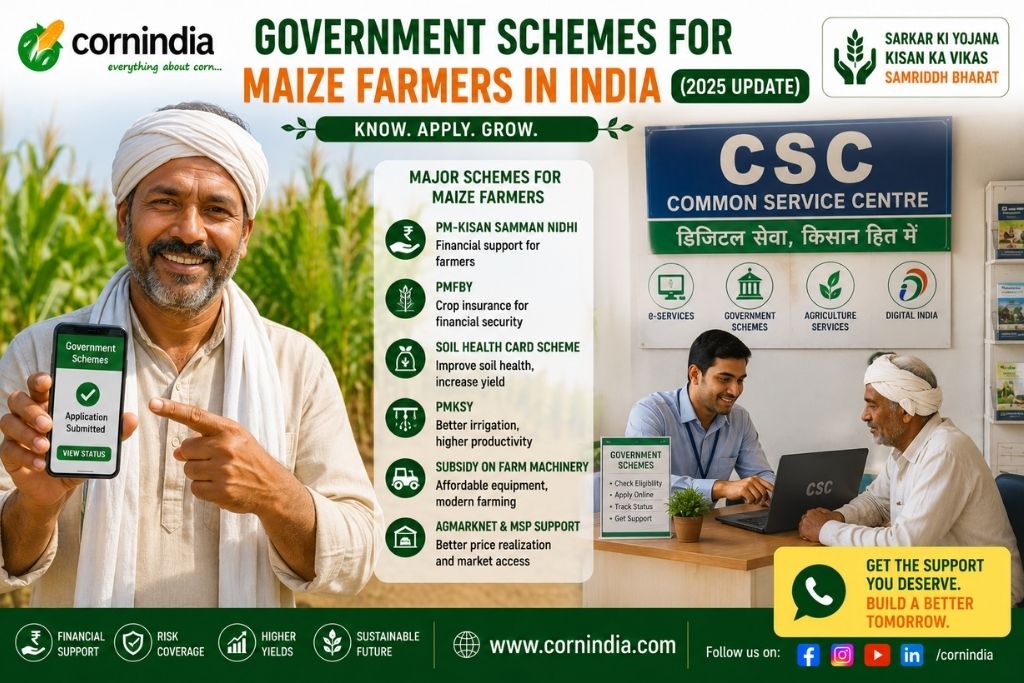
Every season, the Indian government runs a wide network of schemes designed to support farmers — income support, crop insurance, input subsidies, credit access, irrigation assistance, and price protection. But most maize farmers only know one or two of them by name, and many miss out on benefits they're actually eligible for simply because the information is scattered across different departments and portals.
This guide brings together every scheme relevant to a maize farmer in India in one place — what it offers, who qualifies, and how to apply — organised by the type of support it provides.
A quick but important note before we start: Scheme names, subsidy percentages, deadlines, and budget allocations change from year to year and sometimes mid-year. The information here reflects the latest available details at the time of writing, but you should always confirm current terms with your local agriculture department, Common Service Centre (CSC), or the official scheme portal before applying. Treat this as your starting map, not your final word.
Income Support Schemes
PM-KISAN (Pradhan Mantri Kisan Samman Nidhi)
What it offers: Direct income support of ₹6,000 per year, paid in three instalments of ₹2,000 each, transferred directly to your Aadhaar-linked bank account. Unlike MSP procurement — which favours rice, wheat, and a few other crops — PM-KISAN is crop-agnostic, meaning maize farmers qualify exactly the same as farmers growing any other crop.
Who's eligible: All landholding farmer families, subject to exclusion criteria that rule out higher-income earners, institutional landholders, serving and former government employees above specified ranks, professionals such as doctors and lawyers, and income-tax payers.
Scale: As of the 18th instalment released in October 2024, over ₹3.45 lakh crore had been transferred cumulatively to around 11 crore farmers, making PM-KISAN one of the biggest direct benefit transfer schemes globally. Budget 2025-26 retained the annual outlay at ₹60,000 crore.
How to apply:
- Register on the official PM-KISAN portal (pmkisan.gov.in) or visit your nearest Common Service Centre (CSC) for registration assistance
- Link your bank account to Aadhaar
- Complete eKYC — this is now mandatory, and farmers who fail to complete Aadhaar-based or face-authentication eKYC are removed from active rolls
- Keep your land records updated, as periodic verification drives are used to confirm ongoing eligibility
Crop Insurance
Pradhan Mantri Fasal Bima Yojana (PMFBY)
What it offers: Protection against losses from natural calamities, pest infestations, and disease outbreaks — covering cereals including maize, pulses, oilseeds, horticulture, and commercial crops.Coverage spans pre-sowing to post-harvest losses via direct benefit transfer, with claims settled based on assessed crop loss.
Premium you pay: Just 2% of the sum insured for Kharif crops (which includes maize) and 1.5% for Rabi crops — with the government subsidising the remaining premium cost.
Claim performance: 80% of claims were settled within 30 days in recent seasons, with the scheme using AI-based tools for loss assessment. Total claim disbursement reached approximately ₹10,000 crore in 2024-25, with a budget allocation of ₹16,000 crore for 2025.
Who's eligible: Any farmer growing notified crops on owned or leased land — both loanee and non-loanee farmers qualify, provided the land is recorded in the applicant's name. Income-tax payers and government employees are typically excluded.
Documents needed: Land records, bank account details, Aadhaar (kept mobile-linked for OTP verification), and a sowing certificate confirming what crop you've planted.
Deadlines: Applications typically close by July 31 for Kharif season and December 31 for Rabi season each year — but always verify current-year cutoffs, as these dates can shift.
How to apply:
- Visit pmfby.gov.in, your state agriculture portal, or a nearby CSC
- Register with Aadhaar, bank details, crop type, and land records
- Pay your premium share through the bank, CSC, or online
- If you suffer a loss, report it within 72 hours through the portal or CSC — delayed reporting is one of the most common reasons claims get complicated, so don't wait
Input and Seed Subsidies
National Food Security Mission (NFSM) — Coarse Cereals Component
What it offers: NFSM specifically covers maize under its Coarse Cereals component, alongside barley — aiming to increase production through area expansion, productivity enhancement, and improved seed distribution in identified districts across the country.
Key benefits under NFSM relevant to maize farmers:
- Certified seed subsidy: typically ₹25 per kg or 50% of the seed cost, whichever is less, for improved varieties — with different rates for newer high-yielding hybrids and older varieties. Assistance is generally limited to two hectares per farmer.
- Integrated Nutrient Management (INM) support: financial assistance of ₹500 per hectare or 50% of cost, whichever is less
- Integrated Pest Management (IPM) / plant protection support: ₹500 per hectare or 50% of the cost, whichever is less, for a maximum of two hectares per farmer
- Farm mechanisation assistance for select equipment, and field demonstrations where you can see improved varieties and practices tested on farms in your area
How to apply: Contact your local Agriculture Technology Management Agency (ATMA) office, block-level agriculture officer, or Krishi Vigyan Kendra (KVK). Many states now run this through dedicated e-portals — for example, Madhya Pradesh's e-Krishi Yantra Grant Portal — where you register with documents including land records (B-1 Khasra), Aadhaar card, passport photo, and bank passbook copy.
2025-26 update: NFSM has been renamed. During 2024-25, the National Food Security Mission was renamed the National Food Security & Nutrition Mission (NFSNM), continuing the same core objectives with an expanded scope covering nutri-cereals and enhanced seed and varietal replacement targets. Ask your local office whether your district's guidelines have been updated under the new name.
Fertiliser Subsidy
What it offers: The government subsidises urea, DAP, NPK, and other fertilisers directly through manufacturers, keeping retail prices affordable for farmers — including growing encouragement for nano-urea and organic fertiliser adoption to reduce over-dependence on chemical inputs.
How it reaches you: This subsidy is generally built into the retail price you pay at the fertiliser shop — you don't need to apply separately, but keeping your Aadhaar linked at point-of-sale (POS) systems at fertiliser retail counters is now standard practice for subsidy tracking.
Irrigation Support
PMKSY — Per Drop More Crop (PDMC)
What it offers: Financial assistance for installing drip and sprinkler irrigation systems, along with support for small water storage structures and watershed development — directly relevant for maize farmers looking to reduce water use and improve yield through precision irrigation.
Subsidy level: Typical assistance ranges vary by state and farmer category, generally covering a meaningful share of the system cost for small and marginal farmers, with slightly lower rates for other farmer categories.
How to apply: Apply through your state horticulture or agriculture department's micro-irrigation portal, or visit a nearby CSC. You'll typically need land ownership documents, Aadhaar, and a bank account for DBT-based subsidy transfer. Only purchases from government-empanelled vendors qualify for the subsidy — always confirm vendor empanelment before purchasing equipment.
PM-KUSUM (Solar Irrigation)
What it offers: A scheme to solarise Indian agriculture, covering standalone solar agriculture pumps up to 7.5 HP for off-grid areas and solarisation of existing grid-connected pumps — reducing your dependence on diesel or unreliable grid power for irrigation.
Subsidy structure: Typically a 30% central subsidy plus 30% state subsidy, with the farmer contributing the remaining 40% (a more generous 50:30:20 split applies in North-Eastern and hilly states).
Who's eligible: Owner-cultivators, tenant farmers, oral lessees, sharecroppers, and self-help groups or joint liability groups of farmers.
How to apply: Through your state renewable energy development agency or the MNRE-linked state portal. Documents needed typically include land records, Aadhaar, and bank details.
Credit and Loan Support
Kisan Credit Card (KCC)
What it offers: Short-term credit for agricultural needs — seeds, fertilisers, equipment, and working capital — at subsidised interest rates, with easy access compared to traditional bank loan processes. Loans up to a specified ceiling attract interest subvention, bringing the effective interest rate down to around 4% with prompt repayment incentives.
Recent update: The Kisan Credit Card limit under the Interest Subvention Scheme was raised to ₹5 lakh in Budget 2025-26, up from the earlier ₹3 lakh ceiling.
Who's eligible: All farmers — owner-cultivators, tenant farmers, oral lessees, sharecroppers, and self-help groups or joint liability groups of farmers — as per official guidelines. Small, marginal, and tenant farmers are all covered, and KCC can also extend to allied activities such as livestock, poultry, and fisheries.
How to apply:
- Visit your nearest bank branch (public sector, private, or cooperative) or apply online through your bank's portal
- Submit the KCC application form along with land records, Aadhaar, and identity proof
- PM-KISAN beneficiaries typically get fast-track KCC enrolment — mention your PM-KISAN registration when applying
- Repay according to your crop cycle to maintain the concessional interest rate benefit
Farm Mechanisation Support
SMAM (Sub-Mission on Agricultural Mechanisation) and PM-KISAN Tractor Scheme
What it offers: Access to modern farming machinery — tractors, power tillers, harvesters, and other mechanised equipment — at subsidised rates, along with training programmes on effective machine use. The PM Kisan Tractor Scheme specifically offers 20–50% subsidies on tractor purchases to small and marginal farmers, integrated with your existing PM-KISAN registration.
Who's eligible: Small and marginal farmers, with priority often given to those already enrolled in PM-KISAN with completed eKYC.
How to apply: Apply through your state agriculture portal (many states run dedicated portals for this), selecting the tractor subsidy or mechanisation scheme option under the farmer's corner. You'll need Aadhaar, PM-KISAN ID if applicable, land records (khata khatouni), and bank passbook. Note that state-specific deadlines apply and vary by season — check your state portal for current cutoffs.
Price and Market Protection
PM-AASHA (Pradhan Mantri Annadata Aay Sanrakshan Abhiyan)
What it offers: A scheme to ensure farmers receive the Minimum Support Price for their crops, built around three components: Price Support Scheme (direct government procurement at MSP), Price Deficiency Payment Scheme (compensation when market prices fall below MSP), and Private Procurement and Stockist Scheme (encouraging private sector procurement participation).
Relevance for maize farmers: Maize is one of the crops where PM-AASHA's price protection mechanisms matter significantly, given that market prices have frequently traded below the declared MSP in recent seasons (as covered in our post on current maize prices). If you're in a state where a Price Deficiency Payment or Market Intervention Scheme has been activated for maize, registering through your local mandi or state agriculture department is essential to claim the compensation.
How to apply: Registration is generally done through your state's designated procurement agency (NAFED, state civil supplies corporation, or state-specific nodal agency) — watch for announcements at your local mandi or through your state agriculture department when MSP-related interventions are activated for maize in your state.
e-NAM (National Agriculture Market)
What it offers: An online trading platform connecting farmers directly with buyers across India, enabling bidding, transparent price discovery, and direct sales — reducing dependence on local intermediaries.
Relevance for maize farmers: e-NAM listings can help you access better prices from buyers outside your immediate local mandi, particularly useful when local prices are depressed due to oversupply — a recurring issue in major maize states.
How to apply: Register at your nearest e-NAM-enabled APMC mandi. You'll need your Aadhaar, bank account details, and land records for registration as a seller on the platform.
Crop Diversification Support (Relevant for Farmers Considering a Switch to Maize)
Crop Diversification Programme (CDP) under RKVY
What it offers: A sub-scheme under the Rashtriya Krishi Vikas Yojana aimed at reducing dependence on water-intensive crops like paddy by encouraging alternative crops including maize, pulses, oilseeds, and cotton — particularly significant in states like Punjab, Haryana, and Uttar Pradesh. The scheme supports alternate crop demonstrations, financial aid for farm mechanisation relevant to the new crop, value addition support, and training.
Relevance for maize: If you're a paddy farmer in a water-stressed region considering a switch to maize, this programme is specifically designed to support exactly that transition.
How to apply: Through your state agriculture department under the RKVY framework — availability and specific benefit structures vary significantly by state, so check with your local office.
Putting It Together: A Practical Sequence
If you're a maize farmer trying to figure out where to start, here's a sensible order of priority:
1. Register for PM-KISAN first — it's the foundation scheme that many other benefits (fast-track KCC, tractor subsidy eligibility) are built on top of.
2. Get your Kisan Credit Card — this unlocks affordable credit for your season's inputs and, with PM-KISAN linkage, is faster to process.
3. Enrol in PMFBY before your season's sowing deadline — crop insurance is your protection against the genuinely unpredictable risks (weather, pests) that no amount of good farming can fully control.
4. Check NFSM eligibility for seed and input subsidy — particularly valuable if you're trying a new hybrid variety or improving your nutrient/pest management practices.
5. Explore irrigation subsidies (PMKSY, PM-KUSUM) if you're considering drip irrigation or solar pumping — these have meaningful long-term payback given the subsidy percentages involved.
6. Watch for PM-AASHA activation in your state during harvest season, especially in years when maize mandi prices are trading below MSP.
A Final, Important Reminder
Government schemes change. Budget allocations shift year to year, application deadlines move, subsidy percentages get revised, and sometimes schemes get renamed entirely — NFSM's transition to NFSNM in 2024-25 is a good example of exactly this kind of change happening even to well-established programmes.
The most reliable way to stay current is to:
- Visit your nearest Common Service Centre (CSC) or block-level agriculture office periodically, especially before each sowing season
- Follow official scheme portals directly — pmkisan.gov.in, pmfby.gov.in, and your state agriculture department's website
- Ask your Krishi Vigyan Kendra (KVK) — they typically stay current on both central and state-specific scheme updates and can guide you through the application process in person
At CornIndia, we track policy and scheme developments relevant to India's maize farmers as part of our ongoing coverage. If you need help understanding a specific scheme or figuring out which ones apply to your situation, reach out — we're happy to help point you in the right direction.
Related reads on CornIndia: Current Maize Prices in India: State-Wise MSP Breakdown | Drip Irrigation for Maize: Water Savings and Yield Gains | Maize Hybrid vs Open-Pollinated Varieties: Pros and Cons






0 Comments