
Every kharif season, millions of Indian farmers open a packet of hybrid maize seed, pour it into their seeders, and sow it without thinking too much about where it came from. That seed packet is the end product of a process that spans 8–10 years of plant breeding, multiple cropping seasons of seed multiplication, a complex contract farming supply chain, and a regulatory certification system — all before it reaches the dealer's shelf.
For seed companies and researchers, understanding how hybrid seed production works in India is not just academically interesting. It's operationally essential. The seed supply chain, the economics of production, the geography of where seeds are grown, the regulatory framework, and the emerging competitive dynamics — all of these shape what's possible in this market and where the opportunities lie.
This post covers the full picture: the science of how hybrid seed is made, the production system that scales it, the market landscape, and where India stands in 2026.
The Science Foundation: Why Hybrids Work
To understand how hybrid seed is produced, you first need to understand why hybrids exist in the first place.
Maize is naturally a cross-pollinating crop. Wind carries pollen from the male flowering structure (the tassel at the top of the plant) to the female flowering structure (the silks emerging from the cob) — often on a completely different plant. This natural cross-pollination creates genetic diversity in every generation.
When plant breeders take advantage of this biology deliberately — crossing two genetically distinct, homozygous parent lines — the resulting F1 (first filial generation) offspring shows heterosis, or hybrid vigour. The hybrid plant outperforms both parent lines in yield, growth rate, and often stress tolerance. This yield advantage of 25–40% over open-pollinated varieties is the commercial foundation of the entire hybrid seed industry.
In 2022, hybrid seeds dominated the Indian maize seed market, accounting for 65.8% of its value, while open-pollinated varieties made up the remaining 34.2%. Hybrid maize occupied over 60% of India's total maize cultivation area. Bihar and Tamil Nadu lead with 100% hybridisation rates.
The critical catch: the yield advantage exists only in the F1 generation. If a farmer saves seed from a hybrid crop and replants it, the F2 plants lose heterosis and performance drops sharply — which is why hybrid seed must be purchased fresh every season.
The Three Levels of Hybrid Production: Breeder → Foundation → Certified
Hybrid maize seed production in India operates through a three-tier seed multiplication system, each stage maintaining progressively larger quantities of seed at decreasing genetic purity standards.
Tier 1: Breeder Seed
The starting material. Produced by the breeder (ICAR institute, state agricultural university, or private company R&D division) under their direct supervision. Breeder seed is the purest form — 100% genetically true to the original inbred lines developed through the breeding programme.
Quantities are small — a few hundred kilograms at most — sufficient to produce foundation seed in the next step. ICAR-IIMR in Ludhiana has developed and released 25 maize hybrids notified by the Central Varietal Release Committee (CVRC), with an additional 15 hybrids in the pipeline. ICAR supplies breeder seed of its public hybrids to seed companies and state agencies under licensing arrangements.
Tier 2: Foundation Seed
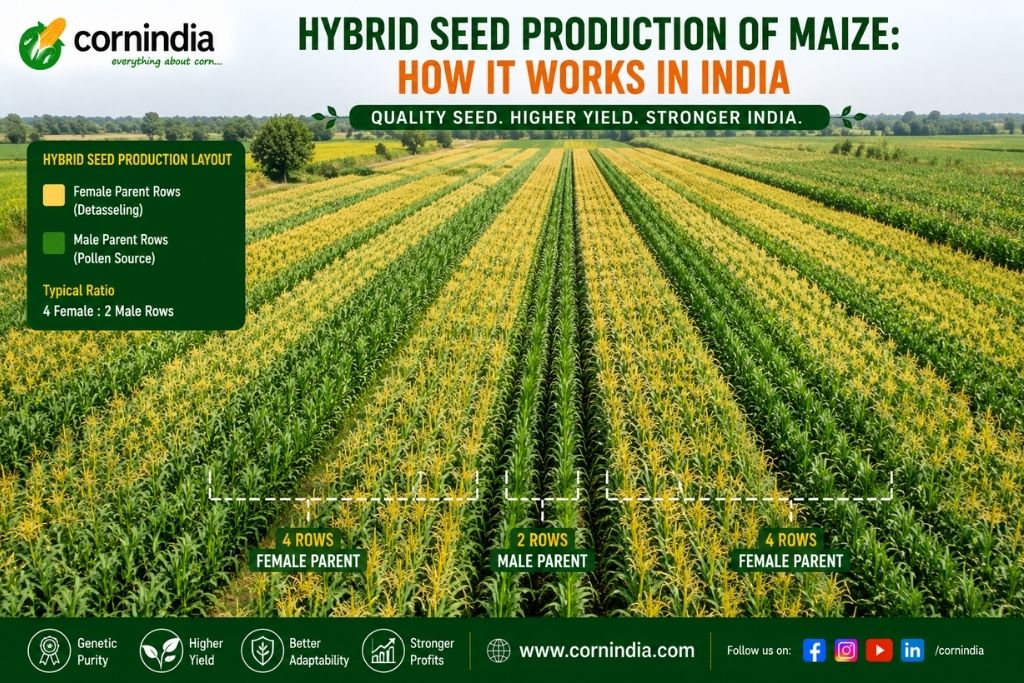
Foundation seed is produced from breeder seed under close supervision, maintaining strict genetic purity. Foundation seed consists of production of single crosses by sowing male and female parents in a 2:4 row ratio. Detasseling is done in female rows after removing off-types, diseased and unwanted plants. Certification is maintained under the guidance of a monitoring team consisting of personnel from the National Seed Corporation, Seed Certification Agencies, breeders from agricultural universities and ICAR nominees.
Foundation seed is produced in relatively small plots — clean, isolated fields under direct technical supervision. The seed from female rows in this plot becomes the foundation seed used to produce certified hybrid seed at commercial scale.
Tier 3: Certified Hybrid Seed
This is the commercial product — what goes into the farmer's seed packet.
For certified seed production, male and female single crosses are sown in a 2:6 or 2:8 row ratio. Female plants are detasseled at the appropriate time after removing all off-types, diseased, and undesirable plants. Certification standards are maintained as per norms under the guidance of the monitoring team. The seed obtained on female rows is called the certified seed.
The ratio matters enormously for economics. A 2:6 ratio means 2 rows of male parent (pollen donor) for every 6 rows of female parent (seed-bearing). The more female rows per male row, the more certified seed you produce per acre of production plot — but you need enough male rows to ensure complete pollination coverage across the female rows.
The Central Operation: Detasseling
Detasseling is the operation that makes hybrid maize seed production unique — and the one that most clearly illustrates the biological ingenuity at the heart of the hybrid system.
Maize is monoecious — meaning each plant has both male (tassel) and female (ear/silk) flowers. For a hybrid seed production field to work, you need to ensure that the female parent rows are pollinated exclusively by pollen from the male parent rows — not from their own tassels or from other female plants.
The solution: physically remove the tassel from every female parent plant before it sheds pollen.
Detasseling is the removal of male inflorescence from the monoecious crop. The time taken for pollen shedding from the tassel is 1–2 days after emergence. Detasseling is done when tassels have emerged from the boot leaf but before anthers have shed pollen. Anthers take 2–4 days to dehisce (open and release pollen) after complete emergence.
The detasseling window is extremely narrow — typically just 7–10 days per field as tassels emerge across the population. Miss it, and your female rows will self-pollinate, producing genetically impure seed that cannot be sold as certified hybrid.
Practical detasseling in Indian seed production fields:
- Scouts walk rows multiple times daily during the tassel emergence window
- Tassels are pulled, cut, or snapped cleanly from the plant as soon as they emerge from the boot leaf
- Any escaped tassels that begin shedding pollen require immediate removal
- Follow-up inspections continue through the pollen-shedding period
Detasseling is labour-intensive — requiring 4–8 person-days per acre across the 7–10 day window. In India's primary hybrid seed production zones (Telangana, Andhra Pradesh, Karnataka), this work is done by local agricultural labour familiar with the operation.
The CMS alternative: The laborious detasseling process can be avoided by using cytoplasmic male-sterile (CMS) inbreds. CMS inbreds are male sterile as a result of genetic factors in the cytoplasm — since only the female provides cytoplasm to the fertilised seed, male sterility is inherited exclusively through the female parent. CMS systems eliminate the need for manual detasseling in female parent rows, reducing labour costs and eliminating the risk of escaped tassels.
CMS-based hybrid seed production is more reliable and cost-effective when properly implemented, but requires maintaining three lines (CMS female, maintainer, and restorer) rather than two — adding complexity to the breeding and seed multiplication system.
The Roguing Requirement
Beyond detasseling, roguing — the physical removal of off-type, diseased, and undesirable plants — is the other critical quality operation in hybrid seed production.
Off-types arise from various sources: genetic contamination from previous crops on the same field, pollen from adjacent fields, or natural mutations. Every off-type plant in a female parent row that reaches maturity produces seed that is genetically impure — and that seed, mixed into the certified lot, reduces varietal purity below certification standards.
Roguing is done at multiple growth stages:
- Pre-flowering: Remove any plants that don't match the female parent's expected morphology (height, leaf shape, colour)
- During detasseling: Remove any plants that are clearly off-types before or alongside tassel removal
- Post-flowering: Remove any female plants that show self-pollination (developing ears before pollen shed was complete)
Good roguing requires trained field scouts who know the specific morphological characteristics of both parent lines — this institutional knowledge is one of the most valuable assets a seed company's production team builds over years.
Where India's Hybrid Maize Seed Is Produced
India's hybrid maize seed production is geographically concentrated — a fact with significant supply chain implications.
To address the challenge of high seed costs largely due to production being concentrated in southern states like Andhra Pradesh and Telangana, ICAR-IIMR partnered with the Department of Agriculture, Government of West Bengal, and the West Bengal State Seed Corporation to standardise hybrid maize seed production across key districts such as Nadia, Jalpaiguri, Cooch Behar, Murshidabad, Paschim Medinipur, and North 24 Parganas. As a result, 32,465 quintals of hybrid seeds have been produced locally over five years for DMRH 1308, DMRH 1301, and LQMH 1.
Southern production zone (dominant): Andhra Pradesh and Telangana — particularly Nizamabad, Guntur, and West Godavari districts — account for the largest share of India's hybrid maize seed production. The dry, sunny conditions during the rabi seed crop season (October–March), reliable irrigation from Krishna and Godavari rivers, and an experienced local contract farming community make this zone ideal for seed production.
Karnataka: A secondary but significant seed production zone, serving companies targeting the Karnataka grain market with locally adapted hybrids.
Punjab (ICAR-IIMR local initiative): ICAR-IIMR's Ludhiana campus initiated hybrid maize seed production in Punjab for its DMRH hybrids, demonstrating that quality seed can be produced locally to reduce the north-south logistics cost burden.
West Bengal (emerging): ICAR-IIMR's West Bengal partnership is establishing a new seed production region in eastern India — reducing seed costs for farmers in Bihar, West Bengal, Jharkhand, and the North East by cutting transport distances from southern production zones.
The geographic concentration in Andhra Pradesh and Telangana creates a structural supply chain risk: adverse weather, labour disruptions, or pest pressure in these states during the seed production season can constrain availability across the entire country. ICAR's geographic diversification initiative directly addresses this vulnerability.
The Contract Farming Model: How Seed Is Actually Grown
Commercial hybrid seed production in India operates almost entirely through contract farming — seed companies don't grow seed themselves on company-owned land. Instead, they:
- Select and approve contract farmers: Typically experienced farmers in established seed production zones with irrigated land, good agricultural practice track records, and no adjacent maize crop (isolation requirement)
- Supply foundation seed: The company provides the male and female parent seed to the contract farmer under strict custody
- Provide technical supervision: Company agronomists visit the production field at every critical stage — establishment, roguing, detasseling, pollination, harvest — to ensure purity standards are maintained
- Purchase at pre-agreed prices: The company buys the harvested seed at a contracted price per quintal, providing income certainty for the farmer
- Process and certify: The harvested seed goes to the company's seed processing plant for drying, shelling, grading, treating, and packaging, followed by seed certification testing
Farmers earning income from seed production — in Nizamabad, Guntur, or West Godavari — typically earn significantly better returns than from commercial grain maize. ICAR-IIMR's demonstration in Punjab showed that farmers can earn net returns of ₹3.75–₹4.0 lakh per hectare from hybrid seed production — more than double what they earn from commercial grain maize cultivation.
Isolation Standards: The Non-Negotiable
Hybrid seed production fields must be isolated from other maize crops to prevent contamination by foreign pollen. Indian certification standards specify:
- Minimum isolation distance: 200–300 metres from other maize fields (for certified seed production). Foundation seed production requires greater isolation.
- Temporal isolation: If spatial isolation is not possible, stagger sowing dates so the flowering periods of the seed production field and neighbouring maize crops don't overlap.
In practice, seed production zones in Telangana and Andhra Pradesh have developed dense clusters of contracted seed production fields — making spatial isolation progressively more challenging as the area under seed production has expanded. This is one reason ICAR's geographic diversification into West Bengal and Punjab is agronomically important, not just economically.
The Seed Certification System
Every lot of certified hybrid maize seed produced in India must pass through the state Seed Certification Agency (SCA) — a statutory body that verifies the seed lot meets minimum germination, purity, and physical quality standards before it can legally be sold as "certified seed."
The certification process involves:
- Field inspections at sowing, knee-high, flowering/detasseling, and pre-harvest stages — verifying isolation distances, roguing status, and plot identification compliance
- Post-harvest seed testing at accredited seed testing laboratories — checking germination percentage (minimum 75–80% for most maize varieties), physical purity (minimum 98%), and moisture content (maximum 12%)
- Tag and label issuance — certified seed lots receive state SCA tags that must be attached to each packet sold to farmers
ISTA accreditation (International Seed Testing Association) is an additional quality marker that major seed companies pursue for their laboratories — it verifies that seed testing methodology meets international standards and is important for export and import of seed.
Quality control is the quiet differentiator in maize seeds, because one failed lot can damage trust for years in a district. ISTA-accredited seed technology laboratories support consistency at scale — a key differentiator for companies like Nuziveedu in a market where counterfeit packs remain a persistent operational threat.
The Market Landscape: Players and Dynamics
India's hybrid maize seed market is moderately consolidated and growing.
The India maize seed market was valued at USD 359.48 million in 2025 and is estimated to grow to USD 500.64 million by 2031 at a CAGR of 5.67%.
The top five companies — Bayer AG, Corteva Agriscience, Kaveri Seeds, Nuziveedu Seeds, and Syngenta Group — together account for 56.72% of the India maize seed market.
The five dominant players:
Bayer AG (DEKALB brand): The largest multinational player in Indian maize seeds. DEKALB's portfolio covers multiple agro-climatic zones with a strong yield performance track record. Bayer benefits from global R&D — but must compete purely through conventional hybrid performance in India, where GM maize remains commercially unapproved.
Corteva Agriscience (Pioneer brand): Pioneer has been one of the most influential companies in shaping India's hybrid maize market. Pioneer Seeds launched 44 new corn seed hybrid varieties with advanced corn technology in March 2023. Pioneer's agronomic support and distribution networks are among the strongest in the industry.
Kaveri Seeds: India's largest domestic seed company by revenue. Kaveri Seeds recorded net sales of ₹808 crore in June 2024, a 5.32% year-on-year growth. Kaveri's strength is in its deep understanding of Indian agro-climatic zones, extensive rural dealer network, and pricing competitiveness against multinational brands.
Nuziveedu Seeds: A major domestic player with strong presence in southern Indian markets. Known for agronomic advisory services and local variety adaptation.
Syngenta: Syngenta established a new seed production facility in Karnataka in March 2024, targeting increased production of specialty hybrids for southern Indian markets with advanced seed processing and quality control technologies.
Beyond the top five: The market also features Bioseed (DCM Shriram), Rasi Seeds, Advanta Seeds (UPL), VNR Seeds, Ankur Seeds, Indo-American Hybrid Seeds, and dozens of regional players. ICAR-IIMR's DMRH 1301 and DMRH 1308 have been licensed to 18 different private seed companies through 24 MoUs, with an estimated cumulative acreage of 11.57 lakh hectares for DMRH 1308 since release. ICAR's public-private licensing model has seeded (literally) many smaller companies with competitive hybrid germplasm.
Emerging Trends in Indian Maize Seed Production
1. Technology in detasseling: In September 2024, PowerPollen and VNR Seeds initiated a pollination-technology pilot in Indian corn seed production, targeting superior hybrid yields through advanced pollen-capture technology. This is the first serious move toward technology-assisted pollination management in India — a space that could reduce detasseling labour costs significantly if scaled.
2. Doubled haploid (DH) technology accelerating breeding: Doubled-haploid platforms trim generation cycles in maize — a technology being adopted by leading Indian seed companies to accelerate their breeding pipelines. What once took 8–10 years to develop a new inbred line now takes 3–4 years with DH technology, compressing the product development cycle.
3. Geographic diversification of production: ICAR's active push to establish hybrid seed production in West Bengal and other non-traditional states is reducing the geographic concentration risk that has long been a vulnerability in India's maize seed supply chain.
4. Marker-assisted breeding: Marker-assisted backcrossing is enabling the insertion of disease resistance and stress tolerance traits into elite hybrid backgrounds with precision, without compromising yield. This is accelerating the introduction of fall armyworm tolerance, drought resistance, and waterlogging tolerance into Indian commercial hybrids.
5. Counterfeit seed — the persistent challenge: Counterfeit seed packs remain a persistent operational threat to every serious player in Indian maize seeds. Fake seed of popular hybrids is a real commercial and agronomic problem — costing genuine companies revenue and occasionally causing significant crop failures for farmers who unknowingly plant substandard seed.
What This Means for Seed Companies and Researchers
For established seed companies: The most defensible competitive position in Indian maize seeds is built on three pillars — a pipeline of locally adapted hybrids backed by DH-accelerated breeding, a reliable and geographically diversified contract seed production network, and a dealer network with strong farmer trust. Companies that own all three pillars compete on performance, not price.
For emerging/smaller seed companies: ICAR's public licensing model — where companies can license proven IIMR hybrids like DMRH 1308 — provides a shortcut to market with proven germplasm. The cost of building a production network is lower than the cost of building a full breeding programme. The constraint is differentiating your product in a market where several companies may be selling the same licensed hybrid.
For researchers: The two most commercially valuable research areas in Indian maize seed production right now are: DH line development technology (reducing breeding cycle to <4 years) and genomic selection for environment-specific trait prediction (reducing the number of field trial seasons needed to identify the best hybrid for a specific agro-climatic zone). Both can compress the time-to-market for new hybrids significantly.
Final Thoughts
India's hybrid maize seed industry is a sophisticated, technically demanding, commercially dynamic sector that most people in the maize industry interact with at the output end — the seed packet — without understanding what went into producing it.
With the India maize seed market growing at 5.67% CAGR toward USD 500 million by 2031, driven by ethanol blending, poultry feed expansion, and continuous hybrid innovation, the competitive intensity will only increase. The seed companies and researchers that understand the full production system — from inbred line development to detasseling protocols to certification compliance — are the ones best positioned to build lasting advantage in this market.
At CornIndia, we work across India's maize ecosystem and follow seed technology, breeding, and market developments closely. If you're working in hybrid seed production or research, we'd welcome the conversation.
Related reads on CornIndia: Maize Hybrid vs Open-Pollinated Varieties: Pros and Cons | Quality Protein Maize (QPM): The Nutrition Story No One Tells | Waxy Corn and High Oil Corn: Emerging Varieties in India







0 Comments