
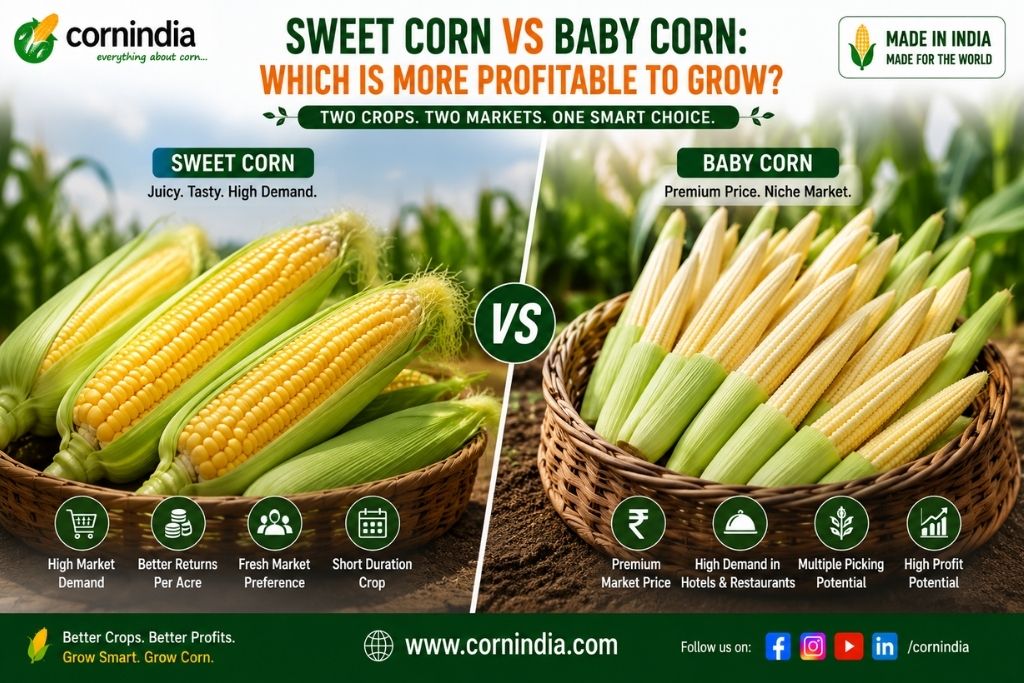
If you're a maize farmer thinking about upgrading from field corn to a higher-value crop, sweet corn and baby corn are both attractive options. Both earn significantly more than commodity grain maize. Both sell as vegetables rather than grain, which means better prices. And both have growing demand from urban markets, food processors, and export buyers.
But they're not the same crop, and they don't suit the same farmer, farm, or market situation.
This post does what most farming guides don't: puts both crops side by side on the same page, with real income numbers, honest cost breakdowns, and a clear framework for deciding which one is right for your specific situation.
Table of Contents
The Quick Answer — And Why It's Incomplete
Sweet corn typically earns more per crop cycle. Baby corn earns more per year.
That one-line summary is accurate — but it misses most of what actually matters when you're deciding which crop to grow. What matters equally:
- How many cycles per year can your land, water, and market support?
- What's your buyer situation — do you have one secured, or are you selling at the mandi?
- How much labour can you manage, and how intensively?
- Are you targeting fresh markets, processors, or export?
The right answer for a 2-acre farmer in Karnataka with direct hotel relationships looks completely different from the right answer for a 20-acre farmer in Bihar growing for an FPO processor contract.
Let's build up the full picture.
Income and Profitability: The Numbers
Sweet Corn
A farmer can earn anywhere between ₹50,000 to ₹1,00,000 in an acre of sweet corn after growing expenses. The crop is harvested within 70–80 days of seeding. The earnings depend on yield and the market price.
Real-world data from farmer case studies validates this range. Ramesh Chauhan, a farmer from Haryana's Palwal district who transitioned from paddy to sweet corn, earns around ₹1 lakh per acre in 70 days. His production costs are approximately ₹20,000 per acre, leaving him with a profit of ₹75,000–₹80,000. He sells sweet corn at ₹15 per kilogram and is optimistic about reaching ₹1.5 lakh per acre as market prices rise.
Breaking this down per acre, per cycle:
| Item | Estimate |
|---|---|
| Crop duration | 70–80 days |
| Fresh cob yield | 8–12 tonnes/acre |
| Farm gate price (open market) | ₹7–₹20/kg |
| Farm gate price (processor/hotel) | ₹15–₹32.5/kg |
| Gross income (mid estimate, 10t at ₹12) | ₹1,20,000 |
| Cost of cultivation | ₹20,000–₹28,000 |
| Net profit per acre per cycle | ₹50,000–₹1,00,000 |
| Cycles per year | 2 (kharif + rabi or rabi + spring) |
| Annual net income per acre (2 cycles) | ₹1,00,000–₹2,00,000 |
Baby Corn
Baby corn economics work differently. The income per individual cycle is somewhat lower than sweet corn, but the number of cycles per year is higher — up to 3–4 — and each cycle also generates fodder income from the plant stover.
| Item | Estimate |
|---|---|
| Crop duration | 55–65 days per cycle |
| Cycles per year | 3–4 |
| Unhusked yield (standard population) | 4–5 tonnes/acre |
| Unhusked yield (high population) | 8–10 tonnes/acre |
| Farm gate price (fresh, husked) | ₹15–₹40/kg |
| Farm gate price (processor/export) | ₹40–₹80/kg (IQF/canned) |
| Cost of cultivation per cycle | ₹20,000–₹28,000/acre |
| Net income per cycle (standard pop) | ₹20,000–₹40,000 |
| Net income per cycle (high pop + processor) | ₹35,000–₹55,000 |
| Fodder income per cycle | ₹3,000–₹8,000 |
| Annual net income per acre (3 cycles) | ₹75,000–₹1,80,000 |
At a glance: Sweet corn earns more per cycle. Baby corn, with 3–4 cycles, can match or exceed sweet corn's annual income — especially if processor prices are secured.
What the Comparison Misses: The Market Risk Dimension
The profitability numbers above look similar. But they hide a critical difference in risk profile.
Sweet corn has a longer shelf life but a narrower buyer window. A sweet corn cob at milk stage should reach the buyer within 24–48 hours for best quality. However, sweet corn can be sold to a wider variety of buyers — fresh vegetable mandis, hotel chains, canteen contractors, sweet corn stall owners, and food processors. If one buyer cancels, you have alternatives.
Baby corn has an even shorter shelf life and requires more precise buyer commitment. Baby corn must be harvested every 2–3 days as successive ears emerge. It deteriorates rapidly at ambient temperature. If you don't have a committed buyer, cold storage access, or proximity to a processor — baby corn will leave you in distress sale territory more quickly than sweet corn. The short shelf life and multiple-picking harvest window requires stronger logistics and buyer commitment than sweet corn.
This is why the three questions most relevant to profitability are not about yield — they're about market:
Question 1: Do you have a buyer commitment before sowing? Both crops require this. But baby corn requires it more urgently — because the harvest frequency and perishability give you less time to find a buyer after you start picking.
Question 2: Is your buyer at mandi prices or processor/direct prices? This is the single biggest driver of the income range. Sweet corn at ₹7/kg and at ₹32.5/kg are the same crop — just sold to different buyers. Baby corn at ₹15/kg fresh and at ₹80/kg canned are entirely different income outcomes. The farmer with processor or direct relationships consistently realises the upper end of the range. The farmer selling at the open mandi gets the lower end — and may barely cover costs in bad price years.
Question 3: Can you manage the harvest frequency? Sweet corn: one main harvest over 2–5 days. Baby corn: 7–8 pickings over 3–4 weeks, every 2–3 days.
For a farmer with limited household labour and no hired help reliably available, baby corn's multiple-picking schedule can become a problem. Missing even one picking window because labour didn't show up means those ears become over-mature and unmarketable — a direct yield and income loss.
m ,
Agronomic Comparison: Which Is Harder to Grow?
Both crops are more demanding than field corn. But in different ways.
| Factor | Sweet Corn | Baby Corn |
|---|---|---|
| Crop duration | 70–80 days | 55–65 days |
| Key timing challenge | Harvesting at milk stage (18–21 days post-silk) | Detasseling on time; picking at 1–2cm silk |
| Irrigation | Moderate — critical at tasselling/silking | Moderate — critical at knee-high and ear fill |
| Labour intensity | Moderate (one main harvest) | High (multiple pickings; detasseling required) |
| Season flexibility | Kharif + Rabi | Year-round (except Dec–Jan in most regions) |
| Variety selection | Critical — only sweet corn varieties work | Flexible — most early-maturing maize works |
| Isolation from field corn | 400–500m or 3-week stagger | Same requirement |
| Pest pressure | Same as field corn | Same as field corn |
| Post-harvest handling | 24–48 hour shelf life | 12–24 hour optimal freshness window |
The critical difference: Baby corn requires detasseling — a labour-intensive daily operation during the tassel emergence window (about 7–10 days per cycle). Sweet corn does not require detasseling. If you're managing a large area of baby corn, detasseling labour planning is non-negotiable.
The sweet corn advantage: One crop cycle gives you one concentrated harvest event. This is logistically simpler. You harvest over 2–5 days, move the product, and you're done. Baby corn keeps requiring your attention across 3–4 weeks of picking per cycle.
Which Crop for Which Farmer?
Here's a practical decision framework:
Sweet corn is probably the better choice if you:
- Are trying specialty corn for the first time — one crop per season, one harvest window, simpler operations
- Have a direct hotel, restaurant, or mandi relationship where you can sell fresh cobs regularly
- Farm in a region with good sweet corn market access — urban centres, hotel clusters, food processing zones
- Have 1–5 acres dedicated to the crop — sweet corn's economics work well at this scale without requiring elaborate logistics
- Want to grow 2 cycles per year (kharif + rabi) on irrigated land for maximum income within manageable complexity
Baby corn is probably the better choice if you:
- Have secured a processor, canning company, FPO, or export buyer before sowing — the higher price realisations at processor level make baby corn significantly more attractive than open mandi prices
- Can commit daily labour during detasseling and picking windows — family labour or reliable hired labour is essential
- Want 3–4 cycles per year and maximum land utilisation — baby corn's short cycle is its biggest asset for intensive farmers
- Have or can access cold storage within 10–15 km of your farm — it extends your selling window and reduces distress sale pressure dramatically
- Are part of an FPO or farmer cluster where collective harvesting logistics and aggregation make the frequent picking schedule manageable at scale
Both work well if you:
- Have direct processor or food company relationships — both crops command premium prices when sold to processors rather than mandis
- Are in a contract farming arrangement — both sweet corn and baby corn are commonly grown under contract, where the buyer specifies quality and the price is fixed before sowing
- Are growing for an urban fresh vegetable market with good daily or twice-weekly delivery routes
The Agri-Business Perspective
For agri-businesses — aggregators, FPOs, processors, cold chain operators — both crops represent meaningful business opportunities, but in different supply chain configurations.
Sweet corn is better suited to:
- FPO-level fresh market aggregation (one seasonal buying window, good volume per transaction)
- Food processing (frozen sweet corn, canned sweet corn) as a seasonal pack
- Hotel and restaurant supply contracts where consistent weekly volumes are needed
Baby corn is better suited to:
- Year-round supply contracts with food service, hotel chains, and institutional buyers
- Export-oriented processing (canned, frozen, IQF baby corn) where year-round supply is a key buyer requirement
- Value-added processing operations seeking to maximise throughput per year — baby corn's 3–4 annual cycles keep a processing facility running far longer than sweet corn's 1–2 seasonal windows
India's corn market was valued at USD 1.46 billion in 2024 and is anticipated to reach USD 2.30 billion by 2030 at a CAGR of 7.86% — with sweet corn and baby corn as the fastest-growing premium segments within this market. For agri-businesses building supply chains in either crop, the market growth trajectory over the next 5 years is strongly supportive.
The most attractive agri-business model in both crops: build a farmer cluster + cold chain + quality grading + direct institutional buyer supply chain. This configuration captures the premium pricing that processors and hotel chains pay, distributes it more directly to farmers, and builds a sustainable income stream that avoids mandi price volatility entirely.
The Annual Income Comparison: Putting It All Together
Here's a direct annual income comparison across different scenarios:
| Crop | Cycles/year | Market channel | Cost/acre/year | Gross income/acre/year | Net profit/acre/year |
|---|---|---|---|---|---|
| Sweet corn | 2 | Open mandi (₹8/kg) | ₹50,000 | ₹1,20,000 | ₹70,000 |
| Sweet corn | 2 | Processor/hotel (₹20/kg) | ₹55,000 | ₹3,00,000 | ₹2,45,000 |
| Baby corn | 3 | Open mandi (₹15/kg fresh) | ₹70,000 | ₹1,50,000 | ₹80,000 |
| Baby corn | 3 | Processor (₹50/kg IQF) | ₹80,000 | ₹3,75,000 | ₹2,95,000 |
| Baby corn | 4 | Processor (₹50/kg IQF) | ₹95,000 | ₹5,00,000 | ₹4,05,000 |
| Field corn (reference) | 2 | Mandi (MSP ₹2,400/qtl) | ₹50,000 | ₹1,20,000 | ₹70,000 |
The most important number in this table: the difference between mandi prices and processor/direct prices dwarfs everything else. A sweet corn farmer selling at ₹8/kg earns the same annually as a field corn farmer. The same sweet corn farmer selling at ₹20/kg to a hotel earns 3.5× more.
The market channel is not a secondary consideration — it's the primary one.
Which Crop Has Better Market Growth?
Both crops are benefiting from the same macro trends: India's urbanisation, the growth of organised food service (quick-service restaurants, cloud kitchens, institutional catering), and the expansion of food processing.
Sweet corn has stronger consumer brand recognition — most urban Indians know what sweet corn is, eat it at restaurants, and are comfortable paying for it. This makes sweet corn easier to sell at retail level.
Baby corn has stronger export and institutional market positioning — it's a year-round supply crop with established global markets (canned baby corn exports to 164+ countries), which gives it structural demand advantages for exporters and processors.
The practical implication: if you're building a domestic fresh market business, sweet corn's brand recognition gives it an edge. If you're building an export or food processing supply chain, baby corn's year-round production and established global demand give it an edge.
The Honest Bottom Line
On pure per-crop-cycle profitability: Sweet corn wins. On annual per-acre income potential with 3–4 cycles: Baby corn can match or exceed it. On market risk and operational simplicity: Sweet corn is lower risk and simpler. On supply chain leverage and processing value: Baby corn at processor prices is exceptional. For first-time specialty corn farmers: Sweet corn is the safer, simpler starting point. For experienced farmers with processor relationships and reliable labour: Baby corn's multiple annual cycles deliver outstanding annual returns.
The honest answer to "which is more profitable?" is: whichever one you can sell at premium prices. Both crops are only significantly more profitable than field corn when they access better market channels. Both earn commodity-level returns when they end up at the open mandi.
Before you choose between sweet corn and baby corn, choose your buyer. Then work backwards to which crop fits that buyer's requirements, your farm's capabilities, and your team's capacity for the operational demands each brings.
At CornIndia, we work with farmers and agri-businesses on both crops — variety selection, agronomic guidance, and buyer connections. If you're making this decision for your farm or building a supply chain in either crop, we'd be glad to help you think it through.
Related reads on CornIndia: How to Grow Sweet Corn in India: A Step-by-Step Guide | Baby Corn Cultivation: Everything You Need to Know | Sweet Corn vs Field Corn: What's the Real Difference?








0 Comments