
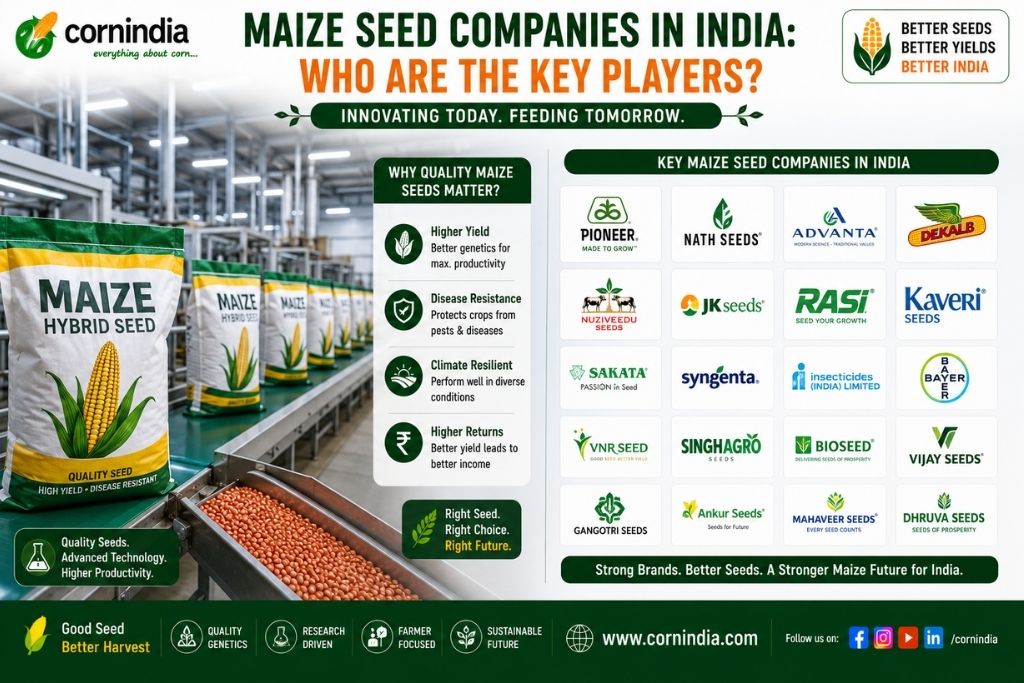
Behind every packet of hybrid maize seed a farmer buys is a company with decades of breeding history, a distribution network built over years, and increasingly, a specific technology bet on where Indian agriculture is heading. Some of these companies are global agricultural giants with research budgets larger than most Indian agri-businesses' total revenue. Others are homegrown companies that understood Indian growing conditions before the multinationals arrived — and never lost that edge.
This post profiles the companies that actually shape what seed reaches Indian maize fields — multinationals and domestic leaders side by side, plus the partnerships and licensing deals currently reshaping the competitive landscape.
The Market, in Brief
The India maize seed market was valued at USD 359.48 million in 2025, and is estimated to grow to USD 500.64 million by 2031, at a CAGR of 5.67%. The market is moderately consolidated, with the top five companies occupying 56.72% combined — Bayer AG, Corteva Agriscience, Kaveri Seeds, Nuziveedu Seeds, and Syngenta Group.
Bayer AG and Syngenta Group alone collectively capture over 40% of the market. Hybrids dominate breeding technology with a 65.60% share in 2025, reflecting farmers' consistent preference for higher yield potential over open-pollinated alternatives.
The competitive dynamics are shaped by a combination of organic growth strategies and strategic acquisitions, though large-scale mergers and acquisitions have been relatively limited in recent years — leaving meaningful room for regional players to maintain strong positions in their specific agro-climatic territories. This is the key structural fact about this market: it's genuinely competitive, not a two-or-three-company oligopoly, and regional specialisation is a real, sustainable strategy — not just a survival tactic for smaller players.
The Multinationals
Bayer AG (DEKALB brand)
Bayer's Indian maize business operates through its DEKALB brand — the legacy of Monsanto's maize seed business, which Bayer inherited through its global Monsanto acquisition. Bayer, sitting among the top companies in India's seed industry, holds major influence over maize, cotton, and vegetables through genetically modified, high-performance hybrid seeds rich in biotechnology, with a large focus on digital farm management tools and precise seed placement to push farmer productivity further.
Globally, Bayer continues to push its maize genetics pipeline forward — the company launched an early-maturity, high-performance corn variety in international markets in October 2022, part of its ongoing hybrid development programme that eventually filters into markets like India. In India specifically, DEKALB hybrids are positioned around consistent yield performance and are among the most recognised commercial hybrid brands in the country.
Corteva Agriscience (Pioneer brand)
Born from the merger of Dow and DuPont, Corteva Agriscience expanded rapidly in India, specialising in hybrid seeds for crops including corn, rice, and millet. The company maintains a research centre in Telangana developing plant varieties specifically to address pests, drought, and other challenges facing Indian agriculture.
Corteva's Pioneer brand has been one of the most agronomically influential names in Indian maize for decades, with deep farmer relationships built around consistent agronomic support alongside seed sales. The company has continued pushing new hybrid technology — Pioneer Seeds, a Corteva subsidiary, launched 44 new corn seed hybrid varieties featuring new Vorceed Enlist corn technology aimed at managing corn rootworm, and Corteva introduced gene-editing technology in March 2023 to add multi-disease protection to corn hybrids globally. How much of this specific technology reaches Indian farmers depends on India's regulatory stance on gene-edited and biotech traits — but it signals where Corteva's global maize R&D is headed.
Syngenta Group
Syngenta is the answer to what a global giant becoming genuinely local looks like — a company famous worldwide, but working specifically on seed solutions suited to India. Syngenta's product range, from hybrid rice and maize to nutrient-rich vegetables, is built to survive both physical and biological stressors including high temperature, drought, and disease. The company positions itself as delivering results, not just seed.
Syngenta India combines crop protection and seed businesses to offer integrated agricultural solutions, with a strong hybrid corn, rice, and vegetable seed portfolio targeting both commercial farming operations and smallholder segments — leveraging its global R&D pipeline and proprietary seed treatment technologies to deliver differentiated products. Syngenta established new maize seed production capacity in Karnataka in 2024, specifically to increase output of specialty hybrids for southern Indian markets — a clear signal of regional-specific investment rather than a one-size-fits-all national strategy.
Advanta Seeds (UPL)
Advanta Seeds carries a strong global reputation for crop seed solutions, particularly in maize, sorghum, oilseeds, and field crops, with its focus on seed research and crop genetics helping farmers achieve more consistent field performance. Now under UPL's ownership, Advanta brings a distinct positioning in India's maize market — historically strong in sorghum and dryland crop genetics, which carries over into maize hybrids suited to more moisture-stressed growing zones.
Groupe Limagrain
A less prominently discussed but genuinely active player in Indian maize seed, Limagrain brings European cooperative-owned breeding heritage and a global maize genetics base to the Indian market, competing primarily in the mid-tier commercial hybrid segment.
The Domestic Leaders
Kaveri Seeds
Founded in 1976, Kaveri Seed Company has grown into one of India's leading suppliers of hybrid seeds, focused on crops including cotton, maize, and rice. The company's strong R&D capabilities have produced high-quality seeds that help farmers combat pests and environmental stress, with operations spanning 18 states and multiple processing plants serving farmers nationwide.
Since its inception, Kaveri has been recognised for precise hybridisation methods and for producing some of farmers' most preferred maize seed in recent years, without relying on hype — its mainstay is more than 600 acres of dedicated R&D farmland for on-field testing and adaptive breeding.
Kaveri Seed Company announced a strategic shift in its business model in 2025, aiming to strengthen its non-cotton seed portfolio — part of an effort to reduce dependence on cotton seeds and target double-digit growth alongside margin recovery. This is directly relevant for maize: as Kaveri diversifies away from cotton concentration, maize is one of the crop categories positioned to receive increased investment and focus.
Nuziveedu Seeds
Founded in 1973 and based in Hyderabad, Nuziveedu Seeds is one of India's largest and most recognised seed suppliers, known for high-quality seeds across cotton, rice, vegetables, and maize. The company operates Seed Technology Labs that rigorously test seed quality, ensuring farmers receive consistently reliable product.
Nuziveedu's defining factor is its emphasis on farms — on-the-ground experimentation, farmer feedback loops, and a vast rural distribution network. It has never been about scale or marketing hype, but continuous, reliable field results that farmers value most.
Beyond maize specifically, Nuziveedu has demonstrated a broader pattern of public-private research collaboration relevant to how it may approach maize breeding partnerships going forward — the company established a partnership with the Indian Agricultural Research Institute (IARI) to develop advanced pigeon pea varieties, an example of the kind of public-private research collaboration increasingly shaping Indian seed innovation.
Rasi Seeds
Established in 1973, Rasi Seeds is renowned for producing high-yield seeds across various agro-climatic conditions, with a direct farmer-interaction approach through its Rasi Mitra programme focused on improving productivity and sustainable agricultural growth.
Rasi, based in Tamil Nadu, is usually the preferred choice among cotton farmers nationally, but has steadily built its presence in maize, bajra, paddy, and vegetable hybrids since 1973 — extending well beyond its original crop focus. The company's commitment doesn't end with product diversity; it also provides one of the most extensive farmer support systems in the industry.
VNR Seeds
Founded in 1998 and based in Chhattisgarh, VNR Seeds has become a major player producing and marketing hybrid seeds suited to India's diverse climates and soils. The company made a significant leap in 2023 with the establishment of the country's largest seed processing facility in Raipur.
VNR's most notable recent move for maize specifically is technological: PowerPollen's collaboration with VNR Seeds brings pollen-capture technology to corn seed production, boosting hybrid vigour and seed set efficiency — a partnership specifically aimed at improving corn crop yields for Indian farmers, positioning VNR at the front edge of pollination technology adoption in Indian hybrid maize seed production.
DCM Shriram Ltd (Bioseed)
Bioseed, DCM Shriram's seed business, maintains a meaningful maize presence with a track record built on regional adaptation across multiple Indian growing zones — a domestic conglomerate-backed player competing on genetics and distribution depth rather than global R&D scale.
JK Agri Genetics
Since its inception in 1989, JK Agri Genetics has been a key player producing hybrid seeds, particularly in cotton, maize, and rice, emphasising sustainable breeding techniques and advanced research to develop new crop varieties.
Ankur Seeds
A significant player particularly active in central and western Indian maize markets, competing on regional hybrid adaptation and established dealer relationships.
Recent Developments Reshaping the Landscape
Three types of change are actively reshaping who competes for Indian maize farmers' seed purchases — and how.
1. Public-private licensing is lowering the barrier to entry
Public institutions increasingly license pre-breeder material under liberalised terms, spawning a wave of small and medium enterprises specialising in niche crops. ICAR-IIMR's hybrid licensing model — covered in our earlier post on hybrid seed production — has licensed proven hybrids like DMRH 1308 to 18 different private companies through 24 separate MoUs. This model means smaller seed companies don't need decades of breeding investment to enter the maize market with a competitive, proven hybrid — they need a production and distribution network, and a licensing agreement.
2. Technology partnerships are becoming a genuine differentiator
VNR Seeds' PowerPollen partnership is the clearest example: rather than building pollination technology in-house, VNR is partnering with a specialist technology provider to gain a specific production efficiency edge. Doubled-haploid platforms are trimming generation cycles in maize breeding across the industry — a technology increasingly licensed or partnered for, rather than developed from scratch, even by well-resourced companies.
3. Domestic players are actively diversifying away from single-crop dependence
Kaveri's 2025 strategic pivot away from cotton concentration and toward its non-cotton portfolio (including maize) reflects a broader pattern: domestic seed companies that built their scale on cotton in the 2000s and 2010s are now recognising maize's growth trajectory — driven by ethanol blending demand, poultry feed expansion, and rising MSP support — as a more durable long-term growth category than cotton, where genetic and market saturation has slowed growth.
4. Regional specialty hybrid investment continues
Syngenta's 2024 Karnataka production facility expansion, specifically targeting specialty hybrids for southern Indian markets, illustrates that even global players are choosing regional specialisation over one-size-fits-all national product strategies — a validation of the "regional players hold strong positions in specific agro-climatic zones" pattern that defines this market's competitive structure.
What This Means for Different Readers
If you're a seed company evaluating India's maize market: The moderate consolidation (top five at ~57% share, no single dominant player) means genuine competitive entry is possible — particularly through ICAR public licensing partnerships, which lower the capital barrier that historically favoured only well-funded multinationals. Regional specialisation, rather than attempting national scale immediately, is a validated strategy that established players like Rasi, Kaveri, and Syngenta's Karnataka investment all demonstrate.
If you're an agri-business evaluating supply partnerships or distribution: Multinationals bring proven genetics and biotech trait pipelines but often work through established, sometimes rigid distribution frameworks. Domestic leaders (Kaveri, Nuziveedu, Rasi) typically offer deeper regional agronomic relationships and more flexible engagement for aggregators and processors building direct farmer sourcing networks.
If you're tracking where innovation is headed: Watch the technology partnership space closely — PowerPollen-VNR's pollination technology, doubled-haploid breeding acceleration, and ICAR's expanding public licensing network are the three trends most likely to reshape competitive positioning over the next 3-5 years, more than any single company's marketing or distribution scale.
Final Thoughts
India's maize seed industry is neither a multinational-dominated market nor a purely domestic one — it's a genuinely mixed competitive landscape where global R&D depth and domestic agro-ecological knowledge both matter, and where public sector breeding institutions (ICAR-IIMR chief among them) increasingly function as a technology source that both multinationals and small domestic entrants can build upon.
For farmers, this competitive diversity is generally a good thing — it means genuine choice, regional-specific hybrid options, and continuous innovation pressure across the industry. For agri-businesses and seed companies themselves, understanding this landscape — who's strong where, who's partnering with whom, and where the public licensing opportunities sit — is foundational to any serious strategy in India's maize seed market.
At CornIndia, we track this competitive landscape closely as part of our broader coverage of India's maize ecosystem. If you're evaluating partnerships, distribution strategy, or market entry in this space, we'd welcome the conversation.
Related reads on CornIndia: Hybrid Seed Production of Maize: How It Works in India | Maize Hybrid vs Open-Pollinated Varieties: Pros and Cons | Top 10 Maize-Producing States in India




0 Comments