
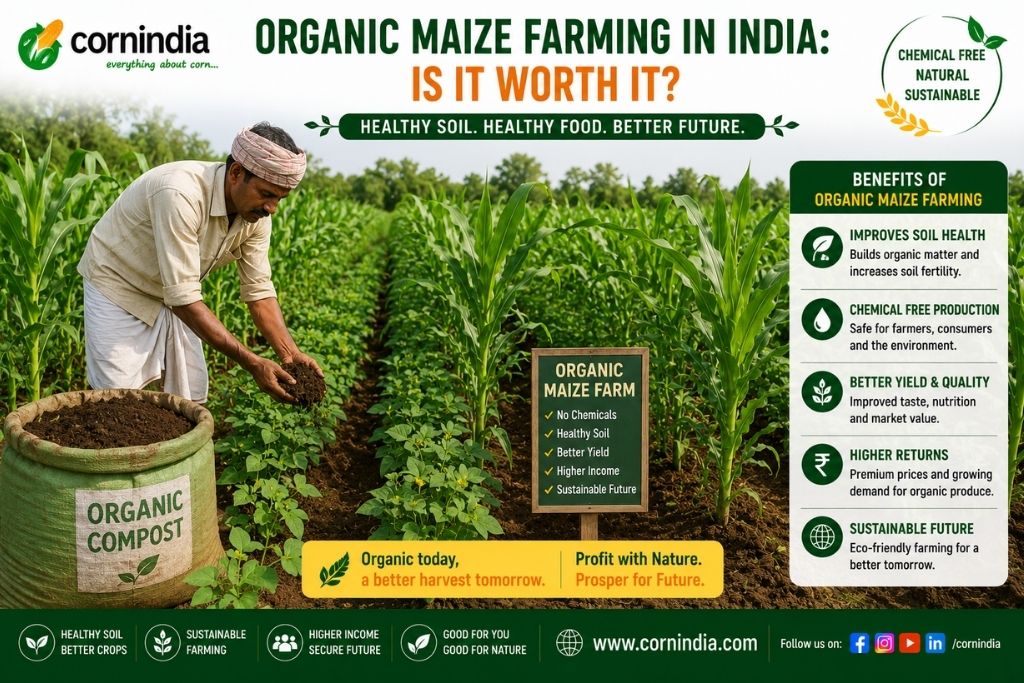
Ask most people what organic farming offers and you'll get a version of the same pitch: lower input costs, healthier soil, premium prices, growing demand. All of that is true — under the right conditions. What often gets left out is a harder truth: for a meaningful number of Indian farmers who've made the switch, the premium prices never fully arrived, and the yield gap took years to close.
This post gives you both sides honestly, with real numbers, so you can make a genuinely informed decision for your own maize farm — not a decision based on either organic farming's most enthusiastic advocates or its harshest critics.
What "Organic Maize Farming" Actually Means
Organic maize farming means growing your crop without synthetic fertilisers, synthetic pesticides, or genetically modified seed — relying instead on farmyard manure, compost, biofertilisers (Azospirillum, PSB), botanical pest control (neem-based sprays), crop rotation, and other natural soil and pest management practices.
To sell your maize as certified organic in India, you typically need one of two certification routes:
NPOP (National Programme for Organic Production): Third-party certification, recognised for both domestic and export markets. Obtaining NPOP certification can cost ₹25,000 to ₹40,000 per year, including audits and paperwork expenses that most marginal farmers cannot afford on their own.
PGS-India (Participatory Guarantee System): A decentralised, community-based certification model where farmers certify each other's produce through peer review and group assessment, verified by a PGS Regional Council — a genuinely low-cost alternative to NPOP, with over 12.88 lakh hectares currently certified under PGS-India Organic nationally. The trade-off: PGS is recognised for domestic markets but not accepted for exports, which limits income diversification for certified farmers. PGS-India also faces the challenge of lower market visibility, since leading retailers and institutional buyers often prefer third-party NPOP certification.
We won't go deeper into certification mechanics here — the more important question is whether the underlying farming economics justify the switch in the first place, certification aside.
The Yield Question: What Actually Happens to Your Harvest
This is where most farmers' real anxiety about organic conversion lives, and it deserves a straight answer.
Yes, yields typically drop during transition — but the size and duration of that drop varies enormously by region and management.
In a ten-year comparative study, organic maize saw an average production decrease of just 3% compared to conventional maize over the full period — though individual years varied. Regular weather conditions produced higher yields for conventional agriculture, but organic systems performed far better during drought conditions, outyielding conventional by around 30% in dry years. This drought-resilience finding matters enormously for India's largely rain-fed maize belt, where erratic monsoon performance is the single biggest yield risk every season.
In Indian field trials specifically: A comparative economics study found the benefit-cost ratio for organic maize was 1.37, notably higher than the 1.12 ratio recorded for conventional maize farming in the same region — indicating organic maize was economically more efficient per rupee invested, not just in absolute yield terms.
But this isn't universal. In tropical and subtropical regions where pest pressure is manageable through biological means and soil organic matter is naturally higher, organic systems tend to reach yield parity faster. India's north-eastern hill states, which already practise low-input agriculture by tradition, find the transition to certified organic production far smoother — both agronomically and economically. In contrast, in irrigated, high-input agricultural zones such as Punjab or the Indo-Gangetic plains, the yield drop during organic conversion tends to be larger and takes longer to recover.
The practical implication: where you farm and how input-intensive your current system already is matters more than any generic "organic yields X% less" statistic you'll find online. A rain-fed maize farmer in a hill state with naturally low chemical input use has a much easier organic transition than an irrigated Punjab farmer running a high-fertiliser, high-pesticide conventional system.
The Economics: Where the Real Money Question Lives
Yield is only half the profitability equation. The other half — cost structure and price realisation — is where organic farming's genuine economic case either holds up or falls apart.
Lower input costs are real
Reduced labour, fertiliser, and pesticide costs, together with somewhat increased seed and equipment costs in some systems, are the main factors contributing to organic production's lower overall cost of production. Labour costs in organic systems are often higher per operation, but organic labour peak times differ from conventional farming's peak periods — which can make it possible to hire labour at lower rates during those different windows.
For maize specifically, you're saving on: synthetic urea, DAP, MOP, and chemical pesticides/fungicides — inputs that, as covered in our fertiliser guide, can represent a significant share of your total cultivation cost. You're adding cost in: compost/FYM sourcing and application (if not self-generated on-farm), biofertiliser inputs, and potentially more labour-intensive weed management without herbicides.
The premium price is the linchpin — and it's not guaranteed
Here is the single most important honest point in this entire post: organic farming's profitability case depends almost entirely on securing a genuine price premium. Without it, the economics frequently don't work.
Over a ten-year period in one comparative analysis, organic maize proved to be 25% more lucrative than conventional maize, even after accounting for a substantial price premium of up to 140% built into the analysis. That's a powerful result — but it assumes the premium was actually realised in the market. This is exactly where many Indian organic farmers' real-world experience diverges from the theoretical case.
The cautionary example: In Sikkim — India's first fully organic state — farmers report being unable to charge a premium price for their produce, which is usually the expected norm for organic output. One farmer growing maize alongside cardamom, millets, and buckwheat noted that his crop yield has stabilised since converting to organic in 2010, but it still does not earn him a higher price. Middlemen he sells to don't distinguish between organic and conventional produce when setting the price they pay.
This is a critical, sobering data point. Sikkim is India's flagship organic success story at the policy level — its complete shift to organic in 2016 improved biodiversity and eco-tourism — and yet individual farmers, particularly those growing staple crops like maize rather than the state's flagship export crops (cardamom, ginger, turmeric), report not capturing the premium that organic farming is supposed to deliver.
Why the premium fails to materialise for many farmers:
- Rural consumers and farmers themselves often lack awareness of organic products' value — this knowledge gap creates a fundamental disconnect in the supply chain, where farmers grow organic but don't know how to market it as such, and buyers don't know or care to ask.
- State marketing initiatives for organic produce frequently lag due to funding constraints, with promotional focus concentrated on a handful of high-value export crops rather than staple grains like maize.
- Without a direct buyer relationship (a processor, a health-food brand, an export aggregator, or a certified retail chain), organic maize sold through ordinary local traders or mandis is very likely to be priced identically to conventional maize — because the buyer has no reason, mechanism, or incentive to pay more for something they can't verify or don't value.
Where the premium does work: Madhya Pradesh's organic soybean clusters under PGS-India demonstrate that ensuring higher returns to smallholders is achievable — but this success is tied to organised clusters with dedicated market linkages, not individual farmers selling into generic local markets. The pattern that emerges: premiums materialise reliably when farmers are organised into clusters or FPOs with a specific buyer relationship already built — not when an individual farmer converts to organic and hopes the market will notice and pay more.
The Realistic Cost-Benefit Picture for Maize Specifically
Putting the yield and price data together, here's the honest range of outcomes:
Best case (strong premium secured, favourable growing region): Lower input costs + a genuine 20-30%+ price premium from a committed buyer + modest or no yield penalty (especially in rain-fed, naturally low-input zones or drought years) = meaningfully higher net income than conventional maize. This is the scenario supported by the 1.37 vs 1.12 benefit-cost ratio finding and the ten-year "25% more lucrative" analysis.
Middle case (partial premium, mixed yield results): Lower input costs largely offset by a modest yield reduction (5-15%) and only a small or inconsistent price premium — net income roughly comparable to conventional farming, with the main benefit being reduced input cost volatility and improved long-term soil health rather than a dramatic income jump.
Worst case (no premium captured, high-input region): Yield gaps of 24-33% common in input-intensive conventional systems converting to organic, combined with no meaningful price premium (the Sikkim maize experience) = genuinely lower income than conventional farming, at least until (and unless) a real market linkage is established.
The determining factor across all three scenarios isn't the farming practice itself — it's whether you have a secured buyer willing to pay a premium before you convert, not after.
Practical Guidance: Is It Worth It for Your Farm?
If you're a small/marginal farmer considering organic as a niche strategy:
Before converting, answer this question honestly: do you already have, or can you realistically build, a direct relationship with a buyer who will pay a verified premium for organic maize? This could be a health food brand, an organic-certified feed company, an export aggregator, or a retail chain with organic sourcing programmes.
If yes — and especially if you can join or form an FPO/cluster with other farmers to meet that buyer's volume requirements — organic maize is a genuinely strong opportunity. The lower input costs, the premium, and increasingly favourable government support (PKVY subsidies for inputs, certification, and training) stack in your favour.
If no — converting to organic maize on the hope that a premium market will materialise is a real financial risk. You may end up, like the Sikkim maize farmers, growing to organic standards and selling at conventional prices, which is the worst of both worlds: you've absorbed the transition-period yield risk and lost access to cheaper synthetic inputs, without capturing any of the upside that's supposed to justify the trade-off.
If you're already practising low-input or traditional farming and wondering if formal certification is worth it:
This is actually the stronger starting position. If your current practices are already close to organic standards — minimal synthetic fertiliser and pesticide use, traditional seed varieties, FYM-based soil management — the agronomic transition cost is low or negligible. Your decision becomes almost entirely about market access, not farming practice change.
In this situation, PGS-India certification is worth strong consideration: it's specifically designed to be low-cost for exactly this kind of smallholder, and reduces the bureaucratic and financial barrier that keeps many already-organic-in-practice farmers from formally accessing organic market premiums. The key remaining step is finding the buyer or joining a cluster — the certification itself is the easier part.
The Verdict
Organic maize farming in India is worth it — conditionally, and the condition is a secured market premium, not a hoped-for one.
The agronomic case is genuinely reasonable: input costs drop, drought resilience improves, and in rain-fed or naturally low-input regions the yield penalty is often modest and temporary. The Karnataka benefit-cost ratio data (1.37 vs 1.12) and the ten-year "25% more lucrative" finding both show that organic maize can be a real profitability win.
But the Sikkim maize experience is not an outlier to dismiss — it's a genuine, common failure mode. Organic conversion without a secured buyer relationship frequently means absorbing the costs and risks of organic transition while receiving conventional-market prices, because most local mandis and traders have no mechanism to recognise or pay for the organic distinction.
The practical rule: if you can line up a real buyer — a cluster arrangement, an FPO with existing organic market access, a direct processor or brand relationship — before you convert, organic maize farming is a genuinely strong strategy, especially if you're already farming with relatively low chemical inputs. If you're converting speculatively, hoping the market catches up to your certification, treat that as a real financial risk, not a formality.
At CornIndia, we work with farmers evaluating exactly this kind of transition — helping think through market access, certification pathways, and whether organic conversion makes sense for your specific farm and region. If you're weighing this decision, we're glad to help you think it through honestly.
Related reads on CornIndia: Fertilizer Guide for Maize: NPK Ratios and Timing | Government Schemes for Maize Farmers in India | Intercropping with Maize: Best Companion Crops for Higher Income





0 Comments