
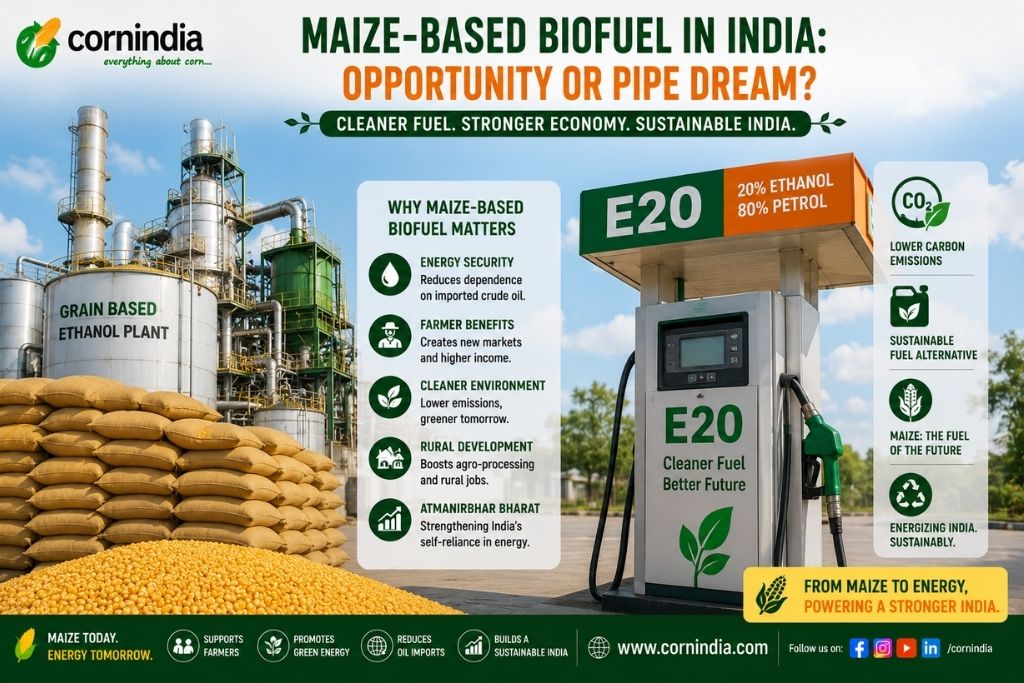
A few days ago, on July 3, 2026, the Indian government confirmed something that would have seemed unlikely just three years earlier: India achieved its 20% ethanol blending target in petrol in December 2025, ahead of schedule — up from about 1.5% in 2013-14. And running quietly underneath that headline number is an even bigger structural shift: maize, not sugarcane, is now the single largest feedstock behind it.
As of January 31, 2026, India's ethanol blending programme had reached 19.98%, with maize allocations standing at 478.90 crore litres — 46% of total allocations — making it the single largest contributor within the grain-based feedstock basket. The government now states maize accounts for more than 40% of ethanol supplied under the programme.
For a country that grows maize primarily for poultry feed and food, this is a genuinely new role for the crop — and a fast-growing one. But growth built on policy mandates always invites a harder question: is this a durable, structurally sound opportunity, or a bubble sustained by subsidy and political will that could deflate the moment priorities shift?
Let's look at the evidence on both sides.
The Scale of What's Actually Happening
The numbers here are not modest.
Installed ethanol production capacity in India approached 20 billion litres by November 2025, with capacity expected to increase by another 15% as new projects become operational. India now has close to 500 ethanol distilleries, and the programme has reportedly generated investment exceeding ₹40,000 crore.
In the first half of Ethanol Supply Year (ESY) 2025-26, ethanol supplies reached about 515 crore litres against a total contracted volume of 1,059 crore litres — nearly 49% already delivered within six months. Grain-based distilleries contributed around 333 crore litres of this, with maize accounting for the largest share.
The shift toward maize specifically — rather than rice or sugarcane — has been rapid. Industry experts note that maize offers several structural advantages: year-round availability, easier supply chain management, and lower water usage compared to other feedstocks. It is also seen as suitable for supporting higher blending targets beyond E20.
The increasing use of maize is expected to drive fresh investment in storage facilities, rural supply chains, ethanol production capacity, and agricultural processing infrastructure across multiple states.
The Case for "Genuine Opportunity"
1. Maize has real agronomic advantages as an ethanol feedstock
The government has specifically noted that maize requires significantly less irrigation than paddy — one of the crops it is displacing in the biofuel feedstock mix — and is being actively promoted through higher minimum support prices. Compared to sugarcane, which is notoriously water-intensive, and rice, which faces its own food-security sensitivities, maize's lower water footprint and dual kharif-rabi cropping calendar genuinely make it a more sustainable long-term feedstock choice on paper.
2. The DDGS by-product economics are real and growing
This is arguably the strongest structural argument for maize ethanol's durability, because it's not just about fuel — it's about what's left over after the ethanol is extracted.
Distillers Dried Grains with Solubles (DDGS) — the protein-rich by-product of maize-based ethanol production — has emerged as a strategically important alternative feed ingredient for India's livestock and poultry sectors, offering a scientifically sound and economically viable way to recycle nutrients back into animal production systems.
The India DDGS market was valued at USD 177.42 million in 2025 and is projected to reach USD 337.57 million by 2031, growing at 11.32% CAGR. DDGS supplies 26-30% crude protein at prices 15-20% below soybean meal, supporting 10-15% inclusion rates in feed formulations without hurting feed conversion. Maize-derived DDGS fetches around ₹12 per kg in the market — meaningfully higher than rice-based DDGS at ₹8 per kg, reflecting its superior protein content.
This matters enormously for the economics of grain ethanol plants. Ethanol production costs in grain-based distilleries run higher than sugarcane-based routes — approximately ₹75.23 per litre for maize versus ₹46.61-60.02 for various sugarcane feedstocks — but accounting for DDGS and CO₂ by-product revenue brings the net maize-based production cost down to approximately ₹62.84 per litre. The DDGS revenue stream isn't a minor bonus; it's a meaningful part of what makes maize ethanol economically viable at all.
3. Real investment is already following the maize ethanol growth
The March 2025 policy allowing cooperative sugar mills to process maize and damaged food grains beyond the cane-crushing season is enabling year-round DDGS production, while the government provides interest subvention of up to 6% for five years to reduce distillery capital costs. Established players are expanding capacity specifically around this opportunity — Modi Naturals' Raipur facility expansion in 2025 is a direct example of industry investment responding to the maize-DDGS opportunity.
A National Academy of Agricultural Sciences (NAAS) strategy paper, prepared under the guidance of Dr. H.S. Jat, Director of ICAR-Indian Institute of Maize Research, has specifically outlined a roadmap for maize as a sustainable feedstock for India's ethanol targets — signalling institutional, research-backed commitment behind the shift, not just distillery-level opportunism.
4. Farmer income impact is measurable
The ethanol blending programme has reportedly generated more than ₹1.58 lakh crore in direct income for the farming community, with assured demand for sugarcane, maize, and rice creating a reliable market for farmers. Government promotion of maize cultivation for ethanol has contributed to a 10% increase in maize farming area. For maize farmers specifically, ethanol demand functions as an additional, price-supportive buyer alongside poultry feed and starch processors — reducing dependence on any single demand channel.
The Case for "Pipe Dream" — Or at Least, Serious Structural Risk
1. Capacity now significantly exceeds actual blending demand
This is the single most important cautionary data point. Installed production capacity approached 20 billion litres by November 2025, while current E20 demand absorbs only about half of installed capacity. E20 (20% blending) represents the technical ceiling for most vehicles currently on Indian roads.
This creates a genuine policy challenge: underused distilleries face high fixed costs, lower returns, and the real risk of becoming stranded assets. Higher blending targets beyond E20 may therefore be driven partly by the need to utilise capacity that has already been built, rather than by clean underlying demand growth.
This is a classic overcapacity risk pattern: policy incentives drove a wave of distillery investment predicated on continuously rising blending targets, but the physical constraint of vehicle fuel compatibility means demand cannot simply keep rising to match capacity without further vehicle fleet transition (flex-fuel vehicles) or export markets for the surplus ethanol.
2. The maize supply-demand math has already broken once
Before 2021-22, India produced 32-33 million tonnes of maize against domestic demand of only 28 million tonnes, allowing a surplus for exports. With roughly 7 million tonnes now diverted to ethanol production in 2024-25, that balance broke — turning India into a net importer of maize. Maize prices surged from roughly ₹15,000 to ₹25,000 per tonne.
Distilleries reportedly faced an estimated maize shortfall of 17 million tonnes, with maize prices rising to around ₹26-30 per kg — and poultry, which consumes nearly 60% of India's maize, has faced direct supply pressure as a result.
This is the clearest evidence that the maize ethanol expansion has, at least at points, outpaced the raw material base supporting it — creating exactly the kind of cross-sector competition and price volatility that makes long-term planning difficult for every downstream user of maize, not just distilleries.
3. Hybrid seed adoption and post-harvest infrastructure remain genuine bottlenecks
The NAAS strategy paper itself acknowledges that hybrid maize variety adoption remains limited, and post-harvest losses due to inadequate drying and storage facilities pose significant concerns. Yield variability caused by climate change further threatens supply chain reliability. This is an important, honest acknowledgment from the very institutions promoting maize ethanol: the raw material supply chain isn't yet built to reliably support the scale of demand the programme envisions.
4. The broader resource-substitution question
The ethanol blending programme may shift external dependence rather than eliminate it — it can reduce crude oil imports while increasing dependence on fertiliser inputs, natural gas, edible oils, and grain imports, many of which are themselves imported. Increased cultivation of maize, sugarcane, and rice may also reduce land available for pulses and oilseeds, where India already has high import dependence.
This is a systems-level critique worth taking seriously for anyone evaluating the long-term policy durability of maize ethanol: it's not obviously true that diverting agricultural land toward ethanol feedstock production is a clean net win for India's overall import bill, even if it reduces the specific crude oil import line item.
5. Water and environmental costs, while lower than sugarcane, are not zero
The government states ethanol distilleries consume about 3-5 litres of processed water per litre of ethanol and are increasingly operating Zero Liquid Discharge systems to recycle water — an improvement, but not elimination, of the water footprint concern that critics raise.
A Quick Note on the Sugarcane Comparison
Maize hasn't displaced sugarcane by policy design so much as by circumstance and relative advantage. Sugarcane-based distilleries have maintained robust performance, supplying 182 crore litres and achieving 62% of contracted volumes in recent periods, with sugarcane juice remaining the dominant contributor within that category. Sugarcane producers remain confident in their capacity, with over ₹40,000 crore invested and production capacity exceeding 9,000 million litres — enough, industry leaders argue, to support blending targets well beyond E20.
The reality is a dual-feedstock system, not a maize-replaces-sugarcane story: the government is likely to continue adopting a dual-feedstock approach, encouraging both sugarcane and grain-based ethanol while monitoring food security implications, alongside efforts to develop second-generation biofuels from agricultural residues. Maize's rise reflects genuine structural advantages (lower water use, more flexible timing, year-round availability) more than any policy preference for maize over cane — and both feedstocks are likely to remain part of the mix for the foreseeable future.
Weighing the Evidence: What the Data Actually Supports
Here's the balanced picture, before the verdict:
What's genuinely solid:
- The DDGS by-product economics are real, growing, and increasingly institutionalised (dedicated DDGS market reports, major company investment, government policy support for year-round production)
- Maize's agronomic case (lower water use, dual-season flexibility) versus sugarcane and rice is legitimate and not merely a talking point
- India achieving E20 ahead of schedule demonstrates the programme's execution capability is real, not aspirational
- Farmer income impact is measurable and provides maize farmers a genuine additional demand channel
What's genuinely fragile:
- Installed ethanol capacity already exceeds demand at the E20 ceiling — a real overcapacity and stranded-asset risk exists right now, not hypothetically
- The maize supply base has already proven unable to meet demand without price spikes and import dependency — this isn't a future risk, it already happened
- Raw material infrastructure (hybrid seed adoption, storage, drying) lags behind the ambition of the programme, by the acknowledgment of the very institutions running it
- Higher blending targets beyond E20 face a genuine technical ceiling (vehicle compatibility) that pure policy will won't solve without parallel investment in flex-fuel vehicles
The Verdict
Maize-based biofuel in India is a genuine, structurally sound opportunity — but the growth trajectory as currently configured is running ahead of its supporting infrastructure, and a correction in pace (not direction) is likely and probably necessary.
The core thesis holds up: maize is a legitimately better ethanol feedstock than sugarcane on water-use and flexibility grounds, the DDGS by-product creates a genuine second revenue stream that makes the economics work, and the programme has demonstrated real execution capability by hitting E20 ahead of schedule. This is not a policy mirage — actual litres of ethanol are being produced, actual distilleries are running, actual farmer income is being generated, and actual protein is flowing back into the poultry feed chain via DDGS.
But "genuine opportunity" is not the same as "risk-free, unlimited growth story." The evidence of a maize supply shortfall, price spikes, and India's shift to net maize importer status in 2024-25 is not a warning sign for the future — it's something that has already happened once. Combined with installed ethanol capacity now running well ahead of E20 demand, the near-term risk isn't that maize ethanol fails as a concept — it's that specific distilleries built on overly optimistic capacity assumptions, or maize farmers who expand acreage assuming linear demand growth, could face a bumpier few years of price volatility and capacity underutilisation before the sector's growth rate settles into something the maize supply chain and vehicle fleet can actually sustain.
For agri-businesses: the opportunity is real, but the disciplined play is in DDGS processing and distribution infrastructure (a genuinely underbuilt, high-growth segment) and in maize supply chain reliability (storage, drying, hybrid seed distribution) — not in speculative new ethanol distillery capacity chasing blending targets that may not materialise on the timeline currently assumed.
For researchers: the most valuable open questions are exactly the ones NAAS and ICAR-IIMR have already flagged — climate-resilient hybrid development, post-harvest loss reduction, and modelling the actual maize acreage and yield growth needed to sustainably support ethanol demand without repeating the 2024-25 shortfall and price spike.
Related reads on CornIndia: How Maize Is Used in the Poultry Feed Industry in India | Current Maize Prices in India: State-Wise MSP Breakdown | India's Maize Export Potential: Opportunities and Challenges





0 Comments