
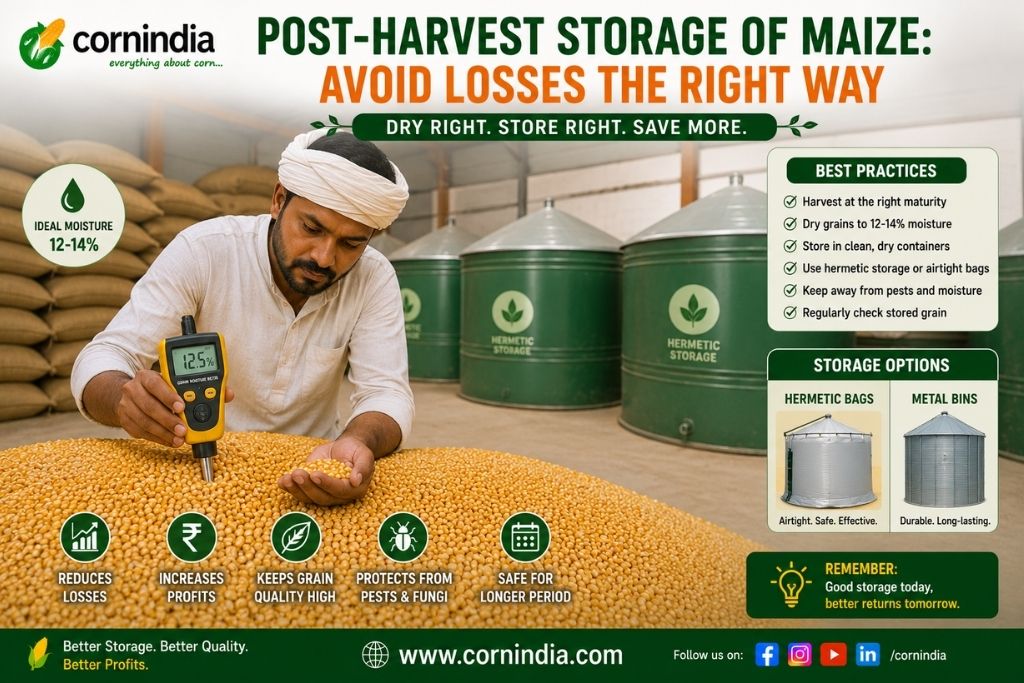
The work of growing a good maize crop doesn't end at harvest. It ends when that grain reaches a buyer, or your kitchen, in the same condition it left the field.
In between those two points is storage — and storage is where a significant share of Indian maize quietly disappears. India's total post-harvest food grain loss is estimated at 12–16 million metric tonnes annually — enough to feed one-third of the country's poor. Insects alone are responsible for a large share of this. Insect infestation can account for 24.2% of these losses, totalling around ₹1,300 crores every year.
The frustrating part is that most of this loss is preventable. Three enemies — moisture, insects, and toxin-producing mold — cause almost all storage damage in maize, and all three respond well to the same basic set of practices. This guide covers exactly what those practices are.
The Three Enemies of Stored Maize
Before the techniques, it helps to understand what you're actually fighting, because the three main storage risks are deeply connected to each other.
1. Moisture is the root cause behind almost everything else. Grain stored too wet creates the exact conditions that insects and mold need to thrive.
2. Insects — primarily weevils — physically damage kernels, reduce weight, and open the door for fungal contamination.
3. Aflatoxin and other mycotoxins are toxic compounds produced by fungi that grow on grain under warm, humid conditions — and they're the most dangerous of the three because they're invisible, don't affect taste, and pose real health risks to humans and livestock.
Get moisture right, and you've gone a long way toward controlling the other two as well.
Enemy 1: Moisture — Get This Number Right Before Anything Else
Every storage decision starts with one number: the moisture content of your grain at the time you put it into storage.
The safe target: 12–13% moisture content for long-term storage.
Research confirms that maize should be kept below 13% moisture content for safe long-term storage.Fungi generally cannot grow below 13% moisture content in starchy grains like maize — this threshold is directly tied to the relative humidity that grain moisture creates inside a storage container.
Why this number matters so much: Fusarium toxin production showed a significant negative correlation with temperature and humidity but a significant positive correlation with seed moisture content — meaning wetter grain drives toxin formation more than almost any other single factor. Storing maize at 15% moisture resulted in low germination percentage and dry matter losses of up to 35%, along with fungal growth.
That's not a small loss — 35% dry matter loss from moisture alone, before insects or mold have even been counted separately.
How to check moisture without a meter
If you don't have a moisture meter, here are field tests that give you a reasonable estimate:
The bite test: Bite a kernel. If it's hard and shatters rather than dents, moisture is likely below 15%. Soft, dentable kernels mean moisture is still too high for storage.
The salt jar test: Fill a dry glass jar halfway with grain, add 1 tablespoon of dry salt, seal, and shake for a minute. Check after a few hours — if salt sticks to the jar's inner walls or clumps, moisture is above the safe range. If the salt stays loose and dry, your grain is likely safe.
The best investment: A basic digital moisture meter costs relatively little and removes all the guesswork. If you're storing grain in any meaningful quantity, this is worth having.
How to dry maize to the right moisture
Field drying: The most common method for smallholder farmers. Spread harvested cobs (with husk removed) on a clean tarp, cemented floor, or raised drying platform in direct sun for 3–7 days depending on starting moisture and weather. Turn the grain 2–3 times daily for even drying. Never dry directly on bare soil — this introduces contamination and moisture from below.
Avoid the common mistake: Farmers often delay harvest for several weeks and let the crop dry in the field before harvesting, which exacerbates mold contamination and aflatoxin production due to increased insect infestation and damage. Harvesting shortly after physiological maturity, followed by controlled drying off the field, produces better results than prolonged field drying.
Rainy season challenge: If harvest coincides with unseasonal rain and you cannot achieve safe moisture immediately, do not leave wet grain in ordinary bags for extended periods — this is exactly when mold and aflatoxin risk spikes fastest. If drying must be delayed, temporary hermetic storage (explained below) can safely hold wet grain for a short period without spoilage.
Enemy 2: Storage Insects — The Weevil Problem
The maize weevil (Sitophilus zeamais) and related storage pests are the most persistent threat to stored grain in Indian conditions.
Weevil infestation can cause losses of 15–90% among smallholder farmers, ranking it among the most destructive storage pests of maize grain in tropical and subtropical regions. Weevil infestation reduces grain quantity, lowers nutritional and market value, and also affects germination percentage — a serious concern when seed and grain are stored together.
How weevils get into your grain: Adult weevils lay eggs inside individual kernels. The larvae develop and feed entirely within the kernel, invisible from the outside, until the adult weevil emerges by boring a small exit hole. By the time you see visible holes and adult weevils crawling on your grain, the infestation is already well established — eggs and larvae are likely present throughout the stored lot.
Prevention and management
Sanitation first: Clean out all harvesting, handling, and storage equipment before use. Remove all broken corn, dust, and foreign material that can harbour insects. Check and repair storage containers to prevent gaps. Keep the area around storage structures clear to discourage insect activity. A clean storage structure and clean, undamaged grain are your first line of defence — insects preferentially colonise damaged kernels and dusty residue left from previous storage cycles.
Only store dry, undamaged grain: Broken kernels and grain with cracked seed coats are far more vulnerable to insect entry than clean, whole kernels. Sort and remove visibly damaged or broken grain before storage where practical.
Botanical protection: Mixing dried neem leaves (approximately 2–3 kg per quintal of grain) through the stored lot is a traditional, low-cost method that repels many storage insects. Neem oil-treated cloth or paper layered between grain also provides some protection, though effectiveness is lower than chemical treatment for heavy infestations.
Chemical protection (for larger stored quantities): Malathion dust (5% WP) applied at recommended rates to storage bags and structures provides effective residual protection against weevils and other storage pests. Always follow label instructions for dosage, and never apply insecticide dust directly onto grain intended for immediate consumption without following the specified waiting period before use.
Biological control (emerging option): Beauveria bassiana, an entomopathogenic fungus, has shown effectiveness as a biocontrol agent against maize weevil over extended storage periods, offering a non-chemical alternative for managing storage insect populations. This is an area of growing interest for farmers wanting to reduce chemical treatment of stored food grain.
Regular inspection: Check stored grain every 2–3 weeks for the first three months of storage — this is the highest-risk period for insect population buildup. Look for exit holes in kernels, live insects, webbing, or unusual odour. Early detection allows intervention before an infestation spreads through the entire stored lot.
Enemy 3: Aflatoxin — The Invisible Threat
This is the storage risk that deserves the most respect, because unlike moisture (which you can measure) or weevils (which you can see), aflatoxin contamination often shows no obvious signs until testing reveals it.
Aflatoxin is produced by the fungus Aspergillus flavus, which can infect maize both in the field (during drought or heat stress) and during storage under warm, humid conditions. The fungus can be recognised by a gray-green or yellow-green mould growing on corn kernels in the field or in storage. Plant stress due to drought, heat, or insect damage usually increases aflatoxin levels, and damage to the grain seed coat permits easy entrance of moulds and promotes rapid development of storage rots at high moisture and temperature.
Why aflatoxin matters so much: Beyond reducing the market value and feeding value of your grain, aflatoxin exposure carries genuine health risks for humans and livestock consuming contaminated grain over time. Buyers — particularly poultry feed mills and food processors — test incoming grain for aflatoxin levels and reject or heavily discount lots that exceed regulatory limits (typically 10–20 ppb for feed use in India).
The connection to insects and moisture: Humid conditions and storage insects can worsen the production of aflatoxin — insect damage creates entry points for fungal spores, and both insects and fungi thrive in the same high-moisture conditions. This is why the three enemies of storage aren't really separate problems — they compound each other. Poor moisture control invites both insects and mold; insect damage accelerates mold growth; and mold growth (especially under warm, humid conditions) produces the toxin.
How to reduce aflatoxin risk:
- Dry quickly after harvest — the longer grain sits at high moisture before drying, the more opportunity Aspergillus has to establish and produce toxin
- Remove damaged and broken kernels before storage — most Aspergillus infection occurs on corn in broken and damaged kernels and in foreign material
- Avoid co-storing maize with legumes — elevated aflatoxin contamination has been documented in maize stored alongside cowpeas and other legumes known to be susceptible to aflatoxin
- Maintain moisture below 13% throughout the storage period — not just at the point of initial storage
- Never repeatedly open and reseal hermetic storage if you're using it — repeatedly breaking a hermetic seal increases fungal growth and aflatoxin contamination risk, especially in grain stored at higher moisture content, because oxygen re-enters the bag environment. Plan your grain withdrawal in fewer, larger takings rather than frequent small openings.
If you suspect contamination: Grain with visible mold growth, unusual colour, or musty odour should not be consumed or fed to livestock without testing. Contact your nearest KVK or agricultural university for aflatoxin testing facilities if you have concerns about a specific batch.
Storage Structure Options: Matching the Method to Your Situation
Different storage structures offer different levels of protection. Here's an honest look at what each does well and where it falls short — purely from a practices and effectiveness standpoint.
Traditional structures (mud bins, bamboo cribs, earthen pots): Familiar, low-tech, and widely used across rural India. Effective for short-term storage of well-dried grain, but generally offer less protection against moisture fluctuation and insect entry compared to sealed alternatives. Comparative studies found that when grain was packed in metal, earthen bins, and plastic bags, moisture content increased over the storage period and reduced seed viability — while hermetically sealed storage maintained more stable conditions.
Woven polypropylene (PP) bags: The most common bag type for grain storage and transport in India. PP bags do not control moisture exchange with the surrounding environment — grain moisture content in PP bags fluctuates with ambient humidity, and a significant increase in moisture content and reduction in grain quality was observed in PP bags compared to hermetic alternatives. Suitable for short-term storage and transport, but not ideal for extended storage periods, especially in humid conditions.
Hermetic bags (Super Grain Bags, PICS bags): These use an airtight, multi-layer design that seals oxygen out and traps the small amount of CO₂ produced by grain respiration, creating a low-oxygen environment that is hostile to both insects and mold. Maize stored in hermetic bags with an initial moisture content of 12.07% showed satisfactory temperature, moisture content, and lightness throughout the storage period, resulting in better germination rates than conventional storage methods. PICS bags maintained the original moisture content of grain for extended storage periods and prevented aflatoxin accumulation, even after two months of storage, compared to conventional woven bags which showed higher aflatoxin content tied to higher moisture levels.
Hermetic storage's biggest advantage is that it works through physical sealing rather than chemical treatment — meaning no pesticide residue concerns and effective protection even without regular monitoring, provided the seal remains intact.
Metal bins/silos: Offer good protection against rodents and provide a stable storage environment, provided the structure is properly sealed against moisture ingress. Regular inspection for rust, leaks, or condensation (especially with temperature fluctuations between day and night) is important.
Enemy 4 (The One We Haven't Named Yet): Rodents
Rodent damage in stored maize compounds every other problem — rodents physically destroy grain, contaminate stored lots with droppings and urine (a health and quality issue), and damage storage structures, creating entry points for moisture and insects.
Prevention practices:
- Store grain off the ground on raised platforms — rodents access ground-level storage far more easily
- Seal all gaps, cracks, and openings in storage structures — rodents can enter through remarkably small openings
- Keep storage areas free of spilled grain and food waste that attracts rodent activity
- Maintain a clear perimeter around storage structures — dense vegetation right up against storage areas provides rodent cover and easy access
Your Storage Practice Checklist
Before you store any maize harvest, run through this sequence:
- Harvest at physiological maturity — don't delay harvest hoping for field drying, as this increases mold and insect risk
- Dry to 12–13% moisture before storage — verify with a moisture meter or field test
- Clean storage structures and equipment thoroughly before filling — remove old grain residue, dust, and debris
- Remove broken and damaged kernels — sort out visibly damaged grain before storage
- Choose sealed/hermetic storage where possible for extended storage periods — the moisture and aflatoxin control benefits are well documented
- Store off the ground and away from walls — reduces moisture wicking and rodent access
- Apply neem leaves or approved insecticide dust for additional insect protection in bag/bin storage
- Inspect every 2–3 weeks during the first three months — the highest-risk period for insect population buildup
- Avoid frequent opening of hermetic storage — plan withdrawals in fewer, larger batches
- Never co-store with legumes or other crops susceptible to aflatoxin cross-contamination
Final Thoughts
The maize you harvest represents an entire season of work — soil preparation, seed cost, fertiliser, irrigation, and pest management. Storage is the final stage where all of that investment either holds its value or quietly erodes away.
The good news is that storage losses are among the most preventable losses in the entire maize production cycle. Moisture control, basic sanitation, appropriate storage structures, and regular inspection — none of these require expensive technology. They require attention and consistency.
Get moisture right first. Everything else — insects, mold, aflatoxin — becomes significantly easier to manage once your grain goes into storage properly dried.
At CornIndia, we work with farmers on the full crop cycle, including post-harvest handling and storage decisions. If you're dealing with a specific storage challenge or planning storage infrastructure for a larger harvest, reach out — we're glad to help.
Related reads on CornIndia: Common Maize Diseases in India and How to Fight Them | Current Maize Prices in India: State-Wise MSP Breakdown | How Maize Is Used in the Poultry Feed Industry in India







0 Comments