
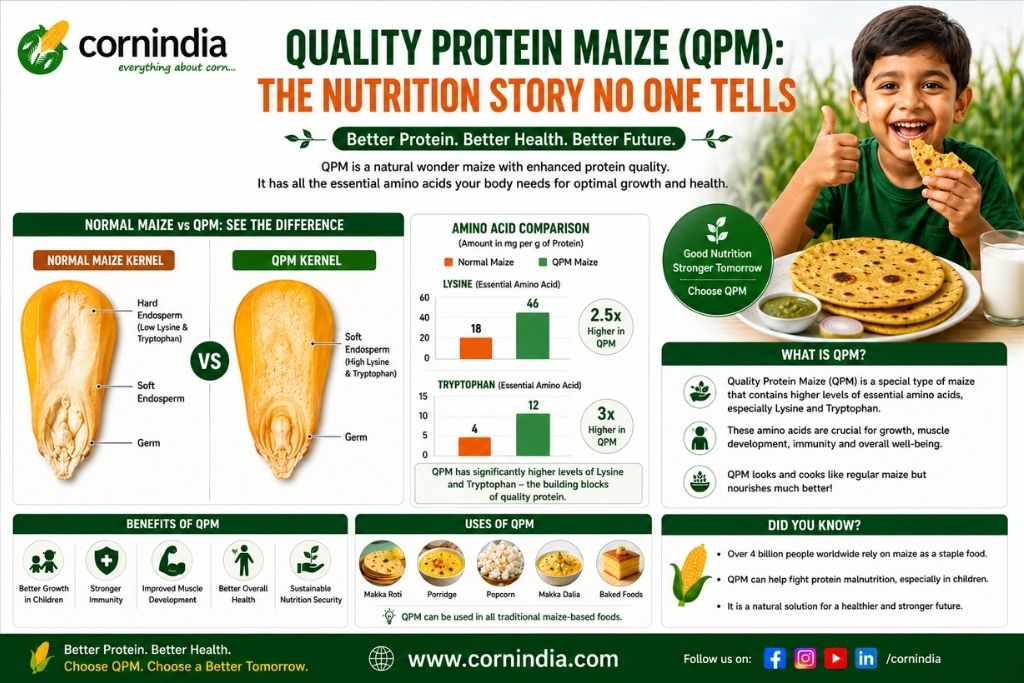
There's a version of maize that could help feed India more nutritiously — reduce child stunting, improve poultry feed efficiency, address protein malnutrition in tribal and rural communities — and most people in India have never heard of it.
It's called Quality Protein Maize, or QPM. It looks identical to regular corn. It tastes the same. It yields comparably. But inside each kernel, something fundamentally different is happening — something that took plant scientists decades to achieve and that quietly earned its inventors the World Food Prize.
This is the story of QPM: what makes it different, why it matters for India specifically, who's growing it, and why it deserves to be far more widely known than it currently is.
The Problem With Normal Maize Protein
To understand QPM, you first need to understand the nutritional limitation it was designed to fix.
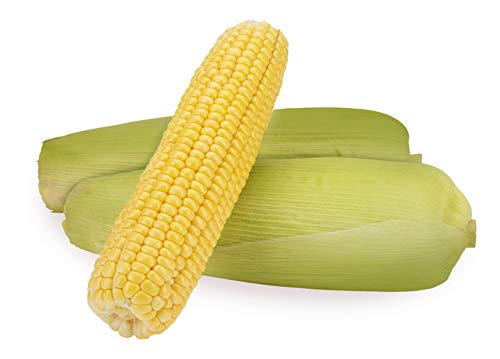
Maize is the world's most produced cereal. It's the staple food for hundreds of millions of people — in Africa, Latin America, and significant parts of rural India. But there's a problem with depending on maize as your primary food source: the protein in normal maize is nutritionally incomplete.
Every protein your body needs is assembled from amino acids — and some of these amino acids your body can't make on its own. You have to get them from food. These are called essential amino acids.
Two of the most critical essential amino acids for humans are lysine and tryptophan. Lysine supports growth, tissue repair, and immune function. Tryptophan is the precursor for serotonin (your mood-regulating neurotransmitter) and for niacin (Vitamin B3 — the deficiency of which causes pellagra, a serious disease).
Normal maize is severely deficient in both. Traditional maize has a drawback of being deficient in two essential amino acids — lysine and tryptophan — which leads to poor net protein utilisation and low biological value. The culprit is a protein fraction in the maize kernel called zein, which dominates the kernel's endosperm and is extraordinarily low in lysine and tryptophan. Even though other parts of the maize kernel contain better-quality protein, zein's dominance drags down the whole nutritional picture.
The result: communities that depend heavily on maize as a staple food are at serious risk of protein malnutrition — even when they're eating enough calories. Children in particular are vulnerable, showing up as stunting, poor cognitive development, and reduced immunity.
This is the problem QPM was born to solve.
What QPM Is — And How It Was Made
Quality Protein Maize (QPM) is a family of maize varieties with enhanced nutritional quality. QPM grain contains nearly twice as much lysine and tryptophan as conventional maize. QPM is a product of conventional plant breeding — it is not genetically modified — and is an example of biofortification.
The scientific breakthrough at the heart of QPM is a naturally occurring genetic mutation called the opaque-2 gene (written as o2). This gene was discovered in the 1960s and found to dramatically reduce the amount of zein protein in the kernel, making space for the better-quality protein fractions — and raising lysine and tryptophan levels significantly.
The problem was that early opaque-2 maize had soft, chalky, dull-looking kernels that were susceptible to pests and disease, and that farmers and consumers didn't like. It yielded poorly and didn't store well. For two decades, the scientific community essentially gave up on it.
The breakthrough came when maize breeders Surinder Vasal and Evangelina Villegas at CIMMYT began their collaborative research in the early 1970s, combining expertise in plant breeding and protein chemistry. They developed breeding strategies that combined the opaque-2 gene with genetic modifiers to restore hard kernel texture while maintaining the improved amino acid composition. This approach enabled the development of agronomically competitive QPM germplasm adapted to diverse environments.
For this work, Vasal and Villegas were awarded the World Food Prize in 2000 — the Nobel Prize equivalent in food and agriculture.
The result of their decades of work: Quality protein maize that looks and tastes like normal maize, with the same higher yield potential, but contains nearly twice the quality of essential amino acids lysine and tryptophan.
In numbers: QPM has about twice the level of lysine (4.15%) and tryptophan (1%) compared to normal maize (2% and 0.5% respectively), and also increased levels of histidine, arginine, aspartic acid, and glycine.
QPM produces 70–100% more lysine and tryptophan than the most modern varieties of tropical maize. In addition, tryptophan can be converted in the body to niacin, which theoretically reduces the incidence of pellagra.
What ICAR Has Built: India's QPM Variety Pipeline
India has been one of the most active countries in the world in developing and releasing QPM varieties — a fact that's almost completely unknown outside the research community.
India has released a significant number of QPM hybrids for commercial cultivation, including Ratan, Protina, Shakti, Shakti-1, Shaktiman-1, Shaktiman-2, Shaktiman-3, Shaktiman-4, Shaktiman-5, HQPM-1, HQPM-5, HQPM-7, Vivek QPM-9, Vivek QPM-21, and Pratap QPM Hybrid-1 — all with enhanced endospermic content of lysine and tryptophan.
Here are the key varieties farmers and seed buyers should know:
HQPM-1
Developed by ICAR-IARI. Released for cultivation across the country. A yellow hybrid with significantly improved lysine and tryptophan levels. One of the most widely adapted QPM hybrids released for Indian conditions.
HQPM-5 and HQPM-7
Also ICAR-IARI releases. HQPM-7 is specifically suited to Karnataka, Andhra Pradesh, Telangana, Tamil Nadu, and Maharashtra — the southern belt where poultry feed demand is strongest and where QPM's nutritional properties can directly improve feed efficiency.
Pusa HM-9 Improved
A medium-maturing QPM hybrid possessing high tryptophan (0.68%) and lysine (2.97%) in endosperm protein. Released for Bihar, Jharkhand, Odisha, West Bengal, and eastern Uttar Pradesh, with an average grain yield of 52 quintals per hectare and maturity in 89 days. This is one of the most nutritionally advanced QPM hybrids available, developed at ICAR-IARI, New Delhi.
Pusa Vivek QPM-9 Improved
An early-maturing hybrid with high provitamin-A (8.15 ppm), high tryptophan (0.74%), and high lysine (2.67%) in endosperm protein — described as a 'multi-nutrient maize hybrid.' Released for Jammu & Kashmir, Himachal Pradesh, Uttarakhand hills, North Eastern states, Maharashtra, Karnataka, Andhra Pradesh, Telangana, and Tamil Nadu.
This variety represents the next level of biofortification — combining QPM protein quality with enhanced provitamin-A in a single hybrid. It's an extraordinary achievement that addresses multiple nutritional deficiencies simultaneously.
The Next Frontier: Combining opaque-2 and opaque-16
ICAR-IARI researchers have combined the opaque-2 gene with a novel recessive gene called opaque-16 (o16), which when present with o2, enhances lysine by 30–40% and tryptophan by 50–60% above standard QPM levels, without inducing opaqueness. The next generation of QPM hybrids using this pyramided gene combination will push nutritional quality even higher — and ICAR is already developing them.
Why QPM Matters: The Human Evidence
This isn't just laboratory science. The evidence for QPM's real-world nutritional impact is grounded in human studies across multiple countries.
Studies on children fed QPM demonstrated that they had fewer sick days, were more likely to escape death due to diarrhoea, and showed reduced stunting with better growth compared to children fed conventional maize.
Randomised, controlled studies in which QPM was provided to rural households found that QPM could improve child nutritional status — specifically improving growth and protein status in maize-dependent populations.
For India, this evidence matters intensely. Despite significant economic growth, India continues to face serious levels of child stunting and protein malnutrition, particularly in states where maize is a dietary staple — Jharkhand, Odisha, Chhattisgarh, tribal belts of Madhya Pradesh, the North East. In these regions, replacing conventional maize with QPM in household diets requires no behaviour change, no new cooking method, no additional cost to the consumer — just a different seed in the ground.
QPM for Poultry Feed: The Economic Angle
QPM's benefits extend well beyond human nutrition. For India's massive and rapidly growing poultry industry, QPM is potentially transformative on purely economic grounds.
Lysine and tryptophan are the two amino acids most commonly added as synthetic supplements to commercial poultry feed — because conventional maize is so deficient in them. These supplements are imported, priced in dollars, and add cost to every tonne of poultry feed produced in India.
Replacing conventional maize with QPM in poultry rations can reduce or eliminate the need for synthetic lysine and tryptophan supplementation — because the QPM grain already contains them at sufficient levels. ICAR-IIMR developed QPM with enhanced protein quality specifically targeted at improving the biological value of protein for both humans and monogastric animals.
For a poultry industry that processes millions of birds every year on maize-based diets, even a modest reduction in synthetic amino acid supplementation costs translates to significant savings at scale. It's a compelling economic argument for larger poultry companies to actively work with seed companies on QPM procurement — something the industry has so far underexplored.
Why QPM Hasn't Gone Mainstream — Yet
If QPM is this good, why isn't it everywhere?
This is a fair question, and the honest answer involves several factors:
1. Awareness is almost zero at the farmer level. Most maize farmers in India have never heard the term QPM. Their seed dealer doesn't stock it. Their neighbour doesn't grow it. The extension system has not prioritised it. ICAR has released excellent varieties, but release doesn't equal adoption.
2. QPM seed availability is patchy. HQPM varieties are available through ICAR channels, SAU seed farms, and some private dealers — but not consistently across all maize-growing states. A farmer in Karnataka might find HQPM-7, but a farmer in Bihar might struggle to source QPM seed at all.
3. The yield premium story hasn't been told clearly. QPM hybrids now match or come close to the yield of standard commercial hybrids under good management. But the narrative among farmers is still that QPM is a "nutrition variety" — lower-priority than yield-focused commercial hybrids. This perception gap is a communication problem, not an agronomic one.
4. The poultry industry hasn't connected the dots. If major poultry companies started actively procuring QPM grain and were willing to pay a small premium for the amino acid quality — essentially offsetting their synthetic supplement costs — it would create a market pull that would transform QPM adoption within five years. This commercial signal hasn't been sent clearly enough.
5. QPM's visual similarity to regular maize is a double-edged sword. It means there's no identity preservation problem for consumers or farmers — QPM and normal maize can be grown side by side without special handling. But it also means there's no visible signal to buyers that they're holding a more nutritious grain, which makes value capture difficult.
Who Should Be Paying Attention to QPM Right Now
Farmers: If you're in a region where HQPM varieties are available and your yield targets can be met, QPM is worth trying — particularly for rabi season, where HQPM-1 and related varieties perform well. The grain price at mandi is the same as conventional maize; the differentiation comes if and when nutrition-premium procurement develops.
Seed companies: The QPM segment is genuinely underdeveloped commercially. ICAR has done the hard breeding work. The opportunity is in production, distribution, and farmer education. A private company that builds QPM into its maize portfolio with a clear nutrition narrative is entering a market where differentiation is almost entirely uncontested.
Nutritionists, health programmes, and NGOs: The evidence base for QPM's impact on child nutrition is robust and growing. For nutrition interventions in maize-dependent communities, QPM is arguably the lowest-cost, highest-impact dietary improvement possible — requiring no change in food habits, only in the grain variety used.
Poultry and aquaculture companies: The economics of QPM grain as a feed ingredient versus conventional maize + synthetic amino acid supplementation deserve serious analysis. The current price parity of QPM grain at mandi (no premium over conventional) means the cost-benefit calculation may already favour QPM procurement — if the supply chain can deliver consistent, verified QPM grain.
Researchers: The next frontier — combining QPM with provitamin-A, zinc biofortification, and the opaque-2/opaque-16 gene pyramid — is where India can establish global leadership in biofortified cereal research. This is one of the most exciting active areas in Indian crop science.
Final Thoughts
QPM is not a future technology. It's not a GMO requiring regulatory approval. It's not expensive or complicated to grow. It exists today, in the form of ICAR-released hybrids that any farmer can access, in a country where both protein malnutrition and maize production are critically important.
What QPM lacks is not scientific validity — it has that in abundance. What it lacks is a story. A connection between the plant breeder's achievement, the nutritional reality on the ground, and the farmer, consumer, and industry buyer who could all benefit.
This is that story, to start.
At CornIndia, we believe QPM deserves a much larger conversation in India's maize ecosystem. If you're a farmer curious about HQPM varieties, a company exploring QPM procurement, or a researcher working on biofortification — reach out. We'd love to be part of that conversation.
Related reads on CornIndia: What is Maize? India's Most Versatile Crop Explained | Maize Hybrid vs Open-Pollinated Varieties | Popcorn Farming in India: Is It Profitable?





0 Comments