
If you grow maize in India, there's one pest you should know better than any other.
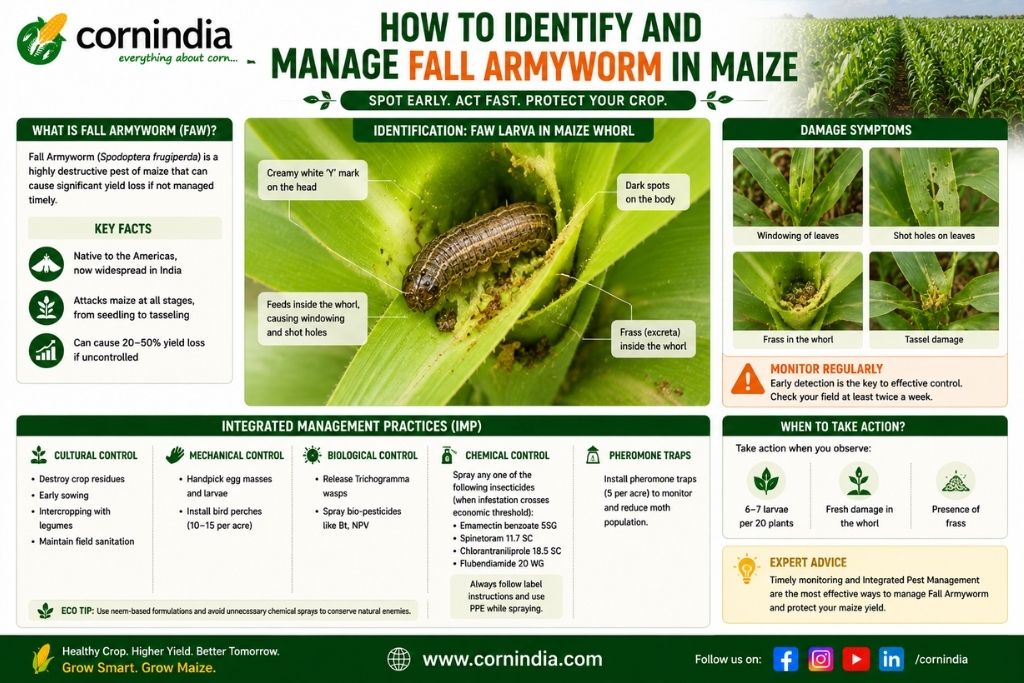
Fall armyworm — called Spodoptera frugiperda in scientific language, and informally known as FAW — arrived in India in May 2018 and has become the most feared maize pest in the country since. It feeds fast, hides well, spreads from field to field overnight, and can cause yield losses of 30–60% if it goes unchecked.
The frustrating part? Most farmers who lose significant yield to FAW don't catch it early enough. By the time the damage is obvious, the larvae are already large — deep inside the whorl or bore into the stem — and much harder to kill.
The good news: FAW is manageable. ICAR and field researchers across India have tested and validated a clear IPM (Integrated Pest Management) protocol that works. The key is starting early, monitoring consistently, and using the right tool at the right stage.
This guide gives you everything you need to do exactly that.
What Is Fall Armyworm and Why Is It So Dangerous?
Fall armyworm (Spodoptera frugiperda) is an invasive insect pest causing serious damage to maize at all stages of its growth. It was first reported in India in May 2018.
What makes FAW particularly dangerous compared to other maize pests:
It attacks early and hides well. Infestation begins at a very early stage — 14 to 21 days after sowing — causing extensive defoliation in maize whorls. The first three larval instars cause damage by scraping leaf surfaces, while later instars reside and feed inside the central whorls, filling them with moist frass (insect droppings) and feeding inside in a protected environment. By the time you see the damage clearly, the larva is already large and harder to kill with standard sprays.
It spreads rapidly between fields. Its ability to reproduce quickly and migrate long distances makes it particularly difficult to manage. Adult moths fly at night, laying eggs on neighbouring plants and in adjacent fields. An infestation that starts in one corner of your farm can cover an entire district within weeks if farmers don't respond collectively.
Yield losses are severe. Yield losses in maize due to fall armyworm infestation can reach 45–60% in heavily infested fields. In India, uncontrolled kharif season infestations — particularly in warm, humid conditions in Karnataka, Telangana, Maharashtra, and Bihar — have caused exactly this scale of damage.
Step 1: Know Your Enemy — Identifying FAW at Every Stage
Before you can control FAW, you need to be able to identify it accurately. FAW is sometimes confused with stem borer, which requires a different control approach.
The Egg Stage
Female moths lay egg masses on the upper or under side of the leaf, covered with tan-coloured scales. Each egg mass contains 50–150 eggs. The incubation period varies from 4–5 days.
Egg masses look like small, fuzzy, yellowish-green patches on the leaf surface. They're easy to miss because they blend with the leaf texture. Check both the upper and lower surfaces of leaves, especially in the early morning.
The Larval Stage (What You'll Usually See First)
This is the stage that causes all the damage. The larvae are smooth-skinned and vary in colour from light tan or green to dull grey body with three creamy yellow dorsal and lateral lines. The larva has a reddish-brown head with a prominent white, inverted Y-shaped suture between the eyes. The larva passes through 6 instars, with the larval period varying from 15–18 days.
The most reliable identification mark: On the 8th and 9th abdominal segments, four large spots are arranged in a square shape on segment 8 and in a trapezoid pattern on segment 9. This "square-and-trapezoid" pattern on the tail end of the larva is the single most reliable way to distinguish FAW from other caterpillars in a maize field.
Early instar larvae (tiny, 1–3mm): Yellowish-green, almost transparent. Found on leaf surfaces, scraping the green tissue and leaving a "windowpane" effect — thin, papery patches where only the leaf membrane remains.
Late instar larvae (large, 25–40mm): Dark grey-brown, aggressive feeders that burrow into the whorl, tunnelling down toward the growing point. At this stage the central whorl is packed with moist, sawdust-like frass — the most visible symptom of a heavy FAW infestation.
The Tell-Tale Damage Signs to Scout For
Here's what to look for when you walk your field:
1. "Windowpane" or "scraping" damage on young leaves: The leaves look like someone has scraped away the green surface, leaving only a thin papery film. This is early-instar FAW feeding and is your best chance to intervene.
2. Ragged holes in the whorl leaves: As the larvae grow, they cut irregular, ragged holes across the leaf whorl. The pattern of holes is less uniform than stem borer damage.
3. Frass in the central whorl: Pull apart the central whorl leaves. If you see moist, granular, reddish-brown frass (like wet sawdust) packed into the funnel of the plant, there's a late-instar FAW larva inside. This is the hardest stage to control.
4. Dead heart: In very young plants (under 30 days), heavy infestation can kill the central growing point, causing what's called a "dead heart" — the innermost whorl dies and turns brown while outer leaves remain green. Similar to stem borer damage, but caused by much larger larvae.
5. Cob damage: At later crop stages (after tasselling), FAW larvae move to the cob, boring into the tip and feeding on the developing grain. Silks may have ragged edges and frass near the cob tip.
Step 2: Set Up Pheromone Traps — Your Early Warning System
You cannot manage FAW by waiting for visible damage and then reacting. By the time you see damage clearly, it's already too late for the cheapest control options.
Pheromone traps are your early warning system — they catch adult male moths before egg-laying begins, giving you a 3–5 day head start on intervention.
How to install and use pheromone traps:
- Install pheromone traps at 4 traps per acre soon after sowing and monitor moth catches. Place traps at canopy height, not too high or too low.
- Use Spodoptera frugiperda-specific pheromone lures (widely available from agri-input dealers in major maize states)
- Check traps daily — count and record the number of moths caught
- Action threshold: The first spray should begin after observation of one moth per trap per day or 5% FAW infestation on the trap crop or main crop.
- Replace lures every 3–4 weeks as they lose effectiveness
Additional monitoring tool: Erect bird perches at 10 per acre to encourage natural FAW predation by birds. Common mynas, egrets, and other insectivorous birds will actively feed on exposed FAW larvae if they have a perch to hunt from. This is a completely free, zero-input control measure that reduces larval populations continuously.
Step 3: The IIMR-Recommended Control Protocol
ICAR's Indian Institute of Maize Research (IIMR) has developed and field-validated a stage-by-stage FAW management protocol for Indian maize farmers. This is the most authoritative guidance available and is the basis for what follows.
The protocol follows an IPM (Integrated Pest Management) approach — starting with biological and botanical controls, escalating to chemical sprays only when pest pressure crosses the economic threshold level (ETL).
Stage 1: At Pest Detection / First Signs (ETL: 1–2 larvae per plant, or 1 moth/trap/day)
Botanical spray — Neem: The first spray should be with 5% Neem Seed Kernel Extract (NSKE) or azadirachtin 1500 ppm (1 litre per acre) at 5 ml per litre of water.
Neem sprays are most effective against early instar (small, young) larvae. They don't kill instantly — they disrupt moulting and feeding behaviour, causing larvae to stop eating and eventually die. They're cheap, safe, and widely available.
How to mix NSKE at home: Soak 50g of neem seeds (kernels only, shells removed) in 1 litre of water overnight. Filter through a cloth. Add a few drops of soap solution (to help it stick to leaves). Spray into the whorl.
Biological spray — Metarhizium anisopliae: Metarhizium anisopliae at 1 kg per acre is an entomopathogenic fungus (a fungus that infects and kills insects) that can be applied as a spray into the whorl. It works best in humid conditions — making it ideal for kharif season use. Available from biocontrol laboratories and some KVKs. IPM implementation using pheromone traps, microbial, botanical and ETL-based insecticides led to maize yield increases of 17–25% over conventional sole-insecticide practices over three consecutive years in Indian trials.
Whorl application — Sand + Lime: A traditional and effective method for reaching larvae hiding deep inside the whorl:
- Mix fine dry sand with lime in a 2:1 to 4:1 ratio (sand:lime)
- Apply this mixture directly into the central whorl of each plant
- The lime irritates and dehydrates the larvae hiding in the funnel, and the abrasive sand physically damages their soft bodies
- This is particularly effective for young plants where sprays can't easily reach into the tightly wrapped whorl
Stage 2: Moderate Infestation (ETL crossed, larvae visible, damage spreading)
When neem or biological controls aren't bringing infestation below threshold, escalate to chemical insecticides. IARI recommends immediate use of chlorantraniliprole when infestation is confirmed.
Recommended chemical options (IIMR + field trial validated):
| Insecticide | Trade name (common) | Dose per litre of water | Best use stage |
|---|---|---|---|
| Emamectin benzoate 5% SG | Proclaim, EM-1 | 0.4–0.5 g/litre | Early to mid-instar larvae |
| Chlorantraniliprole 18.5% SC | Coragen | 0.3–0.4 ml/litre | Early to mid-instar larvae |
| Spinetoram 11.7% SC | Delegate | 0.5 ml/litre | Early instars; also effective on older larvae |
| Azadirachtin 1500 ppm | Neem Gold, various | 5 ml/litre | Early instars; botanical |
Emamectin benzoate showed the highest acute toxicity against FAW, followed by chlorantraniliprole and spinetoram. For farmers who can use only one insecticide, emamectin benzoate is the best-supported choice across Indian field trials.
Critical application tips:
- Spray into the whorl, not just over the plant. FAW larvae hide deep inside the central whorl leaves. A flat, overhead spray that coats only the outer leaf surface will not reach them. Use a high-pressure knapsack sprayer to direct the spray into the funnel of each plant.
- Spray in the evening. As the larvae are active at night, spraying in the evening is more advantageous — larvae are more exposed and active when they feed at night, making them more vulnerable to insecticide contact.
- Repeat at 7-day intervals if infestation persists. Synthetic insecticides provide a period of plant protection of approximately 10 days; however, continuous egg-laying and larval infestations make it difficult to extend management beyond this period without repeat applications.
- Rotate insecticide classes between sprays. Applying the same active ingredient repeatedly accelerates resistance development. Alternate between emamectin benzoate, chlorantraniliprole, and spinetoram across the season.
Stage 3: Cob Stage (FAW at the ear)
At 10% ear damage, apply Bacillus thuringiensis var. kurstaki formulations (400 g/acre) at 2 g per litre, or Metarhizium anisopliae or Beauveria bassiana with spore count of 1×10⁸ cfu/g (1 kg per acre) at 5 g per litre.
For chemical control at the cob stage, spraying emamectin benzoate (0.5 g/litre) into the silk channel of each ear — rather than broadcast spraying — delivers the active ingredient closest to where the larvae are feeding.
Step 4: Field-Level Practices That Reduce FAW Pressure
Beyond sprays, a few agronomic decisions reduce FAW severity before the pest even arrives:
Trap cropping: Planting napier grass (Bana grass) or sorghum around the border of your maize field in a 4:1 or 5:1 (maize:trap crop) ratio attracts FAW moths to lay eggs on the border crop. Larvae concentrate on the trap crop, making them easier to spot and kill at a single location — and keeping the main maize crop cleaner. This is one of the most cost-effective FAW management strategies validated in Indian conditions.
Early sowing: In kharif season, early-sown maize (first 2 weeks of June) tends to have lower FAW infestation pressure than crops sown later in July. Early crops escape the peak FAW flight season, which tends to intensify in August–September in most states.
Clean cultivation: Remove crop residues, weed hosts, and volunteer maize plants from previous seasons before sowing. FAW larvae can survive between crops on these residues and alternate hosts.
Community-level monitoring: FAW spreads from field to field. A single untreated infested field can re-infest treated neighbouring fields within days. Coordinate monitoring and spray timing with neighbouring farmers — this dramatically improves overall control across the community.
Quick Reference: FAW Management Decision Chart
| What you're seeing | Crop stage | Action |
|---|---|---|
| Moths in pheromone traps (1+/trap/day) | Any stage | First neem/azadirachtin spray into whorl |
| Windowpane damage on leaves | Seedling (14–25 DAS) | Neem spray + sand-lime whorl application |
| Ragged holes + frass in whorl | Knee-high (25–45 DAS) | Emamectin benzoate or chlorantraniliprole spray into whorl (evening) |
| Large larvae in whorl | Knee-high to pre-tassel | Emamectin benzoate + sand-lime; check 7 days later, repeat if needed |
| Dead heart in young plants | Seedling | Emamectin benzoate; assess plant stand and consider gapping |
| Cob tip damage + frass | Post-silking | Bt kurstaki or Metarhizium into silk channel; emamectin benzoate if chemical needed |
When to Call for Help
If you've applied two rounds of chemical sprays and still see active infestation above ETL (more than 2 larvae per plant), it's worth getting a second opinion. Insecticide resistance to older chemicals (pyrethroids like cypermethrin, and organophosphates like chlorpyrifos) is increasingly documented in FAW populations across India. If you've been relying on these older chemicals, switching to emamectin benzoate, chlorantraniliprole, or spinetoram typically restores control.
Contact your nearest KVK (Krishi Vigyan Kendra) or state agriculture department plant protection wing if infestation is severe across your village. State-level emergency pest control support is sometimes mobilised for FAW outbreaks at scale.
Final Thoughts
Fall armyworm is serious — but it's not unbeatable. The farmers who consistently manage FAW well share three habits: they install pheromone traps from day one, they scout their fields at least twice a week from germination onwards, and they spray early (neem/biological first, chemical only when needed) rather than waiting for obvious damage.
The IIMR-validated IPM approach isn't complicated. It's a sequence: monitor → threshold → intervene with the right tool → rotate and repeat if needed. Follow that sequence, and FAW becomes a manageable challenge rather than a season-ending crisis.
At CornIndia, we stay current on the latest FAW management research and can connect you with resources, agri-inputs, and expert guidance for your specific region. Reach out if you need help — we're here for it.
elated reads on CornIndia: Soil Preparation for Maize: Getting the Basics Right | Kharif vs Rabi Maize: Which Season Suits Your Farm? | How to Grow Sweet Corn in India









0 Comments