
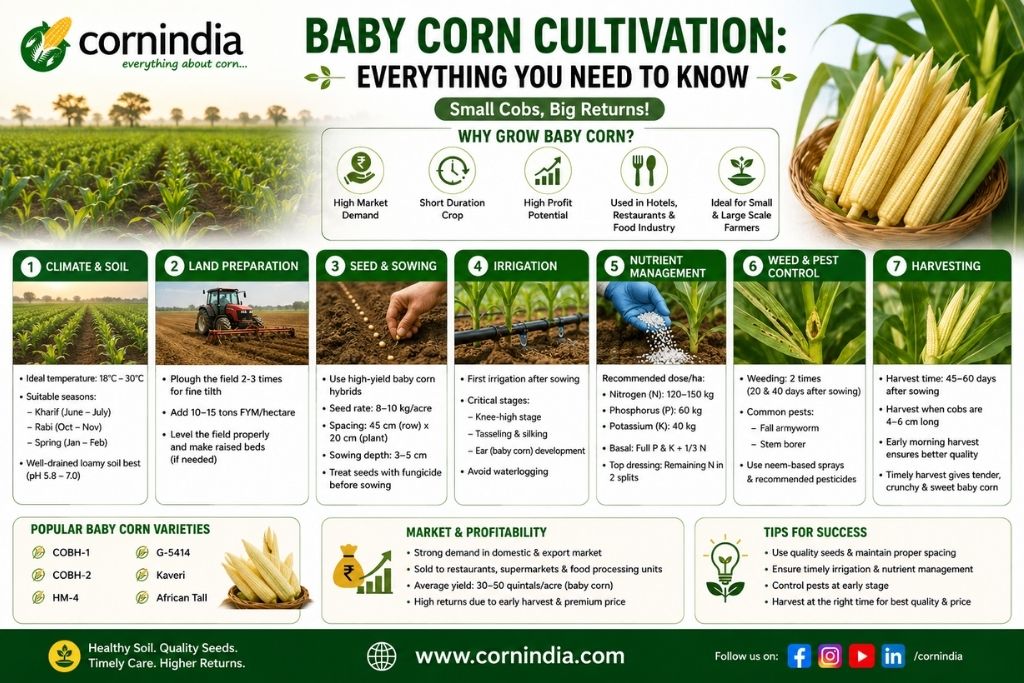
Baby corn is one of those crops that makes you wonder why more Indian farmers aren't growing it.
It's ready to harvest in just 55–65 days — faster than almost any other commercial crop. You can grow it year-round in most parts of India (except December and January). It produces multiple harvests from a single planting. And unlike field corn that competes at commodity prices, baby corn sells as a vegetable — at vegetable prices.
Add to this a growing urban market, active export demand, and food processors buying in bulk, and you have a crop with real potential for farm income diversification.
That said, baby corn has its own rules — different from both field corn and sweet corn. Get those right, and you're in good shape. This guide walks you through everything.
What Exactly Is Baby Corn?
Baby corn is the immature ear of a maize plant, harvested 2–3 days after silk emergence, before any fertilisation (pollination) has taken place. The result is a small, tender, finger-sized cob — typically 4–10 cm long — that can be eaten whole, including the cob itself.
It's nutritionally comparable to popular vegetables like cauliflower, cabbage, tomato, and cucumber — high in fibre, vitamin C, folate, and protein. It's low in calories and fat, which is a big part of why urban health-conscious consumers and food processors are buying more of it.
Importantly, baby corn is not a specific plant variety. It's a harvesting method applied to maize. You're harvesting regular maize — just at a very specific, very early stage of ear development.
Why Baby Corn Is Worth Considering
Here's a quick look at why this crop is drawing farmer interest across India:
Short crop cycle: At 55–65 days from sowing, baby corn turns around faster than almost any commercial crop. You can fit 3–4 crops per year on the same field, compounding your income significantly.
Multiple harvests per crop: Each plant produces 3–5 ears. You harvest them in 7–8 separate pickings over the harvest window, each picking just 2–3 days after silk emergence on successive ears. This spreads your income over several weeks rather than one single harvest day.
Year-round cultivation: Planting time is round the year in peninsular India and February to September/October in North India. This means you're not constrained to one or two seasons — you can stagger planting to maintain continuous supply for buyers.
High-value vegetable market: Baby corn sells in fresh produce markets, supermarkets, hotel kitchens, and food service companies at prices far above commodity corn. Processed baby corn (canned, frozen, IQF) commands premium pricing in both domestic and export markets.
Export demand is growing: India ranks among the largest global baby corn exporters, with shipments going to 164+ countries worldwide. Key import markets include the United Kingdom, the UAE, and Singapore.
Global market tailwinds: The global baby corn market is projected to grow from approximately USD 1.2 billion in 2024 to USD 2.5 billion by 2033, at a CAGR of 9.1%. India is well-positioned to capture a larger share of this expanding pie.
Bonus income from fodder: After each ear harvest, the remaining plant — including the stover, husk, silk, and tassels — provides excellent green fodder for livestock. This is an additional revenue stream that most other vegetable crops don't offer.
Choosing Your Variety
No maize variety has been bred exclusively for baby corn production in India — yet. Baby corn farmers choose early-maturing, prolific varieties that produce multiple ears per plant and flower uniformly across the field. Uniform flowering matters because it means all your plants produce baby corn at roughly the same time, reducing the number of harvesting visits.
At the time of variety selection, preference should be given to short stature and prolific cultivars. Hybrids are preferred over open-pollinated varieties because hybrids have more uniform flowering, requiring only 4–5 pickings. Non-uniform flowering of open-pollinated varieties leads to prolonged harvesting.
Recommended varieties for baby corn in India:
| Variety / Hybrid | Type | Notes |
|---|---|---|
| HIM 123 | OPV | Popular in hill states; prolific ear production |
| VL-42 | OPV | Suitable for multiple agro-climatic zones |
| HIM 129 | OPV | Early maturing; good for northern India |
| Prakash | Composite | Early, prolific; widely used |
| PEHM 1 & 2 | Hybrid | Good uniformity; recommended for peninsular India |
| HM 4 | Hybrid | Superior yield and nutritional quality in kharif |
| HQPM 1 | Hybrid | Quality protein maize; good baby corn yield in rabi |
Ask your local KVK or seed supplier for the variety that performs best in your specific agro-climatic zone. Performance varies significantly by region — a variety that excels in Karnataka may not give the same results in Bihar.
Season and Sowing
When to sow:
- Kharif: May end to June (aligned with monsoon onset)
- Rabi: October to November
- Spring/Zaid: February to March
- Avoid sowing in December and January — cold temperatures slow germination and early growth significantly
For agri-businesses building a year-round supply chain, staggered sowing every 3–4 weeks across your contract farmer network is the standard approach to ensure continuous harvest flow to processors.
Soil requirement: Baby corn grows well in most soil types, but soils with fine organic matter and good water-holding capacity, with a pH ranging from 5.5 to 7.5, are required to maximise yield. Heavy clay soil is not suitable. Do a soil test before the first crop if you haven't already — it's the simplest way to identify nutrient gaps upfront.
Two planting systems — choose one:
System 1 — Standard population (58,000 plants/ha): The top ear on each plant is reserved for grain corn or sweet corn, and the subsequent lower ears are harvested as baby corn. This system is more economical on seed but gives lower baby corn yields per hectare. Suitable for farmers who want to hedge between baby corn and grain income.
System 2 — High plant population (1,75,000 plants/ha): The entire plant output is directed toward baby corn. Tighter spacing means more plants, more ears, and significantly higher baby corn yield. The high plant population system produces yields of about 93–106 quintals of unhusked ears per hectare (9.3–10.60 quintals of husked ears), compared to about 46.5 quintals of unhusked ears per hectare under standard populations. This system is preferred by farmers with secure market linkages and processor contracts.
Seed rate: A seed rate of 20–25 kg/ha is recommended to maximise cob production.
Spacing:
- Standard population: 60 × 20 cm (row × plant)
- High population: closer spacing of 30–40 cm between rows and 15–20 cm between plants
Sowing depth: 3–5 cm in moist soil. Sow 2 seeds per hole and thin to 1 plant after germination.
Fertiliser Management
Baby corn is a nutrient-intensive crop, especially since you're cycling it 3–4 times a year on the same land. Replenishing soil nutrients between crops is essential to maintain yield across seasons.
Organic base: Apply 5–6 tonnes of well-decomposed Farm Yard Manure (FYM) per acre at field preparation. This improves soil structure, water retention, and provides a slow-release nutrient base.
Chemical fertiliser schedule (per hectare):
| Nutrient | Dose | Timing |
|---|---|---|
| Nitrogen (N) | 150–200 kg/ha | Split into 3 equal doses |
| Phosphorus (P₂O₅) | 60 kg/ha | Full dose as basal at sowing |
| Potassium (K₂O) | 40 kg/ha | Full dose as basal at sowing |
Nitrogen is applied at the basal dose at the time of sowing, at knee-high stage (20–25 DAS), and at pre-tasselling stage (40–45 DAS).
Micronutrients: Add zinc sulphate (10 kg/acre) at sowing. Zinc deficiency is common in intensively farmed soils and shows up as pale-yellow leaf striping with reddish veins.
Water requirement: Baby corn requires 400–425 mm of irrigation water with critical stages at baby corn initiation (26–40 DAS) and baby corn development (41 days to harvest). Plan your irrigation schedule around these two windows — any moisture stress here directly reduces cob size and quality.
The Operation That Changes Everything: Detasseling
If there's one practice that separates high-yield baby corn farming from average baby corn farming, it's detasseling — and it's unique to baby corn cultivation.
The tassel is the male flowering structure at the top of the maize plant. In normal grain corn, pollen from the tassel fertilises the silks on each ear, and fertilised silks develop into grain. In baby corn, you want unfertilised ears — because fertilisation causes the kernels to develop and the cob to harden, ruining the baby corn.
Detasseling means physically removing the tassel as soon as it emerges, before it sheds pollen.
Detasseling is an important operation in baby corn cultivation, done soon after tassel emergence. Here's how to do it right:
- Timing: Remove the tassel as soon as it is visible emerging from the top leaf whorl — typically around 45–50 days after sowing
- Method: Pull or snap the tassel cleanly from the plant by hand. Remove the entire structure, including any attached leaves if they are tightly wrapping the tassel
- Frequency: Check your field daily once tassels begin emerging. Not all plants tassel at the same time — stagger your detasseling accordingly
- Labour requirement: Detasseling is labour-intensive. For 1 acre, plan for 4–6 person-days of work over the detasseling window
After detasseling, the plant puts its energy into developing ears rather than producing pollen. This results in more, better-quality baby corn cobs per plant.
Harvesting Baby Corn
Harvesting timing is everything in baby corn. Miss the window and you lose quality; wait too long and the cob starts developing into a mature grain corn ear.
When to harvest: Ears are harvested when the silks are 1–2 cm long — typically 45–50 days after emergence. At this stage the silk has just barely emerged from the husk. The cob inside is tender, 4–10 cm long, and has not been fertilised.
How to check: Gently peel back the husk tip. The baby corn inside should be white to pale yellow, firm but tender, with no developed kernels visible.
Harvest frequency: Baby corn is harvested in 7–8 pickings. Because successive ears on each plant emerge at different times (the top ear first, then lower ears over the following days and weeks), you return to the field every 2–3 days to collect newly emergent baby corn ears at the correct stage.
Handle with care: Baby corn bruises easily and loses freshness quickly at ambient temperatures. Harvest in the early morning. Collect in clean, ventilated baskets or crates. Get it to buyers or cold storage within 6–12 hours of harvest for maximum quality and shelf life.
Expected yields:
- Standard population: ~46.5 quintals unhusked ears per hectare (~4.5 tonnes husked)
- High population: ~93–106 quintals unhusked ears per hectare (~9.3–10.6 tonnes husked)
Pest and Disease Management
Baby corn follows the same pest and disease pressures as regular maize — but with one critical difference: the harvest window is extremely short, so you need to act fast when you spot any issue.
Key pests:
Stem borer: The most common pest. Larvae bore into the stem causing dead hearts in young plants and damage to ears in older plants. For control of stalk borers, Endosulfan 35 EC @ 2 ml/litre is sprayed on 10–14 days old plants, or use more modern alternatives like chlorantraniliprole (Coragen) per current pesticide guidelines.
Fall Armyworm (FAW): Install pheromone traps @ 5 per acre from the very beginning. At first sign of infestation in the whorl, spray emamectin benzoate into the funnel of the plant.
Aphids: Particularly common in rabi. Seed treatment with Thiamethoxam provides good early-season protection.
Key diseases:
Turcicum and Maydis Leaf Blight: Manage with mancozeb or propiconazole sprays. Focus on lower canopy spraying where these diseases start.
Downy Mildew: Treat seeds with Metalaxyl before sowing in areas where downy mildew has been observed previously.
Important: Stop all chemical spraying at least 7–10 days before the expected harvest date for food safety compliance — particularly critical if you're selling to processors or exporters with pesticide residue testing requirements.
The Market Opportunity for Agri-Businesses
This section is for agri-businesses, aggregators, and entrepreneurs thinking about baby corn as a supply chain or processing opportunity.
Domestic market: Urban India's appetite for baby corn is growing steadily. Quick-service restaurants, hotel chains, packaged food companies, and fresh produce supermarket aisles all want consistent, quality-graded baby corn year-round. Most don't have reliable direct farm linkages — this is the gap.
Export market: India's baby corn sector has "strong future potential as a niche, high-value crop," especially when tied to processing industries that add 40–50% to raw value. The processed formats — canned, frozen, IQF — are where margins improve significantly.
India could mirror Thailand's success, which dominates 70% of global canned baby corn. The infrastructure gap is real, but so is the opportunity for processors willing to build grading, processing, and cold chain facilities connected to farmer clusters.
Quality requirements for export: EU pesticide residue limits and US FDA standards are the key hurdles. Any agri-business targeting export markets needs to work with farmers on Good Agricultural Practices (GAP), certified inputs, and spray calendar discipline — particularly the pre-harvest interval for pesticides.
Domestic retail: Domestic retail packs are rising, now accounting for 15% of sales — a trend that's been accelerating as urban consumers look for fresh, healthy, convenient vegetables.
FPO opportunity: Farmer Producer Organisations (FPOs) that can aggregate baby corn from 50–100 smallholder farmers within a 20–30 km radius, provide a centralised cleaning and grading facility, and connect to a processor or hotel chain — this model works, and works well. Baby corn's year-round production cycle makes it ideal for FPO-based aggregation.
Economics at a Glance
| Item | Approximate figure |
|---|---|
| Crop duration | 55–65 days per cycle |
| Cycles per year | 3–4 |
| Seed rate | 20–25 kg/ha |
| Cost of cultivation | ₹20,000–₹28,000/acre per cycle |
| Husked yield | 4.5–10.6 tonnes/hectare (system-dependent) |
| Farm gate price (fresh) | ₹15–₹40/kg (market and grade dependent) |
| Processing / export price | ₹40–₹80/kg (IQF / canned) |
| Net income estimate | ₹25,000–₹55,000/acre per cycle |
| Additional fodder income | ₹3,000–₹8,000/acre per cycle |
Multiply your per-cycle income by 3–4 and you begin to see why baby corn interests serious farming entrepreneurs.
Three Things to Get Right Before You Start
1. Secure a buyer before you sow. Baby corn is perishable. Without a buyer or processor lined up, you'll be forced to sell at whatever the local mandi offers — which may not cover your input costs. Processors, hotels, FPOs, and aggregators should be approached before the first seed goes in the ground.
2. Plan your detasseling labour. Detasseling is non-negotiable for quality baby corn, and it requires consistent daily attention over 7–10 days. Make sure you have the labour arranged before tasselling time arrives — typically around day 45 after sowing.
3. Think about cold chain early. At ambient temperatures, baby corn shelf life is 2–3 days at best. If you're growing at scale or targeting processors, you need a cold chain plan — even a shared cool room within 10–15 km of your farm makes a significant difference in the quality you can deliver.
Final Thoughts
Baby corn is a real opportunity for Indian farmers and agri-businesses who are willing to manage it with the attention it deserves. Short cycles, multiple harvests, year-round production, and a growing market both domestically and in export channels — the fundamentals are strong.
The farmers who make money from baby corn are the ones who treat it as a vegetable business, not a grain business. That means buyer relationships, quality discipline, cold chain thinking, and timely harvesting — not just planting and hoping.
At CornIndia, we have deep roots in India's maize ecosystem and can help you navigate variety selection, buyer connections, and agronomy decisions for baby corn. Get in touch — we'd love to help you grow.
Related reads on CornIndia: How to Grow Sweet Corn in India: A Step-by-Step Guide | Sweet Corn vs Field Corn: What's the Real Difference? | Baby Corn Varieties & Uses








0 Comments