
Every season, millions of Indian maize farmers face the same decision at the seed shop: do I buy the expensive hybrid, or go with the open-pollinated variety?
The seed dealer usually has an opinion. Your neighbour has a different one. The internet gives you ten more. And somewhere in the middle of all that noise, you still have to make a call — because planting season doesn't wait.
This post won't tell you what to buy. What it will do is give you a clear, honest picture of what hybrids and OPVs actually are, what each does well, where each falls short, and — most importantly — which type suits your specific situation as a farmer.
For seed companies reading this: the second half of the post has a section specifically on what this hybrid-vs-OPV landscape means for variety development, positioning, and farmer outreach strategy in India.
Let's get into it.
What's the Actual Difference? A Quick Primer
Before the pros and cons, it helps to understand what you're actually comparing.
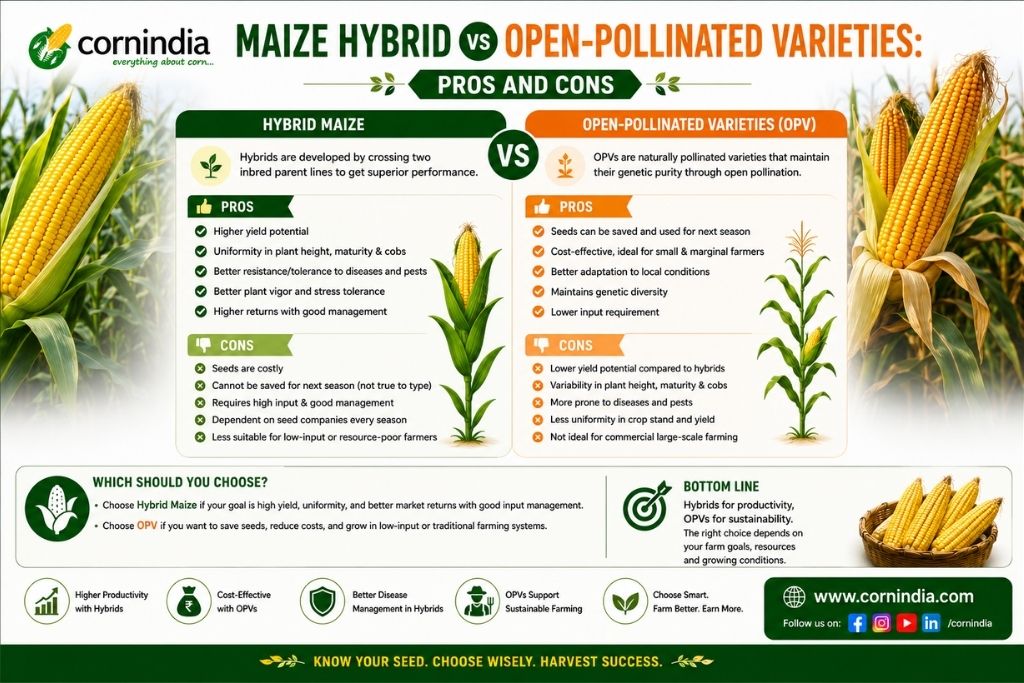
Hybrid maize varieties are developed by crossing two genetically distinct parent lines. The resulting seed — called an F1 hybrid — captures what plant breeders call heterosis or "hybrid vigour." This means the F1 plant often outperforms both parent lines in yield, uniformity, and stress tolerance. It's a well-established breeding achievement. The trade-off: if you save seed from a hybrid crop and replant it next season, you get F2 plants that have lost that hybrid vigour. Performance drops — sometimes significantly. So you need to buy fresh hybrid seed every season.
Open-pollinated varieties (OPVs) are varieties that have been bred through selection over many generations and stabilised. They pollinate freely, and their offspring are genetically similar to the parents. The practical advantage: you can save seed from your own harvest and replant it with minimal yield penalty. OPVs can also be improved on-farm over time by selecting the best cobs for seed — a practice Indian farmers have used for centuries. The trade-off: OPVs generally yield less than top-performing hybrids under high-input, irrigated conditions.
Both types are available in India from government breeding programmes (ICAR, SAUs) and private seed companies. Both have a genuine role to play in Indian maize farming — just in different contexts.
Hybrid Maize: The Full Pros and Cons
Pros
1. Higher yield potential — meaningfully so This is the headline advantage of hybrids, and it's real. The adoption of hybrid maize varieties reflects farmers' growing recognition of yield advantages that can exceed 25–35% compared to traditional open-pollinated varieties. Under good management with irrigation and proper fertilisation, elite hybrids like Pioneer 3369, DKC 9081, or ICAR's DMRH 1308 can push 30–40 quintals per acre, where a comparable OPV might give 20–30 quintals.
2. Uniformity — a big deal for commercial farming Hybrids are bred for phenotypic consistency. Every plant in your field flowers at roughly the same time, reaches the same height, and produces cobs of similar size. For commercial maize farmers supplying starch processors, poultry feed companies, or aggregators with quality specifications, this uniformity means more consistent moisture content, grain weight, and delivery scheduling.
3. Specific trait packages Modern private-sector hybrids often come with targeted traits: drought tolerance, fall armyworm resistance, high starch content for feed efficiency, or resistance to specific leaf blight strains prevalent in a particular region. Non-transgenic hybrids represent the fastest-growing subsegment within this category, benefiting from regulatory clarity and consumer acceptance while delivering enhanced traits through conventional breeding approaches.
4. Shorter crop duration Many commercially popular hybrids are bred for earlier maturity — 85–100 days compared to 100–120 days for many OPVs. Faster turnover means you can plan a second crop or a rabi rotation more easily.
5. Better stress response at high-input conditions When you're investing in irrigation, fertilisers, and pest management, hybrids are designed to respond to those inputs with maximum yield. The more you put in agronomically, the more hybrids return relative to OPVs.
Cons
1. Must buy fresh seed every season — at a significant cost This is the most important downside for cost-sensitive farmers. Hybrid maize seed used in states like Punjab costs about ₹700–₹1,000 per kg during peak season, with nearly 100% of it currently produced in southern India (Telangana and Andhra Pradesh) and transported north — significantly increasing seed and cultivation costs. At 8–10 kg of seed per acre, that's ₹5,600–₹10,000 in seed cost alone per acre, every single season, with no option to save seed.
2. F2 seed recycling collapses yield Farm-saved hybrid seed loses genetic performance in the second generation — germination commonly drops to 75–85%, and purity is harder to verify without lab testing. Farmers who try to save hybrid seed to cut costs typically find themselves with an unpredictable, underperforming crop the next season.
3. Input-dependent performance Hybrids are bred to express their full yield potential under adequate moisture, nutrition, and crop protection. In a drought year, or on a farm where fertiliser is applied below recommended doses, the yield advantage of hybrids shrinks considerably. An OPV, being more genetically diverse, may handle adversity more gracefully.
4. Market concentration risk for farmers A handful of large private seed companies control a significant share of India's commercial hybrid seed supply — Bayer-DEKALB, Pioneer (Corteva), Syngenta, Kaveri, Nuziveedu, and a few others. This gives seed companies pricing power over the farmer. Year-to-year price changes, availability disruptions, or discontinuation of a particular variety can leave farmers scrambling mid-season.
Open-Pollinated Varieties: The Full Pros and Cons
Pros
1. Seed saving — the economics are powerful The ability to save, store, and replant your own seed is OPVs' defining advantage. For OPV varieties, farm-saving is agronomically sound and the FAO actively supports seed-saving programs in smallholder farming regions — provided farmers run a germination test before every planting season and adjust their seed quantity accordingly. An OPV like Ganga Safed 2 may yield about 40–50 quintals per acre — slightly less than top hybrids — but farmers can save seed for use in the upcoming season, which cuts input costs significantly.
2. Better suited to low-input and rain-fed conditions In some farming systems — particularly where yield levels are low (below 1.5 t/ha) and hybrid seed and fertiliser prices are high relative to the price of grain — the highest return on investment may result from using improved OPV seed, which is cheaper than hybrid seed and can be recycled with little or no yield loss. This is an important finding for small and marginal farmers in rain-fed zones of Rajasthan, Madhya Pradesh, or hill states.
3. Genetic diversity and resilience OPVs carry more genetic diversity than hybrids. In practice, this can mean a more variable but more resilient crop response under unpredictable weather. A field of OPVs might have some plants that handle drought better than others — building in a natural buffer. Hybrids, being genetically uniform, either all do well or all suffer together when conditions deviate.
4. On-farm improvement over time Farmers can select the best cobs from their OPV harvest for replanting — a practice known as mass selection. Done consistently over several seasons, this can slowly improve the performance of an OPV in your specific micro-environment. No hybrid allows this — you get what the breeder designed and that's it.
5. Accessible through government channels ICAR-developed OPVs and composites like Shaktiman, Kanchan, VL-42, and HIM 123 are available through government seed agencies, KVK seed banks, and Seed Villages at prices far below private-sector hybrids. For farmers in remote or underserved locations where supply chains for certified hybrid seed are unreliable, OPVs provide a dependable fallback.
Cons
1. Lower yield ceiling Under well-managed, irrigated, high-input conditions, OPVs simply cannot match the top-performing hybrids. Four elite hybrids consistently produced about 18% more grain yield than 10 improved elite OPVs when grown at 16 sites with mean yield between 1.8 and 7.3 t/ha. For progressive farmers investing in drip irrigation, precise fertiliser scheduling, and modern crop protection — this yield gap is real money left on the table.
2. Less uniformity Because OPVs are genetically diverse, plant-to-plant variation in height, flowering time, and cob size is greater than in hybrids. This isn't a problem for subsistence or local-market farming, but it matters for commercial contracts where buyers specify grain size, moisture percentage, or harvest date windows.
3. Fewer trait-specific options The pipeline of new, improved OPVs for Indian maize farmers is thinner than the hybrid pipeline. Most R&D investment from private seed companies goes into hybrid development because hybrids generate recurring seed revenue. ICAR and international institutions like CIMMYT do develop improved OPVs, but the pace and commercial distribution don't match the private hybrid ecosystem.
Head-to-Head Comparison
| Factor | Hybrid | OPV |
|---|---|---|
| Yield potential | 25–35% higher under good inputs | Moderate — suits low-input conditions |
| Seed cost | ₹700–₹1,000/kg (certified hybrid) | ₹15–₹50/kg (government / farm-saved) |
| Seed saving | Not viable (F2 performance drops sharply) | Fully viable; FAO-recommended for smallholders |
| Uniformity | High — good for commercial contracts | Moderate variation across plants |
| Stress resilience | Good under managed stress | More adaptable to unmanaged variability |
| Input dependency | High — yields best with good nutrition & irrigation | More forgiving at lower input levels |
| Trait packages | Strong — drought, pest, quality traits available | Limited — depends on public breeding pipeline |
| Crop duration | Often shorter (85–100 days) | Often longer (100–120 days) |
| On-farm improvement | Not possible | Possible through mass selection |
| Market alignment | Better for commercial / processor supply chains | Better for subsistence / local markets |
Who Should Choose What?
Here's a simple framework to guide your decision:
Lean toward hybrids if you:
- Have reliable irrigation (canal, borewell, or drip)
- Are supplying commercial buyers — poultry feed mills, starch processors, aggregators
- Can invest in full recommended doses of fertiliser and crop protection
- Farm 5+ acres and want maximum yield per acre
- Are growing for rabi season, where yield potential is highest
Lean toward OPVs if you:
- Farm primarily rain-fed land with unpredictable moisture
- Are a small or marginal farmer (1–3 acres) where seed cost is a significant proportion of your total input budget
- Are in a remote area where certified hybrid seed supply is unreliable or arrives late
- Farm in hill regions where ICAR hill-adapted OPVs (VL Maize-16, HIM 129, HIM 123) are better suited to local conditions
- Practice organic or low-external-input farming
The middle ground: Some progressive farmers use a mixed strategy — hybrids on their best-irrigated, highest-input plots for maximum commercial yield, and OPVs on more marginal or rain-fed plots to control costs. This approach diversifies risk while still capturing hybrid yield premiums where conditions justify the seed cost.
A Note for Seed Companies
For seed companies operating in India's maize market, the hybrid-vs-OPV debate has direct strategic implications.
Hybrid seed remains the commercial core — and rightly so, given the yield performance data. The India maize seed market's dominant segment reflects farmers' increasing recognition of hybrid varieties' economic advantages, with yield premiums of 25–35% over open-pollinated varieties justifying higher seed costs in commercial farming operations.
But there are two emerging dynamics worth watching:
Local seed production is reducing cost barriers. ICAR-IIMR's successful hybrid seed production trial in Punjab using DMRH 1308 demonstrated that quality hybrid seed can be produced locally, with farmers earning net returns of ₹3.75–₹4.0 lakh per hectare from seed production — more than double what they earn from commercial grain maize. The long-term implication: as more local seed production infrastructure develops, hybrid seed prices in northern states could fall, making hybrids accessible to a broader farmer base — and potentially shifting the OPV segment downward.
Improved OPVs remain an underserved opportunity for companies willing to invest in them. Farmers in rain-fed zones, hill regions, and low-input environments are a significant portion of India's maize growing area. A well-positioned improved OPV — with a clear "save your seed" story and priced accordingly — could build strong farmer loyalty in segments where private hybrids have struggled to penetrate.
The farmers who have the least access to credit, irrigation, and commercial markets are also the most likely to grow maize year after year regardless of input prices. Serving them well with quality OPVs builds long-term brand equity in markets that the premium hybrid segment often overlooks.
Final Thoughts
There is no universal right answer in the hybrid vs OPV debate — and anyone who tells you otherwise is probably selling something.
What there is, is a clearer question: what are your farm's conditions, your input budget, and your market destination? Answer those honestly, and the variety choice becomes much more straightforward.
For most progressive Indian farmers with irrigation access and commercial market linkages, hybrids will continue to be the dominant choice — the yield and uniformity advantages are simply too significant to ignore when conditions support them.
For small and marginal farmers in rain-fed zones, improved OPVs remain a genuinely rational, economically sound option — particularly when the money saved on seed is redirected into fertiliser or better crop management.
At CornIndia, we work with farmers across both ends of this spectrum and can help you think through the right variety choice for your specific farm and market context. Get in touch — we're here to help you grow.



0 Comments