
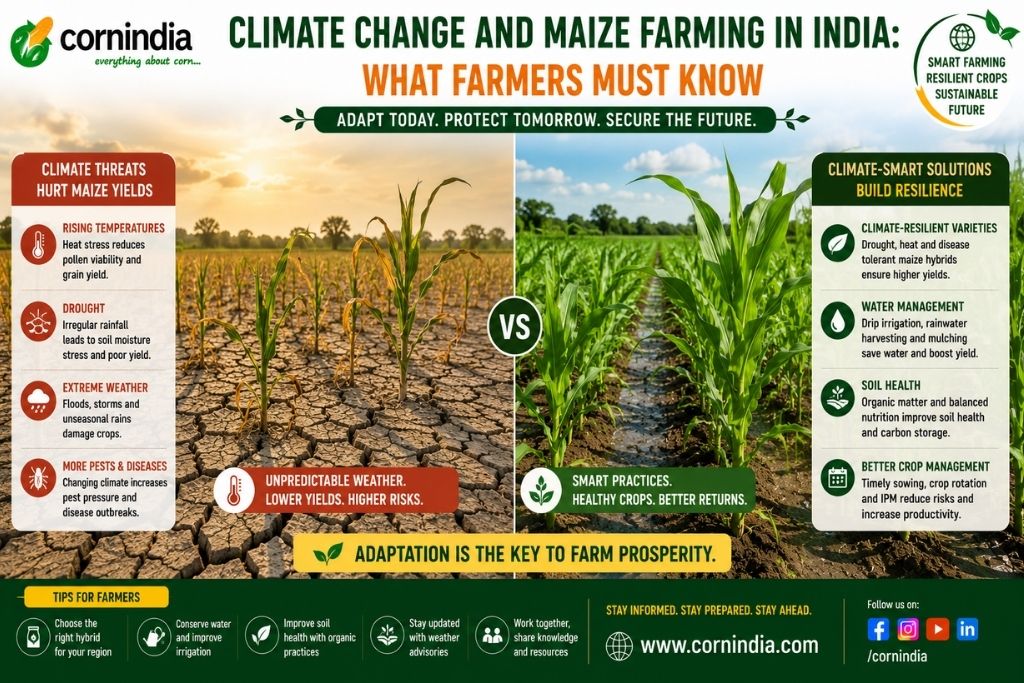
Every maize farmer in India has already noticed something researchers have spent the last decade documenting formally: the monsoon doesn't behave the way it used to. Sowing windows are shifting. Heat spikes arrive at exactly the wrong crop stage. Dry spells stretch longer, then break with intense, damaging rain instead of steady showers.
This isn't a future problem — it's a present one, already measurably affecting yields. But it's also a problem India's maize research institutions have been actively working on, and the resilient hybrids and practices coming out of that work are genuinely worth understanding, whether you're managing a field or studying the trend lines.
This post covers both halves honestly: what the research says is happening and projected to happen, and what's actually being done about it — in breeding programmes and in practical farm-level adaptation.
What the Research Actually Shows
The yield projections — and why the range matters
Climate change is projected to reduce kharif maize yields by 18% in the 2050 scenario and 23% in the 2080 scenario, according to Government of India research cited by the Press Information Bureau. A separate, independently sourced analysis arrives at a strikingly similar figure: without adaptation, rain-fed rice yields are projected to fall 20% by 2050, wheat yields by 19%, and maize by 18%.
It's worth being upfront about why you'll see a range of numbers rather than one definitive figure across different sources. More conservative, shorter-term assessments suggest maize and pulses — both vulnerable to drought and heat — could see losses ranging from 5-15% in sensitive areas under current rainfall variability, even before accounting for the more severe long-term 2050-2080 projections. Climate projections vary because they depend on which emissions scenario is assumed, which climate models are used, and how much adaptation is built into the calculation. The consistent signal across every study, despite this range, is a meaningful downward pressure on yield without intervention — not whether that pressure exists, but how large it will ultimately be.
Research specifically modelling rabi maize in Tamil Nadu under changing northeast monsoon patterns confirms this directional finding for southern India specifically — climate variability is expected to affect maize productivity in the region, consistent with broader national projections.
Why maize is specifically vulnerable
Although maize is usually considered a warm-season crop, it is actually more sensitive to high temperatures than many people assume — a fact that surprises farmers who associate "warm-season" with heat tolerance. The reality is more specific: maize tolerates warmth well within a moderate range, but has a narrow window of ideal temperature during its most critical growth stages — tasselling, silking, and grain filling — beyond which yield drops sharply.
Elevated temperatures exceeding 35°C can reduce yield by up to 20% if adaptive strategies are not implemented. This single data point explains a huge share of the season-to-season yield variability many maize farmers already experience without necessarily attributing it to a specific temperature threshold being crossed at exactly the wrong crop stage.
The two-sided water problem
The Indian monsoon is the lifeline for over 65% of the country's farmland, which is rain-fed with no assured irrigation access. Rainfall patterns have become increasingly unpredictable — shifts in monsoon timing disrupt sowing schedules and crop calendars, rainfall intensity and distribution are shifting toward more frequent short, heavy downpours rather than gentle, prolonged rainfall, and there are longer dry spells or droughts in central and southern India alongside more intense rain and flooding events in eastern and northern regions.
This "two-sided" nature of the water problem is important to understand precisely: it's not simply "less water." It's less reliable water, delivered in more damaging patterns — dry spells at critical growth stages followed by flooding rain that causes waterlogging and stalk rot, rather than the steady, well-distributed rainfall that maize actually needs.
Where the risk concentrates geographically
Of India's 787 districts, 109 have been assessed as carrying very high climate risk and 201 as high climate change risk, based on the country's Third National Communication and Initial Adaptation Communication. Major contributing factors to this risk include low access to irrigation, high frequency of droughts, cyclones, or floods, rising minimum temperatures, small farm sizes, and high-value assets located in hazard-prone areas.
The practical implication for maize specifically: rain-fed kharif maize grown by small and marginal farmers in districts with limited irrigation infrastructure carries meaningfully higher climate exposure than irrigated maize grown by farmers with reliable water access — a distinction that matters enormously when thinking about who needs adaptation support most urgently.
The nutrition dimension researchers are tracking
Beyond yield, climate change reduces crop yields and also lowers the nutritional quality of produce — an area of ongoing research that adds a layer of concern beyond simple tonnage figures. This is a newer, less publicly discussed area of climate-agriculture research, but one that researchers increasingly flag as a compounding concern rather than a separate issue from yield decline.
ICAR's Climate-Resilient Maize Breeding: What's Being Built
This is the genuinely encouraging half of the story, and it deserves equal weight to the risk projections above.
The scale of the national effort
Between 2014 and 2024, ICAR and its associated institutions developed 2,661 crop varieties tolerant to both biotic stresses (pests, diseases) and abiotic stresses (drought, heat, salinity), spanning cereals, oilseeds, pulses, fibre crops, forage, and sugarcane. Of these, 537 varieties were specifically bred for extreme climatic conditions, using advanced precision phenotyping tools for accurate trait selection.
Maize is a direct part of this broader effort. Among 184 newly released crop varieties showcased in a recent ICAR Leadership Programme, several possess special traits including tolerance to drought, flood, and salinity, alongside resistance to major pests and diseases — traits specifically intended to help farmers cope with climate variability and ensure stable production. Four maize hybrids/varieties were among the varieties developed by ICAR institutions in this release.
Multi-environment stress testing — the science behind resilient hybrids
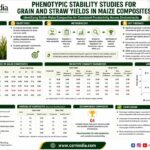
ICAR-IIMR's breeding approach for climate resilience isn't guesswork — it's built on systematic multi-location stress testing. A recent study evaluated 20 sub-tropical maize hybrids alongside 5 commercial checks across different stress ecologies — drought, high temperature, waterlogging, and optimum conditions — at multiple locations, assessing genotype-by-environment interactions to identify genuinely stable, adapted genotypes rather than hybrids that only perform well under ideal conditions.
The testing conditions themselves illustrate exactly what Indian maize now has to survive: at one high-temperature testing site, maximum temperatures reached 42.7°C during the critical flowering period, with grain yields across tested genotypes still ranging from 4.43 to 56.14 quintals per hectare — a massive spread showing that some hybrids collapse almost completely under this stress while others maintain meaningful yield. That performance gap between the best and worst-performing genotypes under identical extreme stress is precisely what climate-resilient breeding aims to close — pulling the whole distribution toward the high-performing end.
Specific released hybrids with documented stress tolerance
ICAR-IIMR has released rabi hybrids specifically noted as tolerant to Turcicum leaf blight and charcoal rot — a disease whose incidence rises under the drought stress conditions climate change is expected to intensify — with these hybrids recommended across Eastern UP, Bihar, Jharkhand, West Bengal, Odisha, Rajasthan, Gujarat, Chhattisgarh, and Madhya Pradesh.
Among newer releases, IQMH 203 — a Quality Protein Maize hybrid — has shown resistance to Fusarium stalk rot and moderate resistance to downy mildew and other stresses under artificial epiphytotic (disease-inducing) test conditions at known hot spots, while also delivering yield superiority of 29.0%, 35.7%, and 28.0% over relevant best checks across three years of testing. This is a useful example of modern breeding pursuing multiple goals simultaneously — stress tolerance, disease resistance, and yield gain, together rather than as separate trade-offs.
The biotechnology acceleration question
At a September 2025 workshop at ICAR-IIMR Ludhiana, experts explicitly called for urgent adoption of biotechnology tools to boost yields, strengthen resilience, and ensure farmer prosperity, given climate stress and yield gaps facing India's maize sector. Integration of biotechnological tools into conventional maize breeding programmes has the potential to enhance genetic gain and breeding efficiency, potentially contributing a 10-15% yield improvement — benefiting farmers as well as the feed and ethanol industries, according to Dr. H.S. Jat, Director of ICAR-IIMR.
This reflects an honest, ongoing debate within Indian maize research: how much of the resilience gain needed to offset climate pressure can come from conventional breeding versus how much requires biotechnology tools whose regulatory pathway in India remains more complex. The workshop specifically flagged regulatory and perception-related challenges as parallel issues to the technical breeding question.
International collaboration strengthening the pipeline
ICAR-IIMR and CIMMYT jointly hosted Maize Field Days in Hyderabad in March 2026, bringing together over 200 scientists from India, Bangladesh, Nepal, Malaysia, Myanmar, and Sri Lanka to exchange germplasm and discuss strategies for climate-vulnerable maize systems across the region — with participants specifically praising the depth of germplasm diversity available for breeding programmes. This kind of regional germplasm exchange is exactly how genetic diversity for drought and heat tolerance — often sourced from different agro-climatic zones and even different countries — gets incorporated into hybrids adapted specifically for Indian conditions.
Practical Adaptation Steps for Farmers Today
Breeding takes years to reach farmers at scale. In the meantime, here's what you can actively do on your own farm right now:
1. Choose stress-tolerant hybrids proactively, not reactively. Ask your seed dealer or KVK specifically about hybrids with documented drought, heat, or waterlogging tolerance for your zone — don't wait for a bad season to make you look for them. ICAR-IIMR's released hybrids with specific stress-tolerance ratings (like those noted above) are a good starting reference point.
2. Adjust sowing dates based on observed local shifts, not just the traditional calendar. If monsoon onset has been consistently shifting in your area over recent years, work with your local KVK to identify a sowing window that better matches actual rainfall patterns rather than the historical calendar date.
3. Prioritise drainage investment for kharif maize. As covered in our soil preparation guide, given the shift toward more intense, concentrated rainfall events, drainage infrastructure — raised beds, field channels — has become more important, not less, even in regions historically considered adequately rain-fed.
4. Consider drip irrigation and precision water management where feasible. As covered in our drip irrigation guide, the combination of erratic rainfall and rising heat stress makes water-use efficiency increasingly valuable — not just for rabi maize, but as supplemental irrigation capability during kharif dry spells.
5. Build soil organic matter as a buffer against both drought and heat stress. Healthy, organic-matter-rich soil holds moisture more effectively during dry spells and buffers root-zone temperature during heat events — one of the reasons why the practices covered in our soil preparation and organic farming posts have relevance beyond their primary purpose.
6. Diversify through intercropping to spread climate risk. As covered in our intercropping guide, a companion crop with different stress tolerance characteristics than maize provides a genuine risk hedge — if maize underperforms in a particular season's specific stress pattern, a well-chosen companion crop may not be affected the same way.
7. Stay connected to your local KVK and AICRP-Maize centre for season-specific advisories. These institutions issue real-time, location-specific guidance during the season — sowing delays, pest pressure changes linked to weather, and variety recommendations — that a generic national guide like this one cannot replicate at the hyperlocal level you need.
What This Means, Honestly
For farmers, the research is not predicting an unmanageable crisis — it's predicting a meaningful yield penalty that adaptation can substantially offset, but not eliminate entirely. The 18-23% figures cited above are explicitly framed as outcomes "without adaptation" — the entire purpose of ICAR's stress-resilient breeding programme and the practical measures above is to close that gap, and multi-location trial data already shows some hybrids maintaining strong yields even under genuinely extreme stress conditions (42°C+ at flowering) where others collapse.
For researchers, the open questions worth continued attention are precisely where ICAR-IIMR's own workshops have focused: how quickly biotechnology-accelerated breeding can be deployed within India's regulatory environment, how effectively genotype-by-environment interaction data can be used to match specific hybrids to specific farmer contexts rather than one-size-fits-all recommendations, and how the yield-quality trade-off (the nutritional quality decline noted in some research) factors into breeding priorities alongside raw tonnage.
The honest, balanced conclusion: climate change is a real and already-measurable pressure on Indian maize yields, the range of projected impact varies by study and timeframe but is consistently directional (negative, without adaptation), and India's maize research institutions are actively and substantively working the problem — not from a standing start, but with real released hybrids, systematic stress testing infrastructure, and active international collaboration already in place.
At CornIndia, we track climate-resilient variety releases and adaptation research closely, alongside practical guidance for farmers navigating a genuinely more unpredictable growing environment. If you need help identifying stress-tolerant hybrid options for your specific district, reach out — we're glad to help you think it through.
Related reads on CornIndia: Soil Preparation for Maize: Getting the Basics Right | Drip Irrigation for Maize: Water Savings and Yield Gains | Intercropping with Maize: Best Companion Crops for Higher Income




0 Comments