
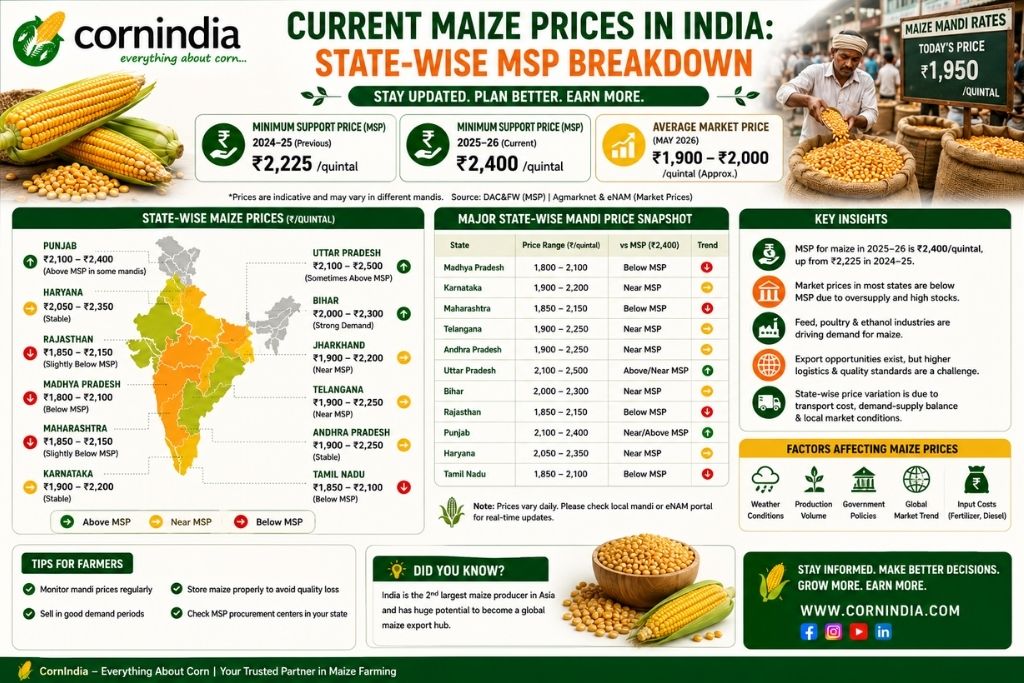
Here's the uncomfortable reality about maize prices in India right now: the government's Minimum Support Price for maize in 2025-26 is ₹2,400 per quintal. But in many mandis across the country, farmers are getting ₹1,600 to ₹1,900 per quintal — sometimes less.
That's a gap of ₹500 to ₹800 per quintal between what the government says you should receive and what the mandi is actually paying. On a 10-acre farm yielding 25 quintals per acre, that gap translates to a loss of ₹1.25 to ₹2 lakh compared to what the MSP promises.
Understanding why this gap exists, which states are most affected, and what options you have as a farmer or agri-business buyer is exactly what this post is about.
The MSP for Maize in 2025-26: What the Government Announced
The Cabinet Committee on Economic Affairs, chaired by Prime Minister Narendra Modi, approved an increase in the Minimum Support Price for maize to ₹2,400 per quintal for the Kharif Marketing Season 2025-26 — an increase of ₹175 per quintal (7.9%) from ₹2,225 per quintal in 2024-25.
The expected margin to farmers over their cost of production for maize is estimated at 59% — the second highest among all kharif crops after bajra (63%). On paper, that's a generous margin. The maize MSP is set at roughly 1.59 times the All-India weighted average cost of production.
A brief history of maize MSP increases:
| Season | MSP (₹/quintal) | YoY Increase |
|---|---|---|
| 2020-21 | ₹1,850 | — |
| 2021-22 | ₹1,870 | ₹20 |
| 2022-23 | ₹1,962 | ₹92 |
| 2023-24 | ₹2,090 | ₹128 |
| 2024-25 | ₹2,225 | ₹135 |
| 2025-26 | ₹2,400 | ₹175 |
The trend is consistently upward. The 2025-26 increase of ₹175 is the largest single-year jump in this period, and it reflects both rising input costs and the government's recognition of maize's growing importance in the ethanol, feed, and starch economy.
What MSP actually means in practice: MSP is a minimum price floor, not a guarantee of what every farmer receives. If market prices drop below the MSP, the government is supposed to step in to purchase the crops, ensuring farmers receive fair value even when market prices fall. In practice, government procurement of maize is limited compared to wheat and paddy — and when open market prices fall below MSP, many farmers have no option but to sell at mandi rates or hold their grain in storage.
What's Actually Happening in Mandis Right Now
Here's where the gap between policy and ground reality becomes stark.
The all-India mandi price for maize is currently around ₹1,710 per quintal — approximately 28% below the MSP of ₹2,400 per quintal.
The bigger crop in kharif 2025 — estimated at a record 28.3 million tonnes, up from 24.8 million tonnes the previous year — has pushed prices lower across major producing states. When supply jumps this sharply in a single season, mandi prices reflect that surplus immediately. Buyers know more grain is coming. Arrivals flood APMCs. And prices fall.
As of mid-June 2026, the average maize mandi price across India is ₹1,900 per quintal, with the lowest prices at ₹1,600 per quintal and the highest at ₹2,300 per quintal.
State-Wise Maize Mandi Prices: The Full Picture
Maize prices vary significantly across states — driven by local supply, proximity to consumption centres (poultry clusters, starch plants, distilleries), quality of grain, and season.
Here's the current state-wise picture based on live APMC mandi data:
Karnataka — ₹1,580 to ₹2,400/quintal
Karnataka is India's second-largest maize producer — and is also the state most visibly affected by the current price slump.
While the Government of India declared an MSP of ₹2,400 per quintal for maize, the prevailing prices in Karnataka were ₹1,600 to ₹1,800 per quintal — far below MSP. Karnataka cultivated maize over 17.94 lakh hectares in the kharif season, with an expected production of over 54.74 lakh metric tonnes — a bumper crop that flooded mandis and crashed prices.
The Karnataka government responded by launching a Market Intervention Scheme for the 2025-26 kharif season, fixing a Market Intervention Price (MIP) of up to ₹2,150 per quintal for maize to compensate farmers for shortfalls below this benchmark.
Current Karnataka mandi prices range between ₹1,580 and ₹2,300 per quintal across different mandis. Prices at Bangalore APMC tend to be higher (around ₹2,300–₹2,400), while more rural mandis like Gadag, Haveri, and Hubli report lower rates closer to ₹1,580–₹2,000.
Key mandis to track: Davangere, Haveri, Belagavi, Challakere, Bellary
Madhya Pradesh — ₹1,800 to ₹2,601/quintal
MP is now India's largest maize-producing state, and its mandi price range reflects this volume. Madhya Pradesh has 49–62 mandis actively tracked for maize, with the highest modal rates at ₹2,400–₹2,601 per quintal in some markets.
MP prices tend to be slightly better than Karnataka because the state has stronger direct linkages to poultry feed suppliers and starch processors in central India who procure at or near MSP. Districts closer to processing units (Chhindwara, Sagar, Ujjain) generally fetch better prices than remote rural mandis.
Key mandis to track: Chhindwara, Sagar, Damoh, Mandsaur, Jhabua
Bihar — ₹1,800 to ₹1,950/quintal
Bihar's rabi maize is widely regarded as premium-quality grain — high moisture uniformity, good grain weight — and is valued by Southeast Asian buyers and domestic feed mills. However, Bihar's current tracked mandi prices show the highest modal rate at ₹1,950 per quintal, well below the national MSP.
Part of the issue in Bihar is poor market infrastructure — fewer APMC mandis, longer distances to major consumption centres, and limited cold storage and silos at the farm level. Farmers in Bihar are often dependent on local traders who buy grain at a discount and sell it forward to processors at better prices, capturing the margin that should reach the farmer.
Key mandis to track: Khagaria, Samastipur, Muzaffarpur, Begusarai
Telangana — ₹1,709 to ₹2,400/quintal
On June 11, 2026, maize mandi prices in Telangana ranged between ₹1,709 and ₹2,400 per quintal, with an average modal rate of about ₹2,035 across 12 mandis.
Like Karnataka, Telangana has taken market intervention steps. Mandis in Adilabad and Medak districts (closer to poultry and feed industry clusters) tend to fetch prices near or at MSP. Mahbubnagar and Nalgonda districts report lower rates, reflecting weaker local demand and higher arrivals.
States such as Karnataka and Telangana have started market intervention measures to support farmers facing mandi prices below MSP.
Key mandis to track: Zaheerabad, Nizamabad, Karimnagar, Khanapur, Siddipet
Maharashtra — ₹2,100 to ₹2,750/quintal
Maharashtra consistently shows relatively better price realisations compared to most other maize states. Maharashtra has 27 mandis tracked, with the highest modal rate at ₹2,700 per quintal. Mumbai (₹2,500–₹3,400/quintal) and Pune/Sangli (₹2,400–₹2,500/quintal) show the strongest rates — driven by proximity to large food processing and starch industries.
Andhra Pradesh — ₹1,900 to ₹2,400/quintal
Andhra Pradesh has 12 mandis tracked, with the highest modal rate at ₹2,400 per quintal. Coastal districts (East and West Godavari, Krishna) typically get better prices due to proximity to port-based buyers and processing units. Interior districts face the same sub-MSP pressure as Karnataka and Telangana.
Rajasthan — ₹1,800 to ₹2,400/quintal
Rajasthan's highest tracked modal rate is currently around ₹2,173–₹2,400 per quintal across 7–10 mandis. Southern districts (Bhilwara, Udaipur, Chittorgarh) — the traditional popcorn and maize belt — tend to fetch the better end of this range.
Tamil Nadu — ₹2,000 to ₹3,650/quintal
Tamil Nadu consistently shows some of the best price realisations for maize among all Indian states. Tamil Nadu has 20 mandis tracked, with the highest modal rate at ₹3,650 per quintal. The reason is structural: Tamil Nadu's maize market is closely integrated with the massive Namakkal poultry cluster, where feed mills compete actively for local maize supply. That competition keeps farm gate prices healthy.
State-Wise Price Summary Table
| State | Current mandi range (₹/quintal) | vs. MSP ₹2,400 | Notable factor |
|---|---|---|---|
| Karnataka | ₹1,580 – ₹2,400 | Below – At | Record production; MIS launched |
| Madhya Pradesh | ₹1,800 – ₹2,601 | Below – At | Strong processor linkages in north MP |
| Bihar | ₹1,800 – ₹1,950 | Below | Poor mandi infrastructure; rabi premium grain |
| Telangana | ₹1,709 – ₹2,400 | Below – At | Market intervention underway |
| Maharashtra | ₹2,100 – ₹2,750 | At – Above | Mumbai/Pune processing demand |
| Andhra Pradesh | ₹1,900 – ₹2,400 | Below – At | Coastal mandis perform better |
| Rajasthan | ₹1,800 – ₹2,400 | Below – At | Southern belt performs best |
| Tamil Nadu | ₹2,000 – ₹3,650 | At – Well above | Namakkal poultry cluster drives premium |
| West Bengal | ₹2,200 – ₹2,450 | At | Growing rabi maize demand |
Why Mandi Prices Are Below MSP — The Real Reasons
The MSP-mandi price gap is not new, and it's not a simple problem. Here are the main forces keeping mandi prices below MSP for maize right now:
1. Record production has created a supply surplus. Kharif 2025 maize output at 28.3 million tonnes is a record, and rabi maize acreage has also increased by 6.6% year-on-year. When supply rises sharply, prices fall. This is basic market economics — and no MSP announcement changes it unless government procurement actively absorbs the surplus.
2. Government procurement of maize is limited. Unlike paddy and wheat, where FCI and state agencies buy enormous volumes at MSP, maize procurement infrastructure is thin. Karnataka's CM specifically urged the Prime Minister to direct NAFED and FCI to immediately commence procurement of maize at MSP under the Price Support Scheme — because without active procurement, the MSP is effectively a notional number for most farmers.
3. Domestic demand sectors are price-sensitive buyers. Poultry feed mills, starch processors, and ethanol distilleries all know that farmers face harvest pressure and will eventually sell — so they hold back procurement, wait for prices to fall further, and then buy. This buyer discipline structurally pressures farm gate prices during peak arrival seasons.
4. Global maize prices are also soft. Globally, higher maize production in the US, Ukraine, and Brazil has increased supply and kept prices steady. When export-parity prices are low globally, domestic prices face an additional ceiling.
5. Lack of farmer storage infrastructure. If farmers could hold their grain for 2–3 months after harvest — waiting for prices to recover — they could avoid distress sales. But most small and marginal farmers need immediate cash after harvest and cannot afford to wait. The absence of affordable on-farm or FPO-level storage is one of the biggest contributors to farm gate price depression.
What Farmers Can Do Right Now
Given this environment, here are practical steps that can help you realise better prices:
1. Explore ethanol plant procurement. The basic rate for ethanol produced from maize is ₹66.07 per litre, with an additional incentive of ₹5.79 per litre for ethanol sourced from maize. Distilleries procuring directly from farmers typically offer prices closer to MSP than open mandis. Identify ethanol plants within 50–100 km of your farm and approach them directly.
2. Check if your state has activated MIS. Karnataka and Telangana have already launched Market Intervention Schemes for maize. If you're in one of these states, register with your local APMC or agriculture department to understand how to access MIS procurement.
3. Join an FPO for collective bargaining. Farmer Producer Organisations that aggregate maize from 100+ farmers can negotiate directly with processors, feed mills, and exporters — bypassing mandi price discovery entirely. The ability to supply a consistent volume and quality at scale gives FPOs significantly more pricing leverage than individual farmers.
4. Invest in quality grading before selling. At the mandi, clean, well-dried, uniformly graded maize attracts higher bids than mixed-quality lots. Invest in basic cleaning and drying to hit the 12–14% moisture specification that most buyers specify. The price difference for quality grain vs. average grain at the same mandi can be ₹100–₹200 per quintal.
5. Use e-NAM for price discovery. The Electronic National Agriculture Market (e-NAM) connects farmers to buyers across states digitally, allowing competitive bidding that can deliver better prices than single-mandi discovery. Register your nearest e-NAM enabled APMC and explore listings from buyers in other states.
6. Time your sales strategically. Maize prices typically recover 2–3 months after peak kharif arrivals (October–December) as fresh supply thins out. Farmers with grain storage who can wait until January–March often realise ₹200–₹400 per quintal more than those who sell at harvest time.
What Agri-Businesses Should Know
For procurement teams, traders, and feed industry buyers, the current price environment presents both an opportunity and a responsibility.
Current mandi prices of ₹1,600–₹1,900 per quintal in major producing states represent the lowest farmgate prices in several years. For buyers with storage infrastructure, this is a genuine procurement opportunity — grain at 20–25% below MSP, with prices likely to recover as the season progresses.
But the structural lesson from this season is also clear: the maize supply chain needs better integration between farmers and end-users. Ethanol plants in Karnataka were found to be purchasing maize from middlemen and traders rather than directly from farmers, defeating the purpose of both MSP and government ethanol incentives meant to benefit cultivators.
Agri-businesses that build direct farmer procurement relationships — through contract farming, FPO linkages, or procurement centres at farm-cluster level — will have a more stable, cost-effective supply chain than those relying entirely on mandi spot purchases. The price advantage may be slightly lower in bumper seasons, but consistency, quality control, and farmer loyalty more than compensate over time.
Final Thoughts
The maize MSP of ₹2,400 for 2025-26 is a well-intentioned price signal. The ₹175 increase recognises that farmers' input costs have risen and that maize plays an increasingly important economic role in India's energy, food, and feed sectors.
But a number that exists only on paper doesn't put money in a farmer's pocket. The implementation gap — between declared MSP and actual mandi realisation — is the central challenge facing India's maize sector right now. Addressing it requires better government procurement infrastructure for maize, stronger farmer-processor direct linkages, improved storage at village and FPO level, and real-time price information that puts negotiating power back in farmers' hands.
At CornIndia, we track maize mandi prices and market developments closely and share updates across our platform. If you want guidance on the best selling strategies for your maize in your state, or if you're an agri-business looking for direct procurement linkages, reach out to our team.
Related reads on CornIndia: India's Maize Export Potential: Opportunities and Challenges | Top 10 Maize-Producing States in India | Kharif vs Rabi Maize: Which Season Suits Your Farm?





0 Comments