
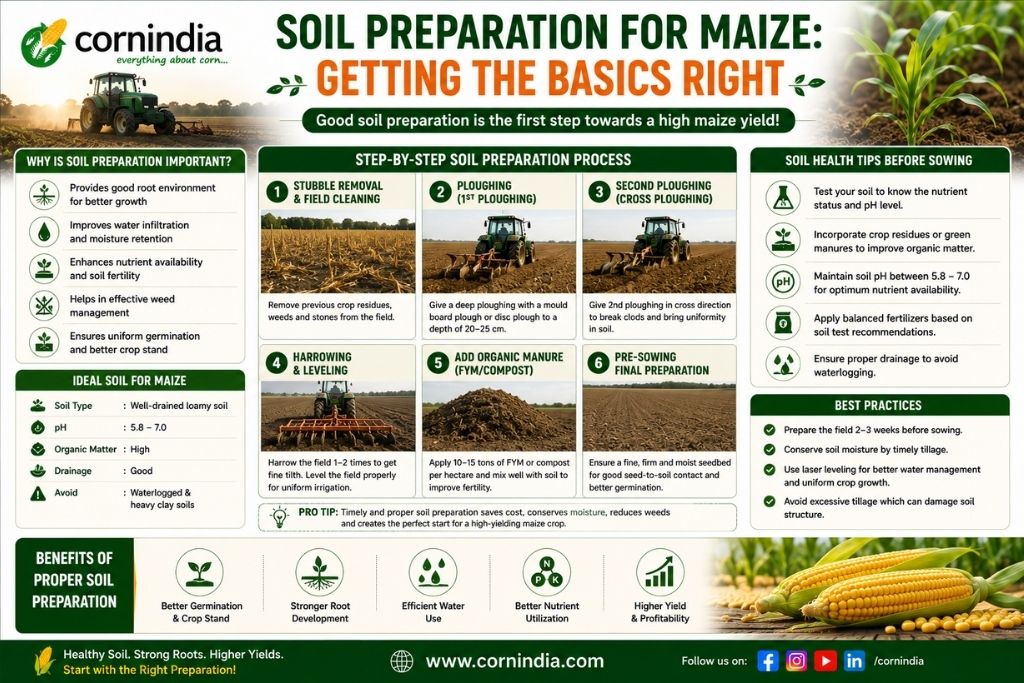
Here's something most farming guides don't say plainly enough: the yield potential of your maize crop is largely determined before you even touch a seed.
Variety selection matters. Fertiliser timing matters. Irrigation matters. But none of those inputs can compensate for a poorly prepared seedbed. Poor drainage, wrong pH, compacted soil, low organic matter — any one of these can cap your yield well below what your hybrid seed is capable of delivering.
The good news is that soil preparation is entirely in your hands. It happens before the season begins, it doesn't require expensive equipment, and getting it right costs very little compared to the yield returns it unlocks.
Here's everything you need to know.
Step 1: Know Your Soil Type First
Maize is more adaptable than most crops when it comes to soil. It can be grown successfully in a variety of soils ranging from loamy sand to clay loam. But not all soils perform equally — and knowing what you're working with helps you prepare more effectively.
Best soils for maize: Soils with good organic matter content, high water-holding capacity, and neutral pH are considered ideal for higher productivity. Well-drained loamy or sandy loam soils that hold moisture without water logging are the sweet spot — they allow roots to go deep, nutrients to stay accessible, and water to move through freely.
Soils that need extra attention:
- Heavy clay soils: Hold too much water, become waterlogged after heavy rain, and form a hard crust when dry that restricts seedling emergence. If you farm clay soils, deep tillage and raised bed preparation are non-negotiable.
- Sandy soils: Drain too fast. Nutrients leach away before roots can absorb them. These soils need higher FYM inputs and more frequent irrigation.
- Low-lying or poorly drained fields: Being a sensitive crop to moisture stress — particularly excess soil moisture and salinity — it is desirable to avoid low-lying fields having poor drainage and fields with higher salinity. If your field holds water for more than 24–48 hours after rain, maize will suffer root damage and stalk rot. Either improve drainage before sowing or choose a different field for maize.
Step 2: Test Your Soil — Don't Skip This
Soil testing is probably the most underutilised tool in Indian farming. It costs ₹200–₹500, takes about a week, and tells you exactly what your soil has and what it's missing before you spend money on fertilisers.
For maize, you want to know at minimum: your soil pH, available nitrogen, phosphorus, potassium, and zinc levels. Organic carbon is a useful bonus.
How to collect a soil sample properly:
- Collect from 8–10 spots across your field, at a depth of 15–20 cm
- Mix all samples together in a clean bucket, take a 500g composite sample from the mix
- Submit to your nearest KVK, soil testing laboratory, or private agri-testing centre
- Test every 2–3 years, or after any major crop rotation or input change
Most KVKs and state agriculture departments provide soil testing as a free or low-cost service. Use it — the nutrient management decisions you make after getting results will save you far more than the test costs.
Step 3: Get Your Soil pH Right
Soil pH controls how available nutrients are to your maize plant. Even if you apply the perfect amount of fertiliser, wrong pH means the plant can't absorb it efficiently.
Maize performs across a wider range than most cereals — pH 5.8 to 7.0 — but yield peaks near pH 6.5. That's your target: somewhere between 6.0 and 7.0, ideally around 6.5.
Here's what goes wrong outside that range:
If your soil is too acidic (pH below 5.8): At low pH, aluminium and manganese become toxic to maize roots. Phosphorus availability drops. Plants look stunted even with adequate fertiliser. This is common in hill states, Jharkhand, Odisha, and parts of North-East India.
Fix: Apply agricultural lime (calcium carbonate) to raise pH. The amount depends on your soil's buffer capacity and how acidic it is — your soil test report will give you a specific recommendation. As a rough guide, 1–2 tonnes of lime per hectare, incorporated during deep ploughing, can raise pH by 0.5–1.0 units. Allow 4–6 weeks for lime to react before sowing. Important: apply FYM along with lime — research shows this improves zinc availability, which lime alone can reduce in acidic soils.
If your soil is too alkaline (pH above 7.5): Above this level, iron, manganese, zinc, boron, and copper availability drops sharply. Phosphorus ties up with calcium. Interveinal chlorosis (yellowing between leaf veins) is common. This is prevalent in arid and semi-arid regions of Rajasthan, parts of Gujarat, and irrigated soils with high calcium carbonate content.
Fix: Apply elemental sulphur (incorporated 4–6 weeks before sowing) to bring pH down gradually. For sodic soils with pH above 8.5, gypsum (calcium sulphate) is more effective. Again, soil test first — the required quantity depends on your baseline pH and soil type.
Step 4: Address Zinc Deficiency Before Sowing
This deserves its own section because it is enormously widespread and enormously underdiagnosed in Indian maize fields.
Surveys by ICAR show that nearly 40–50% of Indian soils are zinc-deficient. And maize is one of the crops most sensitive to zinc shortage. Long-term zinc deficiency lowers yield by 15–40% depending on the crop. In maize specifically, zinc deficiency shows up as white interveinal bands or stripes on younger leaves, shortened internodes, and poor cob development — symptoms that many farmers misdiagnose as a disease or nitrogen deficiency.
A soil DTPA-Zn level below 0.6 ppm is generally classified as deficient. If your soil test shows zinc below this level, correct it at field preparation stage:
Soil application: Apply zinc sulphate heptahydrate (ZnSO₄·7H₂O, containing 21% Zn) or monohydrate (ZnSO₄·H₂O, containing 33% Zn) at 25 kg per hectare during the last ploughing, mixed thoroughly into the top 15 cm of soil. A single corrective soil application can last three to five years in many soils.
Important interactions to remember:
- Applying FYM together with zinc sulphate improves zinc availability — organic matter enhances zinc uptake by chelating it in plant-accessible forms.
- Do not mix zinc fertilisers with phosphorus fertilisers in the same application — high phosphorus can reduce zinc uptake. Apply them separately.
- In high-pH soils, zinc availability is further reduced — watch for deficiency symptoms closely even when you've applied zinc, and consider a foliar zinc spray at the knee-high stage as a top-up.
Step 5: Apply FYM — The Foundation of Everything Else
Before any chemical fertiliser, before seeds, before anything else — organic matter is the foundation of a productive maize field.
Apply 8–10 tonnes of FYM or compost per hectare during land preparation. Some sources recommend up to 10–15 tonnes per hectare for maximum benefit, particularly in soils with low organic carbon.
What well-decomposed FYM does for your maize field:
- Improves soil structure — loosens clay soils, increases water retention in sandy soils
- Feeds soil microbes, which break down nutrients into plant-available forms
- Provides a slow-release source of nitrogen, phosphorus, potassium, and micronutrients
- Reduces the impact of pH extremes (buffers against both acidity and alkalinity)
- Improves water infiltration, reducing waterlogging risk in heavy soils
Practical tips for FYM application:
- Use only well-decomposed (fully rotted) FYM. Fresh manure can burn seedlings and may contain pathogens or weed seeds. Well-decomposed FYM is dark brown, crumbly, and has an earthy (not foul) smell.
- Spread FYM evenly across the field before the last ploughing so it gets incorporated into the soil rather than sitting on the surface
- Mix FYM with composting bacteria (available from KVKs and agri-input dealers) and allow to decompose in open air for 10 days before spreading, to accelerate breakdown and improve nutrient availability.
- Along with FYM, apply 10 packets of Azospirillum (1 kg each) per hectare during the last ploughing — this biofertiliser inoculant fixes atmospheric nitrogen in the root zone from early in the season, reducing your nitrogen fertiliser requirement by 15–20%.
Step 6: Tillage — How Deep, How Many Times, and Why It Matters
Now we get to the physical work of field preparation. The goal of tillage is to create a firm, fine, well-aerated seedbed where germination is uniform, roots can go deep, and water moves evenly through the soil.
Maize requires a firm and compact seedbed free from stubbles and weeds. One deep ploughing should be given, followed by two or three harrowings to bring the soil to fine tilth.
Here's a practical tillage sequence:
Deep primary ploughing (25–30 cm depth): This is the most important tillage operation. Use a disc plough or MB (mould board) plough pulled by a tractor to break up subsoil compaction, bury crop residues, and aerate the lower root zone. Do this 3–4 weeks before sowing, giving the soil time to settle.
If your field has never been deep-ploughed, or hasn't been for several years, you may find a hardpan — a compacted layer at 20–25 cm depth that roots cannot penetrate. A subsoil ploughing or chisel plough operation can break this up. Hardpan is more common than most farmers realise, and breaking it can add 15–20% to your yield without any other input change.
Two to three secondary harrowings (10–15 cm depth): Use a rotavator or disc harrow to break clods, incorporate FYM and zinc sulphate, level the field, and create the fine tilth needed for uniform germination. Combine your FYM and ZnSO₄ spreading with the second harrowing so they get thoroughly mixed into the topsoil.
Field levelling: An uneven field creates micro-lows where water pools and micro-highs where the seedbed dries out too fast. Both affect germination uniformity. Level the field with a blade leveller after harrowing. Uniform germination is not just aesthetically pleasing — it directly affects yield, because all plants then reach the critical tasselling and grain-filling stages at the same time, making crop management far simpler.
Step 7: Drainage — The Non-Negotiable for Kharif
If you're sowing kharif maize, drainage is not optional — it's critical. Maize roots are extremely sensitive to oxygen deprivation. When water stands in a field for more than 2 days, root systems begin to die, the plant becomes vulnerable to stalk rot fungi, and yield losses can be catastrophic.
Two practical drainage solutions for Indian kharif fields:
Raised beds: Prepare raised beds 90 cm wide using a tractor-mounted bed former. Sow maize on the raised beds and let the furrows between beds carry away excess rain water. This is the single most effective water logging-prevention measure for heavy rainfall areas. It also improves aeration around the root zone and makes fertiliser and irrigation management more precise.
Field drainage channels: If raised beds are not feasible, create shallow drainage channels along the periphery and across the field at 10–15 metre intervals. These channels intercept excess water and channel it off the field before it can damage the standing crop. The investment in creating these channels once pays back across multiple seasons.
Step 8: Final Pre-Sowing Checks
Before your seed goes into the ground, run through this quick checklist:
- Soil test done — pH, N, P, K, Zn results in hand
- pH corrected if needed — lime or sulphur applied 4–6 weeks before sowing
- FYM incorporated — 8–10 tonnes/ha during last ploughing, well-decomposed
- Zinc sulphate applied if soil test showed deficiency — 25 kg/ha during last harrowing
- Deep primary ploughing done — 25–30 cm, hardpan broken if present
- Two to three harrowings complete — fine tilth, field levelled
- Drainage sorted — raised beds or drainage channels in place for kharif
- Previous crop residues cleared or incorporated — no large stubbles that will block germination or sowing equipment
Why Most Farmers Skip These Steps — And Pay for It Later
The honest reason most farmers don't do thorough soil preparation is time and effort. There's always pressure to sow quickly at the onset of the monsoon, and deep ploughing, FYM applications, and soil testing feel like delays.
But consider this: a farmer who spends 3–4 extra days and ₹2,000–₹3,000 per acre on proper soil preparation — FYM, zinc, pH correction, drainage — and sees a 20–30% yield improvement over a poorly prepared field, is making a very good return on that investment. At ₹2,000 per quintal for maize grain, even 3–4 extra quintals per acre from better soil preparation covers the input cost many times over.
Soil preparation is the cheapest and most reliable yield insurance in maize farming. Do it once, do it properly, and your other investments — seeds, fertilisers, irrigation — will all work harder because of it.
At CornIndia, we work with farmers at every stage of the maize crop cycle. If you need help interpreting a soil test or planning your land preparation schedule, reach out — we're glad to help.
Related reads on CornIndia: Kharif vs Rabi Maize: Which Season Suits Your Farm? | How to Grow Sweet Corn in India: A Step-by-Step Guide | Maize Hybrid vs Open-Pollinated Varieties









0 Comments