
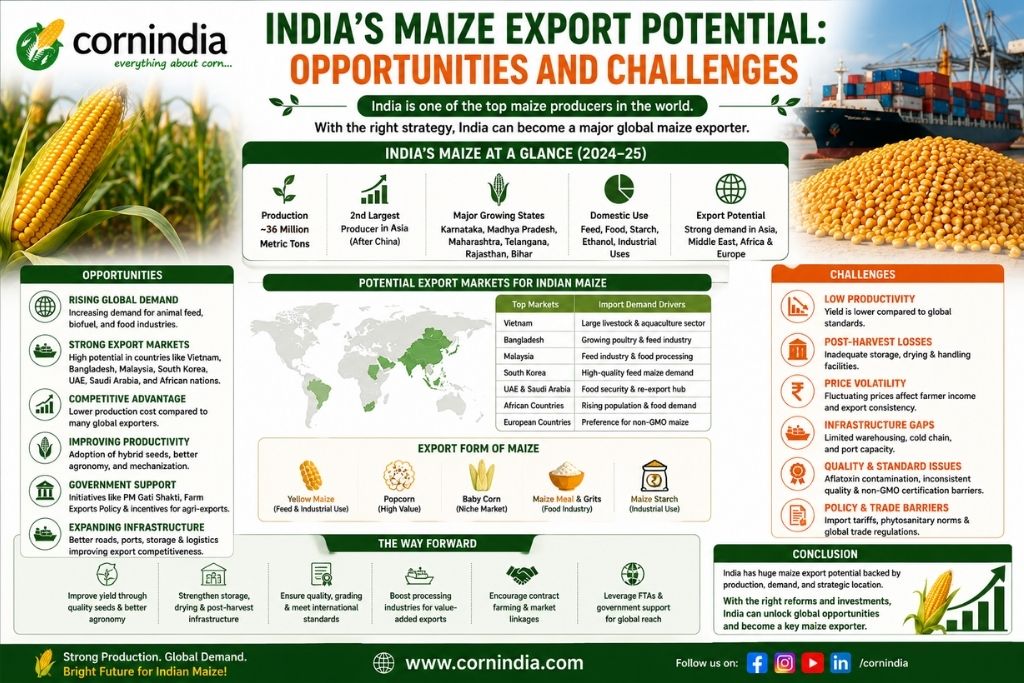
There's an interesting paradox at the heart of India's maize story.
India produces more maize than almost any country on earth — 43.41 million tonnes in 2024–25, a record high. It has two harvest seasons, giving it a supply window that most competitors can't match. Its maize is entirely non-GMO, which a significant and growing slice of the global market specifically demands. Its ports can reach Southeast Asia, the Middle East, and East Africa faster and cheaper than US or South American competitors.
And yet, India ranks as the 5th largest maize producer but only the 14th largest exporter globally.
That gap — between production scale and export performance — is the whole story. Understanding it is essential for any agri-business thinking about the export market, and for any researcher tracking where India's maize trade is headed.
Where India Stands Today: The Export Numbers
Let's start with the data, because it tells a more complicated story than the headlines suggest.
In 2024–25, India exported 556,416.94 MT of maize worth ₹1,705.93 crores (approximately USD 201.17 million). Major export destinations were Nepal, Sri Lanka, Bhutan, Bangladesh, and Thailand.
That sounds reasonable until you compare it to what came before. India's maize export value peaked at USD 764 million in 2022–23, then declined sharply in 2023–24 and again in 2024–25. In 2023–24, India exported 14,42,671 MT valued at USD 443.53 million — and 2024–25 represented a further significant contraction from that level.
In other words, India exported roughly 75% less maize by value in 2024–25 than it did just two years earlier. That's a dramatic swing — and understanding why it happened is as important as understanding the long-term opportunity.
The good news: India's maize exports are improving this fiscal after falling to a five-year low in 2024–25. From April to October 2025, exports rose 20% in volume to over 2.84 lakh tonnes from 2.36 lakh tonnes a year ago, while export earnings increased 28% to USD 112.49 million. Recovery is underway.
Who Buys Indian Maize — and Why
India exports approximately 90% of its maize to neighbouring markets, including Nepal, Bhutan, Bangladesh, Sri Lanka, and Vietnam. These exports primarily cater to non-GMO demand, positioning India in a distinct market segment that does not directly compete with the world's major exporters.
This geographic concentration is both India's strength and its limitation — a point we'll return to.
Why do buyers in these markets prefer Indian maize over American or Brazilian corn? Two reasons dominate:
1. Shipping proximity. Indian maize offers much faster shipping times to Asian and Middle Eastern markets, and it is highly valued for being certified 100% Non-GMO. For a feed mill in Bangladesh or Vietnam, Indian maize arrives fresher, faster, and at lower freight cost than grain shipped from the Gulf of Mexico or Santos.
2. Non-GMO certification. Countries such as the United States, Brazil, South Africa, Canada, and the Philippines primarily cultivate genetically modified (GMO) maize, whereas other countries focus on non-GMO varieties. A significant proportion of global maize imports, especially for feed, comes from GMO sources — but India exports non-GMO maize, placing it in a separate market segment. For buyers in markets with GMO restrictions or consumer preferences for non-GMO feed and food products, Indian maize fills a gap that the largest exporters cannot.
Emerging markets in Africa are also opening up, with Ghana's imports from India growing 82.94% in value and 85.20% in quantity in 2024–25, and Côte d'Ivoire's imports growing 130.19% in value and 130.46% in quantity over the same period. Africa is a watching brief for any serious maize exporter today.
The Competitive Landscape: Where India Stands Globally
India does not compete directly with the US, Brazil, or Argentina in mainstream global maize markets. That's not a weakness — it's a strategic reality that shapes where India's export opportunities actually lie.
The global maize trade is broadly split into two segments:
GMO maize (the mainstream): Dominated by the US, Brazil, Argentina, and Ukraine. These countries supply the bulk of global feed demand — Japan, South Korea, the EU, China, Mexico. The volumes are enormous and prices are driven by Chicago Board of Trade futures. Ukraine continues to offer the most competitive pricing, approximately 45–50% lower than India. India cannot and should not try to compete here.
Non-GMO maize (the niche with growth): Ukraine, India, and South Africa are the key exporters of non-GMO maize. This is India's playing field — and within it, India has genuine geographic and supply chain advantages over both Ukraine (geopolitically disrupted) and South Africa (further from Asian markets).
Global maize imports are projected to rise 4–5% in MY26, driven by increased demand from the EU, China, Algeria, Egypt, and Vietnam. Within that expanding pie, the non-GMO segment — particularly for human food use, specialty feed, and certified-organic markets — is growing faster than the commodity segment.
Rabi maize harvest in India overlaps with harvesting seasons in Brazil, South Africa, Indonesia, and to some extent the Philippines — meaning India's rabi surplus competes with more origins simultaneously. Kharif maize exports, on the other hand, come at a time when Southern Hemisphere supplies are thin, offering India a seasonal window of advantage.
Why Exports Fell: The Domestic Demand Trap
The sharp decline in maize exports between 2022–23 and 2024–25 was not primarily about India losing competitiveness internationally. It was about India's domestic economy absorbing more grain than ever before.
Three sectors competed aggressively for India's maize in 2024–25:
Ethanol blending: The government's push to achieve 20% ethanol blending in gasoline by 2025–26 redirected large volumes of maize toward distilleries. This caused domestic maize prices to rise above global benchmarks, making Indian maize expensive for foreign buyers and reducing the surplus available for export.
Poultry feed: India's broiler industry is one of the fastest-growing in Asia. Maize is the primary feed ingredient. As the industry expanded, so did its demand pull on domestic grain supplies.
Starch processing: India's starch industry — supplying food, pharma, paper, and textiles — also competes for the same maize pool.
The result: Indian maize remained non-competitive in global markets during this period due to strong domestic demand keeping prices elevated.
In the current season, lower domestic prices — the all-India mandi price is around ₹1,710 per quintal, approximately 28% below the MSP of ₹2,400 per quintal — have encouraged foreign buyers, though trade remains cautious in some neighbouring markets. With record production in 2024–25 (43.4 million tonnes) and kharif 2025 output estimated at a record 28.3 million tonnes, the supply picture has improved significantly — and exports are recovering.
The Real Opportunities: Where India Should Focus
Given this landscape, where are India's genuine export opportunities?
1. Southeast Asia's Growing Feed Demand
Vietnam, Malaysia, Thailand, Indonesia, and the Philippines are all expanding their poultry and aquaculture sectors. Their maize import needs are growing. Thailand's maize imports are projected to increase by 6% year-on-year in MY26. India's geographic proximity and non-GMO supply are natural advantages for these markets. Deepening direct trade relationships with feed mills in these countries — rather than routing through traders — is where long-term value lies.
2. Africa's Emerging Non-GMO Market
East and West African countries are increasingly looking for reliable, non-GMO animal feed supplies. Emerging nations in Africa are slowly opening up as eastern African countries look for reliable, non-GMO animal feed supplies. The growth numbers from Ghana and Côte d'Ivoire in 2024–25 hint at what consistent, quality-focused export development could achieve across the continent. Africa represents India's most underdeveloped but highest-potential maize export frontier.
3. Premium and Specialty Maize Exports
Commodity maize exports are a volume game with thin margins. Specialty maize exports are a different business entirely. India has growing capabilities in:
- Waxy maize starch for food processing and pharmaceutical applications
- High-protein QPM (Quality Protein Maize) for nutrition-focused markets
- Organic-certified maize for the EU and Japanese premium import segments
- Baby corn and sweet corn processed formats (canned, frozen, IQF) for food service and retail buyers globally
These niches command prices 30–80% above commodity maize and are far less exposed to competition from US/Brazil/Ukraine. They also require investment in processing, certification, and cold chain — which is exactly where agri-business value creation happens.
4. The Middle East
GCC countries — Saudi Arabia, the UAE, Kuwait, Bahrain — are significant animal feed importers. Their proximity to Indian ports, their preference for non-GMO grain, and their growing food security investment programmes make them natural targets for Indian maize exporters building long-term supply relationships.
5. Value-Added Processing Exports
India exports mostly raw grain. Value-added products — such as maize starch, corn flour, glucose, and specialty derivatives — command premium pricing and reduce reliance on commodity price cycles. Building export-oriented processing infrastructure connected to farmer clusters is a strategic play that India's maize sector has barely begun.
The Challenges That Need Honest Attention
No serious analysis of India's maize export potential is complete without naming the structural constraints clearly.
Price Competitiveness
Ukraine remains the most competitive in terms of pricing, with prices approximately 36% lower than South Africa and 46% lower than India. When domestic demand keeps Indian maize prices elevated, there is no export story. Managing the domestic demand-export balance — through better price discovery, surplus identification, and strategic stock management — is a policy challenge that directly impacts export volumes every year.
Logistics and Port Infrastructure
Inadequate cold storage, poor transportation networks, and high post-harvest losses increase costs and reduce competitiveness. Getting maize from the fields of Madhya Pradesh, Karnataka, or Bihar to export-ready condition at a coastal port involves multiple handling stages where quality can degrade and costs can accumulate. Investing in farm-to-port logistics — through better rural roads, modern silos, and port-side grain handling infrastructure — is a prerequisite for consistent, quality-driven export growth.
Quality and Certification Compliance
Quality is the most important part of global trade. Top buyers have strict health and nutrition rules. Indian exporters clean, grade, and pack maize using sophisticated machinery to meet these requirements. But compliance is not uniform across all exporters. Aflatoxin contamination, moisture variation, and inconsistent grading have cost Indian exporters market access in some destinations. Getting quality right — consistently, at scale — is non-negotiable for export market growth.
Harvest Season Overlap
The harvesting seasons of key maize-producing countries largely coincide with India's kharif harvest. When India, Ukraine, the US, and Brazil all bring their crops to market in overlapping windows, price competition intensifies and Indian exporters face the most headwinds. The rabi season gives India a partial workaround — but expanding rabi maize production with export intent is still an underdeveloped strategy.
The Domestic Demand Tension
The more India's poultry, ethanol, and starch sectors grow — all of which are positive economic developments — the more they compete with export availability. India's maize exports remain limited by strong domestic demand, and future trade will depend on factors such as geopolitics, tariff decisions, and changes in import demand across regions. This tension is structural, not cyclical, and managing it requires deliberate policy — not just hoping for bumper harvests.
What the Policy Environment Looks Like
India's export policy framework for maize has several useful elements — and some significant gaps.
APEDA support: The Agricultural and Processed Food Products Export Development Authority registers exporters, provides quality certification support, and runs the AgriExchange trade data portal. APEDA gives grants to build modern warehouses and testing labs, and the RoDTEP scheme gives money back to exporters to cover local supply chain taxes. These are real benefits for exporters who engage with the system.
Government production targets: The government is targeting consistent production growth in maize — with record kharif acreage up 3–4% year-on-year and rabi acreage up 6.6% to 23.32 lakh hectares as of early 2026. More production, when domestic demand is stable, creates export surplus.
The doubling target: India has set a target of doubling agricultural exports to USD 100 billion by 2030. Maize will need to play a meaningful role in that ambition — but it will require coordinated investment in processing, logistics, and market development, not just raw grain export promotion.
Where policy gaps remain: There is no dedicated maize export promotion strategy comparable to what competitors like Brazil and Ukraine have built. Port-side grain handling infrastructure at key export ports (Kakinada, Mundra, Visakhapatnam) needs investment. Farmer-level awareness of export quality standards — particularly around aflatoxin management, pesticide residue protocols, and moisture control — needs systematic extension effort.
A Framework for Agri-Businesses
For any agri-business evaluating maize exports as a business line, here's a practical framework based on the current landscape:
Start with non-GMO positioning. This is India's single most defensible differentiator in global maize markets. Build your buyer relationships in non-GMO-preferring markets — Southeast Asia, the Middle East, and increasingly East Africa — before attempting to compete in commodity maize markets where pricing will always disadvantage India.
Think beyond raw grain. The margin in raw grain export is thin and volatile. Processed formats — maize starch, corn flour, glucose syrups, baby corn, frozen sweet corn — offer better margins, more stable buyer relationships, and less price sensitivity to global commodity cycles.
Invest in quality infrastructure. Buyers who have been burned by inconsistent Indian quality become ex-buyers quickly. The investment in cleaning, grading, NABL-certified testing, and export packaging pays back in relationship longevity and price premium.
Time your exports to the kharif window. When Indian kharif maize arrives in September–December, competing supply from the Southern Hemisphere is thinnest. This is the seasonal window where Indian pricing is most competitive globally.
Register with APEDA and access RoDTEP. The export benefits are real and meaningful for margin management. Many smaller exporters are not fully utilising the policy support available to them.
Final Thoughts: An Honest Optimism
India's maize export story is not a straight line upward — the 2024–25 data makes that clear. It's cyclical, policy-sensitive, and structurally constrained by the same domestic demand growth that makes India's maize sector exciting in the first place.
But the fundamentals for long-term export growth are genuine. Record production is building a larger surplus base. The non-GMO positioning is a real competitive advantage in a world increasingly questioning GM food supply chains. Geographic proximity to the fastest-growing import markets in Asia and Africa is irreplaceable. And the recovery already visible in 2025–26 export data suggests the sector is resilient.
The exporters and agri-businesses that succeed in Indian maize over the next decade will be those who build quality-first supply chains, invest in processing and value addition, and develop direct, long-term relationships with buyers rather than chasing spot market prices.
The opportunity is there. The question is who organises it well enough to capture it.
At CornIndia, we track India's maize trade closely and work across the value chain — from farm-level sourcing to buyer connections. If you're evaluating maize exports as a business or researching India's trade potential, we'd be glad to talk.
Related reads on CornIndia: Top 10 Maize-Producing States in India (2024–25) | What is Maize? India's Most Versatile Crop Explained | Maize Hybrid vs Open-Pollinated Varieties




0 Comments