
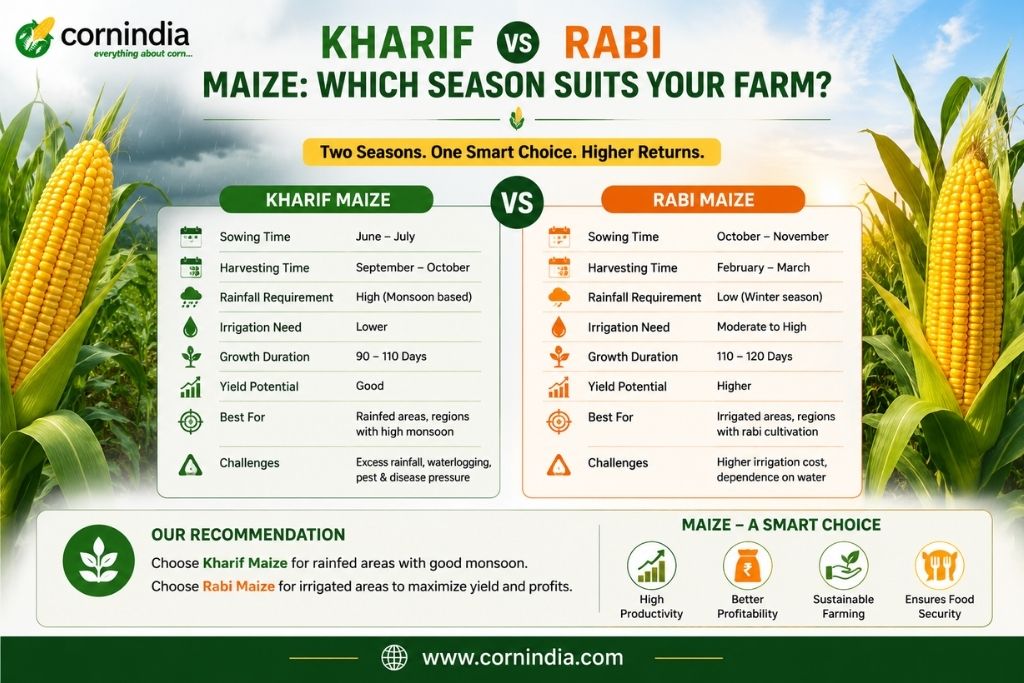
Most Indian farmers already know maize as a monsoon crop. You sow it in June, it drinks the rain, and you harvest it by October. Simple enough.
But here's something a lot of farmers are discovering: maize grown in the rabi season can give you more yield per hectare than kharif. Sometimes significantly more.
So which season is actually better for your farm? The honest answer is — it depends. It depends on your state, your irrigation setup, your soil, and what you're trying to grow maize for.
Let's walk through both seasons properly so you can make a more informed decision.
First, a Quick Recap of the Two Seasons
Before we get into maize specifics, here's the basic framework:
Kharif season runs from June to October. It coincides with India's southwest monsoon. Crops are sown when the rains arrive (usually June–July) and harvested once the rains withdraw (September–October onwards). Maize is classified as a primary kharif crop.
Rabi season runs from October to March. Crops are sown after the monsoon ends, during the cooling winter months, and harvested in spring. Rabi maize is sown between mid-October and November and harvested around February–March.
There's also a spring/zaid season (February–March sowing) for maize, which is popular in north-western states like Punjab — but we'll keep the focus on the main two.
Kharif Maize: What You Need to Know
Kharif is the dominant season for maize in India by a wide margin. Around 83% of India's total maize area is under kharif cultivation. It's what most farmers default to, and for good reason — the monsoon provides the water, which reduces your input cost on irrigation.
When to sow
- Sowing window: June 15th to July 15th in most regions. If the monsoon is delayed, you can push to the first week of August using short-duration hybrid varieties.
- Ideal approach: Complete sowing 12–15 days before the onset of monsoon in your area for best results.
Key advantages of kharif maize
- No irrigation investment needed in rain-fed regions — the monsoon does the heavy lifting
- Lower initial setup cost compared to rabi, since you're not spending on water infrastructure
- Widely suited across most maize-growing states — Karnataka, Madhya Pradesh, Maharashtra, Bihar, Rajasthan, and more
Key challenges of kharif maize
- Waterlogging risk — erratic or excess rainfall can damage root systems and invite stalk rots before flowering
- Pest pressure is higher — warm, humid monsoon conditions create a breeding ground for fall armyworm, stem borers, and fungal diseases
- Fertiliser leaching — heavy rains wash away applied nutrients before the plant can fully absorb them, reducing the efficiency of your fertiliser investment
- Sunshine is limited — cloudy monsoon skies give only 3–5 hours of effective sunshine per day during the growing period, which affects photosynthesis and grain filling
- Lower average yield — kharif maize in India averages around 2,706 kg per hectare, largely because of the above stress factors
Rabi Maize: The Season Gaining Ground Fast
Rabi maize is the quiet achiever. It currently covers only 17% of India's maize area, but it's growing rapidly — and for very good reasons.
When to sow
- Sowing window: Mid-October to November
- In coastal Andhra Pradesh: January (first week) for late-season rabi crops
- Harvest: February to March, depending on the variety and location
Key advantages of rabi maize
1. Significantly higher yields This is the biggest argument for rabi maize. Without the stress of erratic rainfall, waterlogging, and intense pest pressure, rabi maize yields average around 4,436 kg per hectare — nearly 64% more than kharif on average. Many well-managed farms in Andhra Pradesh, Telangana, and Bihar are reporting even higher.
2. More sunshine hours During rabi, maize gets 7–9 hours of bright sunshine per day compared to 3–5 hours during the cloudy monsoon. More sunshine means better photosynthesis, better grain development, and ultimately, a heavier cob.
3. Lower pest and disease pressure The dry, cool winter environment is far less hospitable to most common maize pests. Fall armyworm and other insects are far less aggressive in rabi than in kharif. This directly reduces your spending on pesticides.
4. Better fertiliser efficiency Without heavy rainfall leaching your applied nutrients into the soil, nitrogen and other fertilisers stay available to the root system for longer. Your fertiliser rupee works harder in rabi.
5. Better water management control You know exactly when and how much to irrigate, because you're not depending on unpredictable rainfall. This makes scheduling and planning far more precise.
6. Price advantage at harvest Rabi maize is harvested in February–March, when kharif stocks are depleting. Market arrivals are lower, which often means better prices for your produce.
Key challenges of rabi maize
- Irrigation is essential — rabi maize cannot be grown without assured water supply. This is the single biggest barrier for many farmers. If you don't have reliable irrigation, rabi is not viable.
- Terminal heat stress — if sowing is delayed past November, the grain filling stage in February can coincide with rising temperatures, which reduces yield. Timing matters.
- Higher input cost — irrigation, slightly higher fertiliser recommendations, and land preparation after kharif harvest means your cost per hectare is somewhat higher than kharif.
Side-by-Side Comparison
| Factor | Kharif Maize | Rabi Maize |
|---|---|---|
| Sowing time | June–July | Mid-October–November |
| Harvest time | October–December | February–March |
| Water source | Monsoon rainfall | Irrigation (essential) |
| Average yield | ~2,706 kg/ha | ~4,436 kg/ha |
| Sunshine hours | 3–5 hours/day | 7–9 hours/day |
| Pest pressure | High (fall armyworm, borers) | Low to moderate |
| Fertiliser efficiency | Lower (leaching by rain) | Higher |
| Market price at harvest | More competition (large arrivals) | Often better (lower arrivals) |
| Irrigation needed? | Not always | Yes, always |
| Cost of cultivation | Slightly lower | Slightly higher |
Which States Are Best for Kharif vs Rabi?
States where kharif maize dominates
- Karnataka, Madhya Pradesh, Maharashtra, Rajasthan — large rain-fed tracts, well-suited to kharif
- Bihar, Uttar Pradesh — significant kharif maize belts
- Himachal Pradesh, Uttarakhand — hill farming, traditional kharif maize
States where rabi maize is growing fast
- Andhra Pradesh & Telangana — significant rabi maize areas, especially post-rice harvest. The Krishna and Godavari delta regions are particularly active.
- Bihar — one of the fastest-growing rabi maize adopters in eastern India, driven by assured irrigation from canals
- Tamil Nadu & Karnataka — parts of these states grow rabi maize successfully in irrigated zones
- Punjab & Haryana — spring maize (a close cousin to rabi) is increasingly popular as a wheat-alternative or rotation crop
Can You Grow Both Seasons on the Same Farm?
Yes — and many progressive farmers do exactly this. Growing maize in both kharif and rabi seasons on the same or different plots means:
- Year-round income from maize
- Better land utilisation — your field doesn't sit idle for 5–6 months
- Risk diversification — if kharif suffers from a bad monsoon, rabi can compensate
- Access to better prices in the off-peak rabi harvest window
The key requirement is irrigation infrastructure. If you have access to canal water, a borewell, or drip/sprinkler systems, running a double-season maize calendar is well worth exploring.
What About Baby Corn and Sweet Corn — Which Season Is Better?
Good question. Here's a quick answer:
Baby corn can be grown almost year-round except December and January. Kharif and rabi both work well, giving farmers maximum flexibility.
Sweet corn does best in kharif and rabi seasons. The cooler rabi weather actually enhances the sweetness of the kernels, which is why rabi sweet corn often commands a premium in urban markets and food processing.
Popcorn also does well in rabi, with the dry conditions helping develop the tight kernels that pop well.
Practical Tips Before You Decide
Here are a few things to assess before choosing your season:
1. Check your irrigation source first. If you don't have reliable water access from September to March, rabi is not for you right now. Don't attempt it without assured irrigation — it will end badly.
2. Know your soil drainage. Kharif in poorly drained fields is a risk. If your land retains water for several days after heavy rain, you'll face root rot and stalk rot. Either improve drainage or consider rabi instead.
3. Match your variety to your season. Not all hybrid maize varieties are designed for both seasons. Ask your seed supplier specifically for kharif-suited or rabi-suited hybrids. Planting a kharif variety in rabi (or vice versa) will hurt your yield.
4. Plan your sowing date carefully. In rabi, late sowing is the most common mistake. Sow after mid-November and your grain filling will collide with February's rising heat. Stick to the October–November window.
5. Talk to your local KVK or agriculture officer. Your Krishi Vigyan Kendra (KVK) will have region-specific variety recommendations, irrigation guidance, and sometimes even soil testing support. Use these free resources.
Final Verdict
If you're a farmer with rain-fed land and no irrigation infrastructure, kharif remains your best bet. It's proven, accessible, and still profitable with the right hybrid variety and pest management.
If you have assured irrigation and want to push for higher yields and better prices, rabi maize is the smarter option. The yield gap between the two seasons is significant — nearly 64% more on average — and that gap directly translates to income.
And if you're ambitious about making maize your primary income crop, consider building toward a double-season calendar — kharif for volume, rabi for value.
At CornIndia, we work with farmers across both seasons and can help you choose the right seed variety, plan your input schedule, and connect with buyers. Reach out to us anytime.
Related reads on CornIndia: What is Maize? India's Most Versatile Crop Explained | Sweet Corn Cultivation Guide | Baby Corn Cultivation









0 Comments