
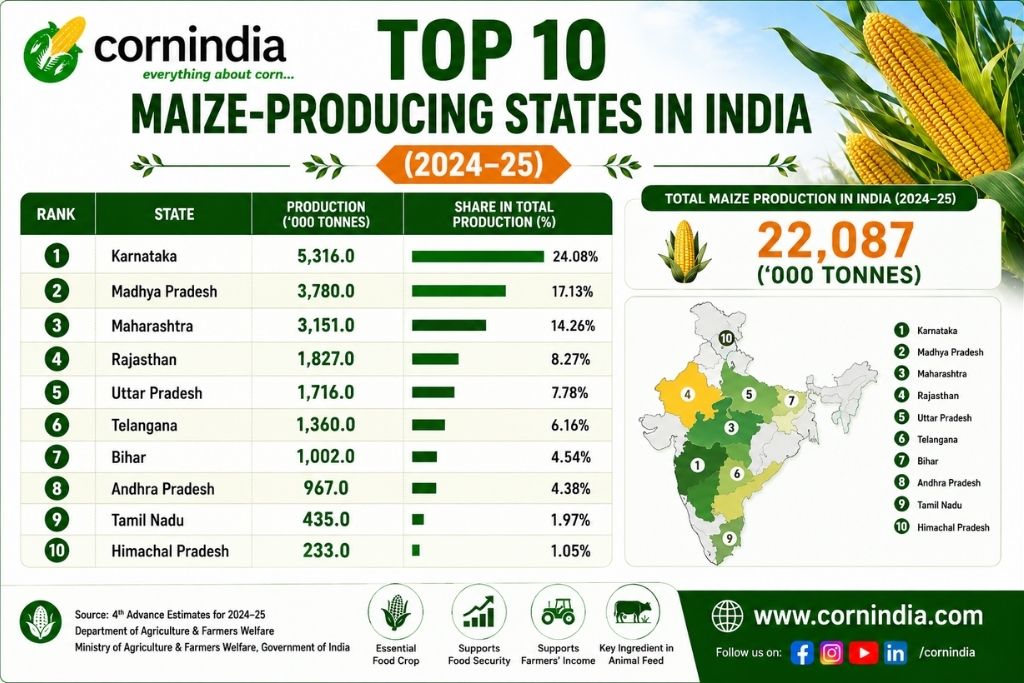
India's maize story in 2024–25 is one of record-breaking numbers. Total production hit 43.41 million tonnes — the highest the country has ever recorded — up from 37.9 million tonnes just the year before. That's a remarkable leap in a single year, driven by rising demand from the poultry feed, starch, and ethanol sectors.
But India's maize output is not evenly spread. A handful of states dominate production, and understanding their geography, strengths, and limitations is essential for agri-businesses sourcing grain, researchers tracking crop trends, and anyone trying to understand where India's maize industry is heading.
Here's a detailed look at the top 10 maize-producing states in India as of 2024–25, based on the latest government advance estimates.
India's Maize at a Glance (2024–25)
Before the state-by-state breakdown, here are the key national-level numbers:
- Total production: 43.41 million tonnes (Final Estimate, APEDA)
- Total area under cultivation: ~10.74 million hectares
- National average yield: ~3.54 tonnes per hectare
- Kharif share: ~83% of total area
- Rabi share: ~17% of total area
- Exports (2024–25): 5.56 lakh MT worth ₹1,705.93 crores
- Top export destinations: Nepal, Sri Lanka, Bhutan, Bangladesh, Thailand
Now, let's get into who's growing it.
1. Madhya Pradesh — 6.64 Million Tonnes | 15.30% Share
The new #1 — and pulling away fast.
Madhya Pradesh claimed the top spot in 2024–25, contributing 15.30% of India's total maize production across nearly 19 lakh hectares — the largest cultivated area of any state in the country, at 21.47% of India's total maize acreage.
What's driving MP's rise? A combination of improved hybrid seed adoption, government support for modern farming practices, and strong infrastructure across central districts. The state has a diverse agro-climatic landscape that supports both kharif rain-fed maize in eastern belts and irrigated cultivation in central and western zones.
Key districts: Chhindwara, Sagar, Damoh, Ratlam, Ujjain Primary season: Kharif (with growing rabi adoption) Industry significance: MP maize feeds a rapidly growing network of poultry farms and starch units in central India.
2. Karnataka — 6.19 Million Tonnes | 14.26% Share
The traditional powerhouse — still formidable.
Karnataka held the #1 spot for years and is still widely nicknamed the "Maize Bowl of India." It contributes around 14.26% of national output across 15.6 lakh hectares of cultivated area — roughly 17.63% of India's total maize-growing land.
The state benefits from mild temperatures (21°C–27°C), moderate and well-distributed rainfall (60–90 cm), and well-drained soils across its northern and central districts. Both rain-fed and irrigated farming systems are active here, giving Karnataka a stable production base regardless of monsoon performance.
Key districts: Haveri, Davangere, Belagavi, Chitradurga, Dharwad Primary season: Kharif; some rabi in irrigated zones Industry significance: Karnataka's maize directly supplies some of India's largest poultry clusters in and around Bengaluru and Hubli-Dharwad.
3. Maharashtra — 4.75 Million Tonnes | 10.94% Share
The giant with room to grow.
Maharashtra is the third-largest producer, contributing around 10.94% of India's output across 10.75 lakh hectares. Maize is grown across diverse agro-climatic zones — from the rain-heavy Vidarbha and Marathwada regions to the relatively drier western Maharashtra belts.
Production here is predominantly kharif-dependent, which means monsoon variability has a direct impact year to year. However, the state has been steadily increasing its rabi maize area in districts with access to canal irrigation.
Key districts: Ahmednagar, Nashik, Jalna, Amravati, Aurangabad Primary season: Kharif dominant Industry significance: Strong linkages to Maharashtra's large starch processing and animal feed industries.
4. Bihar — ~4.90 Million Tonnes | ~11.3% Share
The rabi revolution is happening here.
Bihar's rise in the maize rankings has been one of the most dramatic in Indian agriculture over the past decade. The state has rapidly expanded rabi maize cultivation — particularly in the post-rice harvest window — leveraging canal irrigation from the Ganga basin to achieve consistently higher yields than rain-fed kharif.
Bihar is now among the fastest-growing rabi maize adopters in eastern India. Smallholder farmers here have embraced hybrid varieties and contract farming arrangements with processing companies, making it a model for other eastern states.
Key districts: Khagaria, Begusarai, Samastipur, Muzaffarpur, Bhagalpur Primary season: Rabi (major), Kharif (minor) Industry significance: Bihar maize primarily flows to poultry feed suppliers and mandi traders in eastern India, with increasing direct procurement by large agri-businesses.
5. Telangana — 3.39 Million Tonnes | 7.81% Share
High productivity, focused geography.
Telangana contributes around 7.81% of India's maize production from a relatively compact cultivated area of just 2.21 lakh hectares — which means the state punches above its weight in terms of yield per hectare. With well-distributed rainfall during kharif and significant irrigation access from the Godavari and Krishna rivers, Telangana consistently achieves productivity figures above the national average.
Key districts: Nizamabad, Jagtial, Karimnagar, Mahabubabad, Kamareddy Primary season: Kharif dominant, with growing rabi area Industry significance: Telangana is a key maize market with active poultry and starch industries. Nizamabad is one of India's most active maize trading hubs.
6. Rajasthan — ~2.70 Million Tonnes | ~6.2% Share
Defying water scarcity with smart farming.
Rajasthan's position in the top 10 might surprise some — after all, it's one of India's driest states. But maize is grown extensively in the southern and south-eastern districts, particularly in areas around the Aravalli hills where rainfall is relatively higher and soils are suitable.
The state has leaned heavily into drip irrigation and sprinkler systems to make maize viable in water-scarce conditions. Government support for drought-resistant hybrid varieties has also been a factor. However, water availability remains the key constraint limiting further expansion.
Key districts: Bhilwara, Chittorgarh, Udaipur, Rajsamand, Dungarpur Primary season: Kharif Industry significance: Rajasthan maize flows primarily into the animal feed and poultry supply chains of north-western India.
7. West Bengal — ~2.79 Million Tonnes | ~6.4% Share
The eastern outperformer.
West Bengal has been climbing the maize rankings steadily over the last five years, driven primarily by rabi maize expansion in the post-aman rice harvest window. The state's fertile alluvial soils, good irrigation network, and moderate winter climate create near-ideal conditions for rabi maize — and yields in some districts reportedly exceed 5 tonnes per hectare, well above the national average.
Key districts: Malda, West Dinajpur, Cooch Behar, Murshidabad Primary season: Rabi dominant Industry significance: Growing procurement by feed companies and starch processors in eastern India.
8. Tamil Nadu — ~3.06 Million Tonnes | ~7.0% Share
Year-round potential with strong industry linkages.
Tamil Nadu's maize belt is concentrated primarily in the western and northern districts. The state grows maize in both kharif and rabi seasons, and its proximity to large poultry clusters in Namakkal — one of India's largest poultry production hubs — creates consistent, high-volume local demand that keeps prices stable and procurement reliable.
Key districts: Namakkal, Salem, Erode, Dharmapuri, Coimbatore Primary season: Kharif and Rabi (both active) Industry significance: Tamil Nadu's maize is almost entirely consumed by the state's own massive poultry and starch processing industries, making it a tight, well-integrated supply chain.
9. Andhra Pradesh — ~2.0 Million Tonnes | ~4.6% Share
Delta advantage with export orientation.
Andhra Pradesh benefits from proximity to ports, fertile delta soils, and reliable irrigation from the Krishna and Godavari rivers. While the state's share dipped slightly in 2024–25 due to delayed monsoon rainfall, it remains a strategically important maize state — especially for export-oriented procurement chains and coastal processing industries.
AP also has a meaningful rabi maize window in its coastal districts, particularly in East and West Godavari.
Key districts: East Godavari, West Godavari, Krishna, Kurnool, Prakasam Primary season: Kharif and Rabi Industry significance: Port proximity (Kakinada, Visakhapatnam) makes AP maize attractive for export-oriented buyers.
10. Uttar Pradesh — ~1.8–2.0 Million Tonnes | ~4.5% Share
Vast potential, still underperforming.
Uttar Pradesh has the agricultural land, the irrigation infrastructure, and the population of farmers to be a maize powerhouse — but has historically underperformed relative to its size. Maize here competes with wheat and rice for cropping priority, and yields remain below potential.
However, UP is seeing renewed interest in maize cultivation as the ethanol blending programme creates direct procurement links between state distilleries and maize farmers. This could be a significant catalyst for UP's maize ambitions over the next five years.
Key districts: Hardoi, Sitapur, Lakhimpur Kheri, Barabanki, Varanasi Primary season: Kharif Industry significance: Growing ethanol demand from sugar mills converting to grain-based distilleries.
What This Means for Agri-Businesses & Researchers
A few strategic takeaways from the state-wise picture:
1. Procurement geography is shifting northward and eastward. Bihar and West Bengal are the fastest-growing maize states. Agri-businesses looking to build cost-efficient procurement networks should be establishing direct farmer linkages in these states now — before large processors move in and drive up competition.
2. Rabi maize is where the yields — and margins — are. States with strong rabi maize (Bihar, West Bengal, Telangana, Andhra Pradesh, Tamil Nadu) consistently deliver higher-quality grain with lower pest contamination. For starch processors and food-grade buyers, rabi procurement deserves a larger share of the sourcing mix.
3. Rajasthan and UP are the long-term growth plays. Both states have significant headroom for expansion if the right seed varieties, irrigation access, and market linkages fall into place. Rajasthan's drought-tolerant maize programme and UP's ethanol push make them worth watching closely over the next 3–5 years.
4. Tamil Nadu's integrated supply chain is a model worth studying. The tight linkage between Tamil Nadu's maize farmers and its Namakkal poultry cluster — with processors, feed mills, and farmers in close geographic proximity — has resulted in stable prices and efficient logistics. Other states can learn from this model.
5. India's national yield of 3.54 t/ha still lags the world average (4.9 t/ha). The gap is an opportunity. Even a 10–15% improvement in national average yield through better variety adoption and crop management practices would translate to millions of additional tonnes of grain — without bringing a single new hectare under cultivation.
Final Thoughts
India's maize geography is dynamic. The rankings you see today reflect investments, policy decisions, and farming choices made over the past decade — and the rankings five years from now will reflect decisions being made right now.
Whether you're tracking procurement corridors, researching varietal performance across agro-climatic zones, or building a supply chain strategy, keeping a close eye on state-wise production trends is not optional — it's the foundation of any serious maize business in India.
At CornIndia, we track these trends closely and work with stakeholders across the value chain — from seed companies and agronomists to processors and exporters. Get in touch if you'd like to discuss what the data means for your business.
Related reads on CornIndia: What is Maize? India's Most Versatile Crop Explained | Kharif vs Rabi Maize: Which Season Suits Your Farm? | India's Maize Export Potential





0 Comments