
Picture this. You're driving past a maize field somewhere in Karnataka or Madhya Pradesh. Tall, green stalks stretching as far as you can see. Cobs peeking out from their husks. You pull over, pluck one out of curiosity, peel it back — and take a bite.
If you're lucky, you'll get something sweet, juicy, and delicious.
If you're not, you'll get something that tastes like chewing on a mouthful of raw starch. Hard, bland, and nothing like the bhutta you had last monsoon.
Both cobs were from maize plants. Both looked similar from a distance. But they're fundamentally different crops grown for completely different purposes.
That's the sweet corn vs field corn story — and once you understand it, you'll never look at a maize field the same way again.
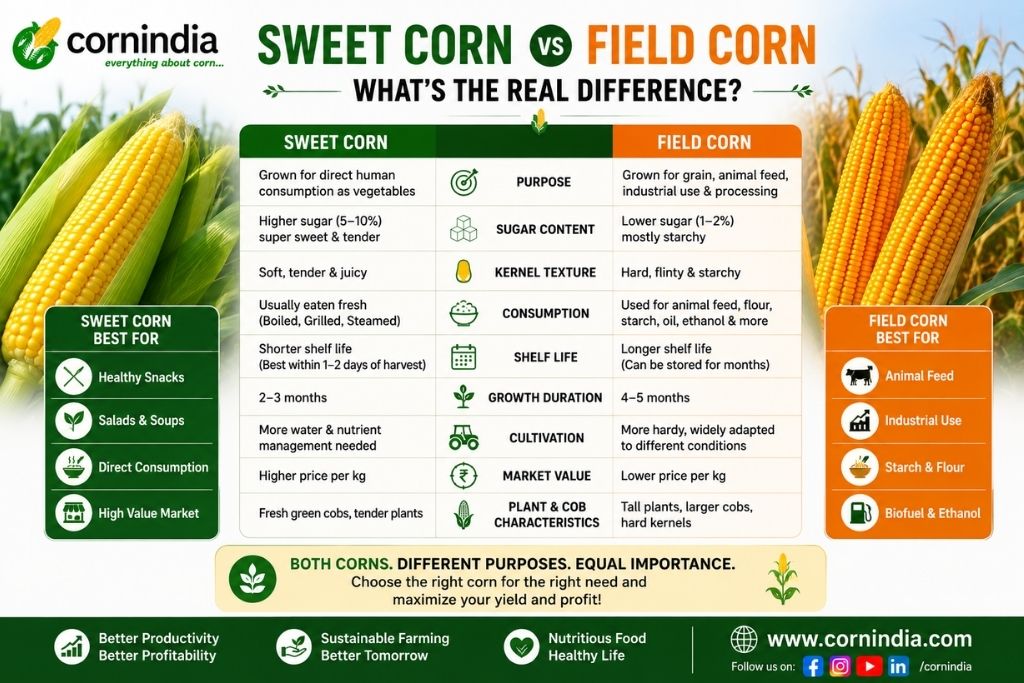
The One-Line Answer
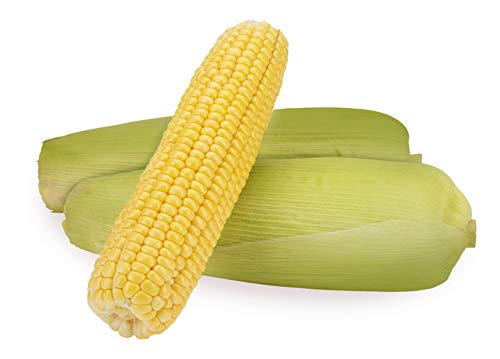
Sweet corn is harvested young, when the kernels are still soft and loaded with natural sugar. It's meant for eating directly — fresh, boiled, roasted, frozen, or canned.
Field corn (also called grain corn or dent corn) is left on the plant until fully mature and dry. It's not meant for eating as-is. Instead, it becomes animal feed, industrial starch, ethanol, cornflour, and dozens of other products that power India's food and manufacturing industries.
Same plant family. Wildly different biology, harvest timing, taste, and market destination.
What Makes Sweet Corn Sweet?
This is actually a fascinating bit of plant science — explained simply.
All maize kernels start out with some sugar in them when they're young. In regular field corn, that sugar quickly converts into starch as the plant matures. By the time field corn is ready to harvest, the kernels are almost entirely starch — dense, dry, and hard.
Sweet corn carries a natural genetic mutation (the sugary gene, or su gene for the technically curious) that slows down or blocks this sugar-to-starch conversion. As a result, the kernels stay sweet, soft, and tender for a window of about 18–21 days after pollination — which is exactly when farmers harvest it.
After that window, even sweet corn starts converting its sugar to starch and loses its appeal for fresh eating. This is why sweet corn has such a short shelf life and why freshness matters enormously at the market.
In short: sweet corn is genetically wired to stay sweet. Field corn has no such instruction — it converts fully to starch and that's exactly what it's supposed to do.
How They Look — Spot the Difference
In a field, sweet corn and field corn plants look nearly identical. Both are tall, leafy, and produce cobs with silk tassels. You'd struggle to tell them apart from a distance.
But up close:
Sweet corn kernels (at harvest):
- Plump, rounded, and filled with milky juice
- Bright yellow (or white, or bi-colour, depending on variety)
- Husk is green and moist
- If you press a thumbnail into a kernel, a milky liquid squirts out — this is the classic "milk stage" test farmers use to confirm the right harvest time
Field corn kernels (at harvest):
- Fully formed, dry, and dented at the top (hence the name "dent corn")
- Husk is brown, papery, and dry
- No moisture or juice — the kernels are hard to the tooth
- The entire plant has dried down by harvest time
How They're Grown — Key Farming Differences
Both crops follow similar growing fundamentals — warm soil, good drainage, adequate nitrogen fertiliser, and proper spacing. But there are some important practical differences Indian farmers should know:
Harvest timing
This is the biggest difference in the field. Field corn is harvested when moisture content in the grain drops to around 18–22%, typically 110–130 days after sowing. It then needs further drying before storage or sale.
Sweet corn is harvested much earlier — around 70–80 days after sowing — at the milk stage, while the plant is still green and standing. You're essentially harvesting an immature cob on purpose. Miss the window by even a few days and the sweetness fades quickly.
Variety selection
Sweet corn and field corn use completely different hybrid varieties. You cannot sow a field corn seed and expect to harvest sweet corn. Sweet corn seeds are specifically bred for higher sugar content. In India, popular sweet corn hybrids include varieties from companies like Syngenta (Accord), Seminis, and several ICAR-bred lines.
Important warning for farmers: If sweet corn is grown too close to field corn, cross-pollination from field corn pollen can reduce the sweetness of your sweet corn crop. Keep a minimum separation of 400–500 metres, or stagger sowing dates by at least 3 weeks to avoid overlapping flowering periods.
Yield per acre
Field corn yields are measured in dry grain weight — typically 20–30 quintals per acre for well-managed Indian farms. Sweet corn yield is measured in number of cobs — typically 12,000–15,000 cobs per acre, or roughly 8–12 tonnes of fresh cobs per acre.
Market destination
Field corn goes to mandis, grain traders, feed manufacturers, and starch processors. Sweet corn is sold fresh to vegetable markets, hotels, restaurants, supermarkets, street vendors, and food processors who freeze or can it. These are two completely separate supply chains.
What Each Is Used For in India
Field corn uses in India
- Poultry and livestock feed — over 50% of India's field corn goes directly into animal feed, especially for broiler poultry farms
- Industrial starch — used in food processing (custard powder, cornflour, glucose), pharmaceuticals, paper, textiles, and adhesives
- Ethanol production — India's ethanol blending programme is driving enormous demand for grain maize from distilleries
- Corn oil extraction — from the germ of the grain
- Processed food ingredients — including high-fructose corn syrup (used in packaged beverages and confectionery), corn starch, maltodextrin
- Export — India exported over 5.56 lakh MT of maize in 2024–25, primarily field corn
Sweet corn uses in India
- Fresh vegetable market — boiled or roasted cobs sold at markets, street stalls, and restaurants
- Bhutta — the monsoon street food staple roasted on open coals, sold with lime and masala
- Salads, soups, and sandwiches — sweet corn is a staple ingredient in Indian restaurant menus
- Frozen sweet corn — processed and frozen for retail supermarkets and food service companies
- Canned sweet corn — used by hotels, restaurants, and institutional kitchens
- Baby food and health products — sweet corn's natural sugars and soft texture make it useful in early nutrition products
Which Is More Profitable to Grow — Farmer's Perspective
This is the question most farmers really want answered. The honest answer: sweet corn can be significantly more profitable per acre, but it comes with more complexity and market dependency.
Here's how they compare:
| Factor | Field Corn | Sweet Corn |
|---|---|---|
| Crop duration | 110–130 days | 70–80 days |
| Yield measure | Dry grain weight | Fresh cob count |
| Market | Grain traders, mandis | Vegetable markets, processors |
| Price | MSP of ₹2,090/quintal (2023) | ₹7–₹32.5/kg fresh (varies widely) |
| Shelf life after harvest | Long (dry grain, months) | Very short (3–5 days fresh) |
| Profit potential per acre | ₹15,000–₹25,000 | ₹50,000–₹1,00,000 |
| Market risk | Lower (govt MSP backstop) | Higher (price volatility, perishability) |
| Input complexity | Moderate | Moderate-high |
| Contract farming available? | Rarely | Yes - with processors and exporters |
A Gujarati farmer named Ramesh Patel who shifted from cotton to sweet corn reported earning ₹45,000 from just his first acre in his first season — after securing a contract with a local food processor. Stories like this are becoming more common as India's food processing sector grows.
The key for farmers considering sweet corn: secure your market before you sow. Because sweet corn is perishable and cannot simply sit in a mandi waiting for buyers the way dry grain can, having a buyer, processor, or cold storage arrangement lined up before you plant is not just smart — it's essential.
The Big Picture: How India's Corn Market Is Divided
India's overall corn market was valued at USD 1.46 billion in 2024, with projections to reach USD 2.30 billion by 2030 at a CAGR of 7.86%. Within this market:
- Field corn dominates — it makes up the overwhelming majority of India's 43+ million tonnes of annual production, driven by the poultry feed, starch, and ethanol industries
- Sweet corn is the fastest-growing segment — urbanisation, rising health consciousness, and the explosion of quick-service restaurants and processed food categories are all driving sweet corn demand upward
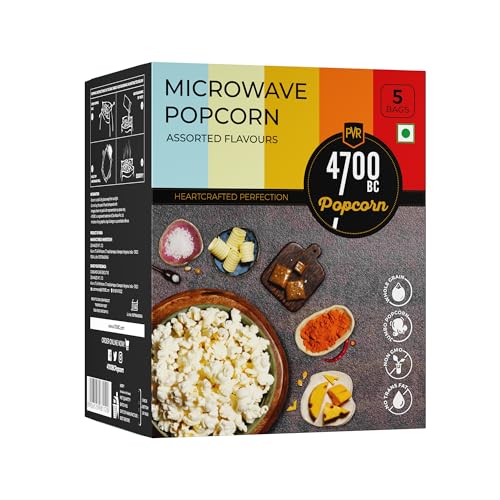
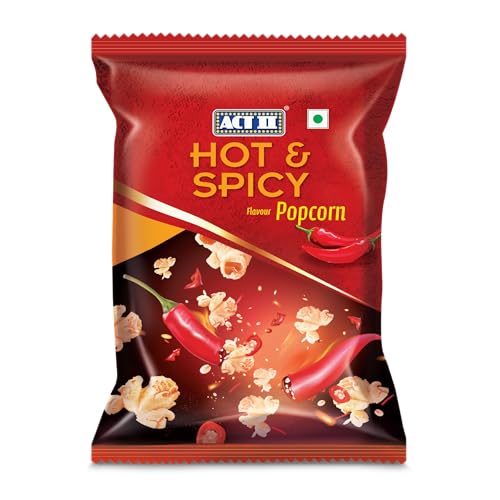
- Popcorn sits in its own growing niche — a separate category with dedicated varieties and a booming retail and cinema market
For Indian consumers increasingly reaching for sweet corn at the salad bar or as a movie-night snack, the supply chain behind that cob is getting longer, more organised, and more sophisticated every year.
Common Myths — Quickly Busted
"Sweet corn and regular corn are the same thing." No. They share a plant family but differ in genetics, harvest timing, taste, nutrition profile, and market use. They're about as similar as table grapes and wine grapes.
"You can eat field corn like sweet corn if you pick it early." Not really. Even young field corn kernels have far more starch and less sugar than sweet corn. The flavour and texture won't compare. Some people do eat young field corn in bhutta-style, but it's a noticeable step down in sweetness and tenderness.
"Sweet corn is less nutritious than regular corn." Sweet corn actually has more natural sugars but also delivers vitamins B1, B5, folate, and fibre in meaningful quantities. Neither is a nutritional villain. Both are whole food crops with good nutritional profiles when consumed as part of a balanced diet.
"Field corn is just lower quality sweet corn." Not at all. Field corn is doing exactly what it's supposed to do — producing large quantities of starchy grain for industrial and feed purposes. It's not an inferior product; it's a completely different product category.
Final Thoughts
Sweet corn and field corn are siblings, not twins. Same plant, same basic structure, but built for entirely different destinies — one for your plate, one for the economy behind your plate.
If you're a consumer, knowing the difference helps you appreciate why that bhutta tastes the way it does, and why the sweet corn at your local supermarket is a genuinely different agricultural product than the grain in your cornflakes.
If you're a farmer, understanding the distinction opens up a real choice: stay with the volume and stability of field corn, or step into the higher-value, faster-cycling world of sweet corn — with the right market linkages in place.
At CornIndia, we work with both. Whether you're growing field corn at scale or exploring sweet corn as your next crop, we can help you make the right call for your farm.
Related reads on CornIndia: What is Maize? India's Most Versatile Crop Explained | How to Grow Sweet Corn in India | Baby Corn Cultivation Guide






0 Comments